





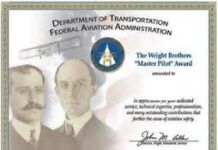















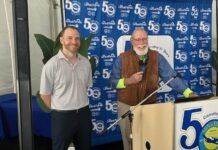



John L. Baker was born July 8, 1928, in O’Neil, Neb. He started flying at 15 and went into the Air Force five years later. He flew fighters in Korea then taught fighter gunnery at Nellis, Pine Castle and Luke. After his military career, Baker went to law school in Omaha, and graduated with honors. From college he went to Washington, D.C., as the U.S. Department of Justice’s first air-crash attorney. After a stint as counsel to the Senate, Baker joined Grumman Corp as program manager on the A-6. From there he joined the FAA as Assistant Systems Administrator for General Aviation, and handled congressional relations. John left the FAA for ALPA, joined AOPA in 1977 and became its president later that year. During his presidency, membership went from 180,000 to 300,000 and AOPA’s annual budget went from $7 million to $30 million.
John — who describes himself as a “shanty Irishman” — wasn’t shyabout using his influence on Capitol Hill and at 800 Independence Avenue toprotect GA’s rights. During his AOPA tenure, he logged about 600 hours a yearflying to meetings around the country — “wherever they could gather acouple hundred people together” — and he became a familiar face as hedefended general aviation on TV. He owned a J-3 Cub and flew AOPA’s Cessna 425Conquest I. He was also President of IAOPA, representing 37 countries at ICAO.In 1990, with about 14,000 hours in his logbook, John retired from AOPA, andstopped flying when he was diagnosed with diabetes. He served on the AOPA boardof directors until he turned 70, and is now a board member emeritus. He spentseveral years living in Palm Springs, then moved back to the Raleigh-Durham areato care for his wife’s aging parents. He’s a voracious reader and builds andflies RC airplanes.
What was your first experience with flying?
I was born on the prairie in the western end of Nebraska and started flyingwhen I was 15 years old. All the ranchers had airplanes back then, and I soloeda J2 Cub the first time I ever rode in it. Nobody told me you had to talk to thegovernment. I went to the University of Nebraska, and when they opened up Cadetsin ’48 I went into the Air Corps, which in ’48 became the Air Force. I couldn’tbelieve somebody would pay me to fly.
I was an honors graduate out of Cadets, got a regular commission, and I flewfighters for eight years. I flew F-80s, F-84s, F-86s, P-51s — that variety ofairplane. Back in those days that was novelty in the military. I was in thesecond jet outfit that went into Korea before the war. I was stationed onOkinawa in the 51st Fighter Group and I was one of the first to come back fromKorea. I taught fighter gunnery then for five years at Nellis in Las Vegas andwhat was then Pine Castle, near Orlando, Fla., and finished my career in themilitary at Luke Field in Phoenix. I resigned in ’55, went back to Nebraska –my family was in the car business — and decided after a couple of years thatthat wasn’t for me, since even the minister felt free to lie to a car dealer, soI went to law school. Kind of going from the frying pan into the fire.
How did you get to Washington?
 |
After I graduated from law school at the Creighton University in Omaha, I washired by the Department of Justice under their honors program. I was the firstfull-time air-crash lawyer that the federal government had. After several yearsat the Justice Department I got an offer from the U.S. Senate, and I went thereas Republican counsel Senate committee — since my politics is somewhere at theright of Attila the Hun. I stayed there for three years then went to Grumman inNew York. I probably would have stayed there as a career, but I got an offerfrom the Nixon people when he was elected, so I went back to Washington withJack Schaeffer at the FAA.
Schaeffer used to call me the “Golden Throated Bullshit Artist ofAviation,” and I worked hard all the years that I was at it to justifythat. My maternal grandmother came from Ireland and my grandfather came fromScotland– on my father’s side it was half Irish and half English. I got theworst of all genetic traits — I got the whimsical sense of humor and themelancholy from the Irish, a shitty disposition from the Scotch, and bad teethfrom the English.
I believe Schaeffer was the best administrator in FAA history because he hadgreat insight and great candor, and he never got mixed up in agency business. Werecognized that we lacked the ability to do basic research and development, andwe contracted it with NASA. When Helms came along, his ego wouldn’t allow him toconcede that anyone had wisdom beyond his, and, as a result, the FAA tried to dothe R&D. When I objected to the airways modernization program, it was notbecause I was objecting to the need for a modernization — that need wasapparent. But, having gone through the first computerization of the program,which took six years to just get programming to do the basics on air traffic, Irecognized that there was no way that the grand program that he put together –which included some very forward-thinking things, plus all the crap from thebottom drawers of the FAA for the preceding ten years to bulk it out — simplywasn’t doable.
I was the only one that testified against it — in front of Norm Mineta –and I thought that was a great irony when he became the Secretary of DOT,because that year FAA announced — with great fanfare — another modernizationprogram, which was program number 14 or 15. When Helms first announced it, itwas a $11.4 billion program, which was the biggest single government program,other than the moon shot. Mineta announced another modernization program, which,interestingly enough, was $11.4 billion. So we’ve gone full circle and haven’tmoved an inch further down the road in 18 years, and the objections I raisedwhen it was originally proposed in ’81 or ’82 still prevail. The FAA simplylacks the ability to manage a program of that magnitude.
When did you leave the FAA?
I stayed at the FAA until Alex Butterfield — who had been a classmate ofmine in the military — came from the White House as the FAA Administrator, andI made the judgment that Alex couldn’t walk and chew gum. So I resigned and wentto ALPA with John O’Donnell, where I was an executive assistant to thepresident, and also got involved in air safety and the political side — beingconservative, they didn’t let me near the union side. I stayed there until I wasoffered the presidency of AOPA, and that was in 1977. After I retired from AOPA,I did some consulting for a number of groups when they were looking at taking onpieces of the modernization program and my advice, universally, was “don’tget involved” because it was not going to get there from here.Unfortunately, that $11.4 billion program at its inception is now a $60 or $70billion program, and we haven’t moved appreciably downstream since.
In the intervening years — particularly during the Clinton era — we had thecompounding factor of FAA being taken over by non-aviation people, and thatalmost assures chaos and disaster. We saw people running flight standards whoweren’t aviators, we saw administrators who had no background in aviation. Then,of course, the most recent lunacy following 9/11, where aviation decisions weremade by non-aviation people, have further compounded the problems regardinggeneral aviation. It was already ailing in the sense that many of the FBOs andairports were in major jeopardy — particularly the mom-and-pop FBOs — whichare the underpinning of general aviation as we know it.
And then the National Security people’s faulty judgments, I think, droveanother nail deep into that coffin, so I’m not singularly optimistic. I thinkthe unfortunate victim is the 60 or 70 percent of the general aviation communitywho fly primarily for the enjoyment of it or the sense of self-satisfaction, andthose few unfortunates who see it as a phallic symbol of some kind. That’s thepiece of aviation that’s in jeopardy.
I quit flying for two reasons. One is because of the medical problem,although now I could go back and fly again — my diabetes is controlled — but,economically, it makes no sense; it’s just simply too expensive, and thatproblem seems to be cascading.
Did product liability legislation give you any optimism?
 |
It only fixed half of the problem. The damage the product liability suits havedone to the manufacturer’s profitability still prevails, and since we havebecome increasingly a litigious society and increasingly we’ve seen theknow-nothing juries award damages on outlandish cases. The reason I left thelitigation side of the law was that people who knew better were making majorrecoveries by misrepresenting the liability side of the industry, and that’scontinued and accelerated.
Who were the people that knew better?
When I was involved in it, there were very few practicing aviation law thatreally had an aviation background. That’s now changed where everybody in thefield’s an expert — or almost everybody is — but the few that wereexperts were distorting facts and so forth to the point where it offended mysensibilities, if nothing else. So I quit practicing law — primarily because Ididn’t like dealing with lawyers — although I left the Justice Departmentundefeated, in that I didn’t lose any of the cases I defended.
From the airline side of it, there were two unfortunate things that happenedin aviation almost coincidentally. Bob Crandall retired about the same time Idid, and we and Herb Kelleher at Southwest were kind of “the dirtydozen” in terms of bugging the world. There have not been, as far as I’mconcerned, many effective spokesmen on either the air carrier or the GA sidesince — not in terms of getting the kind of widespread visibility innon-aviation media. When I was there I could make the evening news most anytimeI chose, and I don’t seem to regularly see people any longer pleading aviation’scase in the general media. They’re seen only after a major disaster.
Are you saying that Phil Boyer is preaching to the converted?
I’m not going to criticize Phil. I left Frederick, Maryland on the day Iretired, because I didn’t believe that it was fair to him to have a dead hand onthe throttle. I suffered through that in a number of jobs I’ve had prior to thatat Grumman and at AOPA. I was determined I wasn’t going to do that to him, so Ihave not made a public comment about GA or AOPA since, because I recognize it’sa hell of a tough job, and 24 hours a day isn’t enough to do it. He has adifferent perspective than I do, and approached it somewhat differently, and Ithink his interests are maybe a little less generic than mine were in terms ofaviation.
I liked airplanes, period. When kids five years old wanted to go to the zoo,I wanted to go to the airport. I’m of that generation. Phil tends to see morethe utility of the machine where I see the romance. As a result, a lot of theeffort that AOPA and the other groups in aviation have made have been for themore sophisticated users, and the fuzzy end of the lollipop is going to the tothe less sophisticated and the less prosperous in aviation.
I don’t mean that as a criticism of Boyer, because I’m not close enoughanymore to know the nuances. I see the general side of it and my feelings onthat haven’t changed a bit, nor my outspokenness, but there are a number ofthings. When I was in AOPA we were, for lack of a better description, the lonewolves in aviation. I didn’t believe in partnering with other members ofindustry because we weren’t a part of the aviation industry, we were part of theaviation community, and as far as I was concerned my responsibilities ran to thepilot member, not to the business side. Obviously, you can’t survive without ahealthy business side, but my judgment in that regard was most of them werebeyond help anyway on the business side of aviation.
Are you talking about NBAA?
NBAA and others — such as GAMA and NATA. Their perspective is very narrow. Ihave no problem with that. They represent who they represent and they do it verywell, but they were not part of the general aviation community at that point, asfar as I was concerned. I think AOPA probably has more business users than NBAA.Business aviation in the broadest definition is what you can write off on yourtaxes, and there were never a hell of a lot of us in aviation that were in thatside of the business aviation field.
There’s too much singing from the hymn book, and, and the one group thatcould have a major impact and for whom I have great regard is the EAA, and theyhave remained strangely silent through a lot of this, and have devoted verylittle in the way of resources to impacting on the public dialogue, and theyrepresent the unrepresented.
In terms of the airlines, that’s a hopeless case. You know, it’s a boom/bustindustry, and it has been from the Ford Trimotor on. They suffer fromover-capacity, then under-capacity, over-regulation, then under-regulation. Thesame thing happened there that happened to a lot of the general aviationcompanies — the accountants and the lawyers started running them. Even at thetime I retired there were damn few aviation people left. They perceivedthemselves to be businesses, but not in the transportation business. They tendedto get into economic problems from which they simply couldn’t extricatethemselves, then they came to the government, claiming to be public utility.We’ve gone through those cycles, and we’re in another one now. In fact, 9/11bailed out a lot of airlines that probably were going down the drain. Thebailout of Boeing is just unbelievable. The government is going to leaseairplanes from Boeing at more than it would cost if we were going to buy them.
Now we’re back to politics.
 |
And politics I loved. I set up AOPA’s PAC. AOPA had the biggest lobbying effortof any aviation group in Washington. Currently I don’t see that anybody in theaviation industry has the ability to scare politicians. That’s unfortunatebecause lots of times it’s not a question of whether they’re with you or agin’you, but you’ve got to get their attention. If you don’t have the ability towhack them upside the head and threaten them, oftentimes you get very littleaction. I was having lunch with the editorial board of the New York Times,trying to sell general aviation to them, and they were anti-PAC, and during thecourse of lunch as a flip comment I said something along the lines that “Idon’t know why you’re so worked up about it; we aren’t buying politicians, wejust want to rent them.” That showed up as the lead item in an editorial tothe New York Times, and my P.R. people made me promise never to say that inpublic.
I wrote Mrs. Dole a note the other day telling her that I had some good newsand some bad. The good news is that I retired, the bad news is that I now livein North Carolina — she’s running for the Senate here. She and I went at itpretty regularly when she was Secretary of Transportation. She decided she wasgoing to be the safety secretary and she didn’t know a relief tube from anaileron. We were back and forth at it all the time because there’s nothing moredangerous than a well-meaning amateur in the safety field. I was particularlymad at DOT for some reason, and I needed a hook on a press conference we werehaving in L.A.. All the networks and wire services were going to be there. Wewere sitting in the hotel room ahead of time and I said, “Well, goddamn it,I’m going to demand that Mrs. Dole be fired since she’s simply not competent todo the job.” Well, that made the evening news. The funny thing was, withina week she resigned because Bob had announced he was going to run for presidentand she had a conflict. So I went around telling everybody, “Don’t screwwith me.”
One function of the changing population is that there are fewer and fewerpeople with aviation backgrounds in Congress. The World War II generation and mygeneration, which immediately follows it, are moving on to our just desserts inone way or another and, as a result, the few that we have — the McCains of thisworld — for instance, are worse than having nothing but enemies. I amconvinced, as a matter of fact — having dealt with many Navy people — thatsalt water causes brain damage. I think Daschle has been available to help. I’mnot sure that he’s been called on as aggressively as he should have been. JimInhofe is a hell of a good friend of aviation, but I see very little of him oflate. Kay Bailey has always been a good friend of aviation. Oberstar has helpedin some limited areas, but, again, he’s really not a knowledgeable aviation guy,and now he’s in the minority on the House side and the minority on the Houseside doesn’t have enough power to blow their nose.
Aviation is small potatoes from a political perspective. Very few members ofCongress or Senators get elected or beaten on aviation issues. As a result, veryfew are willing to go on-the-record one way or the other and take a major stand.They’ll jump in on issues that have no significance where they figure they canbuy a few votes, but finding someone that’s a leader for aviation issues simplyisn’t the case any longer, and some of the people that should have helped overthe years — like the John Glenns — never did. Nobody is going to take acommittee assignment to get an aviation assignment because it carries nopolitical payoff. When you look at airport issues, NIMBY is the byword.Everybody, and particular members of Congress, recognize you’ve got to haveairports so they can get home on Thursday night, but damn few of them want tostand up and fight for an airport in their district because they know they’regoing to lose more votes than they’re going to gain. As a result, airports areorphans, and we’ve seen that dilemma roaring down the road at us.
I’m not a major fan of Governor Ryan in Illinois, but I believe he almostsingle-handedly saved Meigs … but I notice he’s not running again. We’relosing the friend we had there. I have a feeling there are other governors,particularly western governors, that will help us — until you get to the WestCoast, where they’re more concerned about shutting down power plants than theyare building airports. California is a disaster from an aviation standpoint,because there are no effective advocates in the political arena, and the otherside — the crazies — are the dominant side out there.
If we can’t scare politicians what can we do?
AOPA’s Airport Volunteer Program is a good idea because early warning is theclue. I remember many times trying to save an airport when it was in trouble. Bythe time I got notice — maybe three days before the hearing — and came totestify, positions were already so firmly welded where you changed no minds. Iwas spit on and hollered down and never had a chance to talk, so early warningis the key. For most people that are involved in airport fights, aviation is anavocation. Maybe they earn their living in the plumbing business, so their firstpriority is staying afloat in the plumbing business, and the airport comessecond. As a result, you just get into the fight so late that you’re reallyrowing against the tide.
What are some victories you pulled from the jaws of defeat?
We did that regularly. TCAs: We got them modified from the early proposals.Transponders: At one point transponders were going to be mandatory everywhere.We won that war for sure, although it may be lost now. ELTs: Senator Dominicfrom Colorado, who’s long gone, stuck ELTs on an appropriations bill the nightthat Congress adjourned, and nobody even knew it was coming up. The next morningwe woke up and found out they had mandated ELTs. There weren’t any available andFAA had no ability to monitor them, and so forth, so we got that held off foryears.
Why would a Colorado Senator be so concerned with ELTs?
He had a friend who was a scientist from Albuquerque who was in an airplaneaccident in the Rockies in the wintertime, and wasn’t found and froze. It wasone of those personal things that just became a crusade with him. You see thatwith a member of Congress every now and then. We successfully fought off themisbegotten MLS by ourselves before ATA finally joined us and we got it killed.It would have cost users billions in re-equipping costs. Another battle wasDEA’s demand to be able to shoot down airplanes coming on shore that weren’tidentified. Senator McConnell — I started calling him Dr. Strangelove — and Iwere on Larry King one night and Dick Cavett another night. We won that battle,and, in fact, we won it with the help of Carol Hallett, who is now the presidentof ATA.
Back when we had one of the severe fuel crunches we got fuel allocated forgeneral aviation. I traveled to every goddamn refiner in the country to keepthem refining avgas at that time, and I got that done by sticking a guy in theoffice that was making the allocations. He wasn’t even a government employee,and he would throw in GA allocation on fuel. The fuel companies wanted to shutdown because they can make more money making asphalt than they can avgas.
Another time I got into a knock-down, drag-out with Senator Schumer when hewas a congressman from Brooklyn. He had ridden to New York with one of theairlines on Thursday night, like they all do, to campaign, and they were lategetting in. He said something to the captain about, “What happened?”and he said, “Well, it was one of those damn little airplanes that slowedus down,” so Schumer came back and put a bill in to eliminate thefirst-come first-served policy and give priority to air carriers. I went up tohim and I said, “Congressman, this system can’t function if that’s thecase. We’re going to have to oppose you on this thing, and we can beatyou,” and he said something like, “Well, don’t give me that shit. Youknow, you little airplanes don’t belong there,” and we murdered him on thevote. It was three hundred and something, and he maybe got 15, 20, 30 votes,and, he immediately thereafter filed a complaint with both the Department ofJustice and the Elections Commission against me personally and AOPA for unfairlobbying because I had just hired Don Engen — who had been the FAAadministrator — as head of the Air Safety Foundation. It cost me $80,000 inlawyers’ fees to beat that son-of-a-bitch.
Don Engen was an aviator and he had a real problem at the FAA because Mrs.Dole was his boss. He and I became good friends, even though at that time it waskind of an adversarial relationship between FAA and AOPA. I used to stop in hisoffice and sit and visit with him quite a lot, and regularly I’d tell him,”Don, don’t put up with this shit. Quit. You don’t have to take this crapfrom all those DOT gofers who are trying to manage the FAA from overthere.” When he finally did quit I wrote an editorial in AOPA Pilotand he got such a kick out of it that he had it framed and it was up in hisoffice.
The Great Zamboni was a human cannonball in Barnum and Bailey Circus, famousfar and wide. He flew higher, further, with a bigger explosion, the whole nineyards, than any human cannonball in history, and so one day he came in a littlehungover and didn’t do his walkaround on the cannon and they had a new guyloading it, and the guy that loaded it put way too big a charge in and when theyfired it during a performance, why he went right out through the top of thetent, over the net, and out in the parking lot and killed a guy, and Barnum wentup to Bailey and said, “My God, what are we going to do?” and Baileysaid, “I don’t know where we’ll find a man of that caliber.” I wrotethe editorial on the basis that he [Engen] was the Great Zamboni and I didn’tknow where we’d find another man of that caliber at FAA. Don thought it wasgreat, and his wife Mary, who’s a great character — her name was Baker, too, sowe were allies — just thought that was funnier than hell, and so we became fastfriends.
Who did you like to fly with when you were flying 600 hours a year?
 |
I flew by myself most of the time, but Dick Bush at AOPA and I flew together alot. When I was at FAA — which requires two pilots — my keeper was a littleguy named Dave West who had 23,000 hours in DC3s. He had been theadministrator’s pilot from the day the FAA was created in ’58. I flew with Davea lot. He was just sensational. I’ve flew with very professional people, and Ialways felt that I was very professional in the way I flew. I had fivedeadsticks in my career, back in the days of jets being somewhat less thanreliable, and a 600-foot bail-out, back before we had quality stuff. In thosedays 1,500 feet was the bailout minimum, but I had one blow up. I had just shotat a truck and pulled my nose up and the engine blew. It was down in the valleyin some mountains so I knew I wasn’t going anywhere, and I pulled up and Iguessed I got to about 600 feet, and fired the seat. Out I went, still strappedin, so I had to unbuckle and unplug the headset and the mast and pull theripcord, and by the time I got all that shit done I hit the ground, broke bothankles, dislocated both knees, and broke my back and my elbow.
Were the five dead sticks all military planes? Were any of them in GAplanes?
All military.
Were you involved in moving AOPA to the Internet before you retired in1990?
We had taken the first faltering steps, but Phil Boyer brought thatexpertise. He’s a computer geek anyway. I think his first staff meeting after Ileft he said a number of things, one is “I can’t replace John Baker in thesense of personality, because he’s become a bigger-than-life personality, sowe’re going to emphasize Team AOPA” — which they did for a number of years– “and the second is in these meetings around here there won’t be anyfour-letter words.” I thought it was funny because I was then on the Boardand came back six times a year for meetings, and by about the third year he wasswearing about the same rate I did. That job can get to you.
I love politics and I love politicians, and being a lobbyist, which, when youstrip all the horse crap away, is what I did for a lot of years, at Grumman andat the FAA — where I lobbied for the government — and then AOPA. I had a greattime, had a great career, got to play with airplanes up ’til the day I retired,and got to be involved in things I was interested in. When I was in the Senate Iwas involved with the ’64, ‘5 and ‘6 civil rights acts, reform of the code ofmilitary justice, constitutional rights for Indians. I was the minority counselon the Constitutional Rights Subcommittee.
Those don’t sound like Atilla the Hun issues.
Contrary to what politicians concede, the ’64 civil rights act was aRepublican bill because Kennedy’s bill was dead. When he was killed, Johnson hadtremendous impetus, but the Republicans and southern Democrats had, for many,many years, been a coalition opposing civil rights legislation. Republicanswouldn’t vote for cloture on civil rights issues if the southern Democrats wouldsupport the Republicans on other issues. Dirksen was retiring at that time, andhe was my boss, he was the Republican leader in the Senate in those days and agreat character, and he decided that he was more interested in history thanpartisan issues. The administration’s bill — which was a Kennedy bill but beingpushed by Johnson — was dead on arrival because they couldn’t get cloture.Dirksen decided, well, “You sit down with us and we’ll write a bill,”so Nick Katzenbach and I — Katzenbach was the attorney general then — and Iand a fellow named Neil Kennedy, who was on Dirksen’s staff, wrote the ’64 bill,and then we did support cloture on that bill. I spent 11 weeks sitting on thegoddamn floor of the Senate. That’s a lesson in humility. The other issues arenot liberal issues.
Are you enjoying retirement?
I sit here and build radio-controlled airplanes, turn them out like popcorn.I’m running out of places to put them. My wife tells me, “For God sake, getout and crash some,” but I’m a perfectionist by temperament, and so it’sgreat tidy work for me. I also read a book every day or two. I alternate betweenbooks on politics, economics and mysteries.
Thanks to Jeb Burnside for suggesting Mr. Baker
John Baker
Most of AOPA Pilot’s December, 1990 issue was devoted to John Baker’s retirement. Editor Mark Twombly’s column featured “Bakerisms” –John’s unique combination of insight, humor and acerbic wit. With thanks to AOPA Pilot’s Mark Twombly, Julie Summers Walker and AOPA’s Communication Division, here’s a baker’s dozen of “Bakerisms.”
Speaking on the road on the subject of the nation’s capitol andcongress…
It’s nice to be here. It’s always a pleasure to get away from Washington, Disneyland East.
Washington is a funny place. At one end of town is the Congress and at the other end is National Zoo. It takes the visitors in town to tell us natives which is which.
When somebody refers to the mouth of the Potomac, they aren’t talking about the river.
I’m pleased to be here. Don’t take that as a high compliment. Coming from Washington, I’m happy to be damned near anywhere.
On AOPA…
AOPA members and pilots are not good ol’ boys in baseball caps called “Ace” who fly around airports boring holes in the clouds.
The AOPA Political Action Committee is not a process under which we attempt to buy a politician. We don’t want to buy them — we just want to rent them.
In a speech to the chamber of commerce in Frederick, Maryland…
I was flattered by the invitation, of course, until one of my employees pointed out that Frederick county is a big dairy-farm community … and maybe you’re just looking for a lot of bull.
To a staff member struggling with a problem…
You’re getting your underwear wrapped around the axle.
On his favorite federal agency…
The FAA folks always say “We’re here to serve you.” For those of you who are not laughing, ask your neighbor. Those of us who were brought up on a farm have another idea what service means.
Upon being interrupted by a departing airplane…
Someone has to do something about those damned noisy general aviation airplanes.
After coughing into the microphone…
Your fresh air is killing me. I come from the Reagan school of economics. Don’t breathe anything you can’t see.
Twenty minutes into a speech…
I’m going to talk until I think of something to say.
