










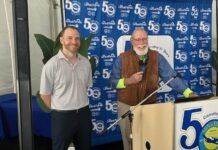

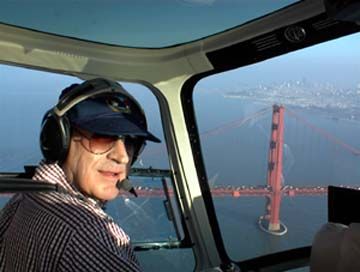
Ray Dolby was born January 18,1933, in Portland, Ore. During 1949-52, he worked on various audio andinstrumentation projects at Ampex Corporation, and during 1952-57 he was mainlyresponsible for the development of the electronic aspects of the Ampex videotaperecording system.
In 1957 he received a B.S. degree from Stanford University, and upon beingawarded a Marshall Scholarship and a National Science Foundation graduatefellowship, left Ampex for further study at Cambridge University in England. Hereceived a Ph.D. degree in physics from Cambridge in 1961, and was elected aFellow of Pembroke College (Honorary Fellow, 1983). During his last year atCambridge, he was also a consultant to the United Kingdom Atomic EnergyAuthority.
In 1963, Dolby took up a two-year appointment as a UNESCO advisor in India,then returned to England in 1965 to establish DolbyLaboratories in London. In 1976 he moved to San Francisco, where his companyestablished further offices, laboratories, and manufacturing facilities. Heholds more than 50 U.S. patents, and has written papers on videotape recording,long wavelength X-ray analysis, and noise reduction.
Dolby is a fellow and past president of the Audio Engineering Society, and arecipient of its Silver and Gold Medal Awards. He is also a fellow of theBritish Kinematograph, Sound, and Television Society and an Honorary Member ofThe Society of Motion Picture and Television Engineers, which in the past hasalso awarded him its Samuel L. Warner Memorial Award, Alexander M. PoniatoffGold Medal, and Progress Medal. The Academy of Motion Picture Arts and Sciencesvoted him a Scientific and Engineering Award in 1979 and an Oscar in 1989, whenhe was also presented an Emmy by the National Academy of Television Arts andSciences. In 1986, Dolby was made an honorary Officer of the Most ExcellentOrder of the British Empire (OBE). In 1997, Dolby received the U.S. NationalMedal of Technology, the IEEE’s Masaru Ibuka Consumer Electronics Award, and theAmerican Electronic Association’s Medal of Achievement. That year he alsoreceived an honorary Doctor of Science degree from Cambridge University, and in1999 was awarded an honorary Doctor of the University degree by the Universityof York.
When was your first flight?
From a very early age I was interested in cars, boats, engines, airplanes —anything that went. My first airplane ride was at age 14. My friend had justturned 16 and got his pilot’s license, and a few days later he took me flying inan Aeronca Champ. I totally trusted him, and we did a series of steep turns,stalls and spins. The image of the earth turning around stayed engrained on mymind, but it was a long, long time before I had the chance to experience thatagain. By the time I learned to fly, in 1990, spins had been eliminated from thetraining. At one point I asked my instructor "What about spins?" andhe said "We don’t do that anymore," and I said "What do you mean?I’ve been looking forward to learning spins for over 40 years!"
He eventually realized that I was serious about it, but the airplane wereusing — my 206 — wasn’t certified for spins. So we rented a 152, which wascertified for spins, and then my instructor said "We’ll have to get someparachutes." That surprised me. Then by the next lesson he figured out thatwe didn’t need them, but I wondered how many spins he had actually done. It feltlike the blind leading the blind. We eventually did go up and did an hour’sworth of spins, and that gave me much more confidence.
You had the airplane before you had the certificate? How did that happen?
I was 57 years old when I decided to learn to fly. I went to the flightschool and the first thing the chief instructor did was try and discourage me.He said "You’re old, your brain is shot, you can’t expect to learnsomething like flying at this stage of your life". Throughout my life I hadbeen into boats, and motorcycles, and Jeeps, and skiing, and I was convinced hewas wrong. The fact that he discouraged me gave me some doubt, but it also gaveme something to work toward.
I had to jump through some hoops with the FAA, because I had had a heartattack six years before. But I had changed the way I ate, got more exercise, andtook the pills I needed to keep that from happening again. The medical approvaltook about three months, and as soon as I got my medical I soloed — in a 152—which gave me a tremendous sense of elation. I had proved I could do it and Iwent out and bought an airplane.
For one thing, I was fed up with the airplanes I was renting. Every airplaneat the school was an older airplane and each one I preflighted had somethingdifferent wrong with it. I started researching airplanes and I decided that aCessna Turbo 206 would be the perfect airplane for me. It was ugly, but it was aheavy hauler. I went to Wisconsin with the broker to buy the airplane and weflew it back to Gnoss. When the chief instructor at my school found out about ithe said, "You’re going to have to start all over again. You can’t fly thissolo until you get 25 hours in it." I did my private pilot checkride in thethat airplane, then had it outfitted with new avionics, and went on to do myinstrument rating in it.
My family and I flew all over the western half of the U.S. in the 206. Ithought I might want to put the 206 on floats, but I discovered that it wasn’t agood idea to put floats on a plane that had not been corrosion-proofed duringmanufacturing. So now it’s a spare airplane and my younger son uses it. He hasflown it all over the country.
If you were that elated at age 14, why did you wait until age 57 to learnto fly?
I took about eight hours of lessons during college, but I realized that itwas an expensive proposition, and I didn’t have any money. I also didn’t havethe time it would take to learn, so I put it on the back burner. I just didn’trealize how long it would stay there.
How did you go about making it happen?
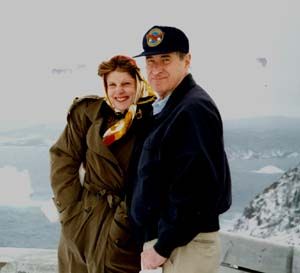 The Dolbys at St. Johns, Newfoundland, the jumping off point for the southern route to Europe via the Azores, a 1350 nm leg; April 1996 |
One day I started buying flying magazines. I think that’s when my wife Dagmarknew the handwriting was on the wall. She and my two kids — who were stillsmall then — told me how dangerous it was, but I prevailed and convinced themthat it wasn’t, and finally everyone came around and grew to like the idea.
When did you get the TBM 700?
In 1993. I placed the order in 1991, before I got my instrument rating. Iknew I wanted to do interesting things with airplanes, and I put myself on asfast a track as possible to be able to do that. When I ordered the TBM, therewas a long list. My wife and I visited the factory in Tarbes in 1992 to see theprogress, and then when the airplane was ready we flew over with the ferry pilotto pick it up and fly it back. I was able to put about 20 hours on the airplanein that process and that helped me a lot when it came to satisfying theinsurance requirements.
Can we talk about your accident at Truckee? What lessons can you give us?
I had 1,400 hours in the TBM at the time of the accident, and a little over2,000 hours total time. It was a classic. I was making a 270-degreecircle-to-land approach. There were no lights surrounding the airport and it wasa dark, moonless night. I made the mistake of doing what you’re told you shoulddo on a circling approach, which is to keep the airport in sight. But when youwork out the geometry of this approach, there’s an arc of somewhere between 120and 150 degrees from which it’s impossible to see the airport. So what’s the useof sticking your head out the window to look into inky blackness. I should havehad my eyes on the instruments. I should have treated that phase of the approachas an instrument phase. The FAA didn’t fault me for anything I did, except theystuck to their guns on a circling approach being a VFR approach that’s supposedto be flown with your head out the window. My argument was that there should bean approach that’s sort of halfway between instrument and visual, and declare itas such, so that you would guide yourself from one waypoint to another throughthe approach. In talking to people since the accident I think that maybe that’sthe kind of approaches we’ll see in the future.
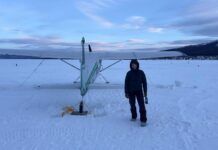
At one point in the turn back to the airport I was very steeply banked anddescending, but I thought I was flying a level constant-rate turn. As soon as Irealized what was happening I corrected the attitude, leveled the wings andstarted pulling up, but a fence tripped me and I couldn’t get the aircraft upagain. So we went into the snow, the deceleration ripped the landing gear offthe airplane, and we skidded along in the snow.
Did you have passengers?
Yes. My wife and my younger son and his girlfriend. Everyone was okay. We allwalked away. We were practically at the end of the runway. But enough damage wasdone to the landing gear, the engine and the wing spar that the insurancecompany decided not to repair it.
[pauses]
I was not very proud of the accident, but it sure taught me a lot of lessons.I will never treat a circling approach as a VFR approach again. I want all myinstruments available to guide me around the turn.
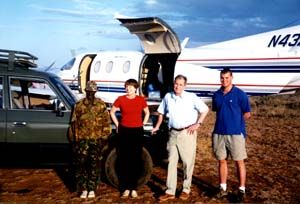 Arrival at Ol Malo, Kenya, north of Nairobi, a 3000 ft dirt runway, June 1999, with the Pilatus PC-12. The airport guard, Dagmar, Ray, and son David, also a pilot (commercial, instrument, fixed wing , and helicopter, private). Two months after this picture was taken the guard was gored to death by a buffalo. |
Was it hard for you to "get back on the horse" after theaccident?
Not at all. About two days after the accident I resumed my helicopterlessons, because I wanted to polish off that rating. Then I started researchingairplanes, because I wanted to get back into it right away. We loved using theTBM 700. We had one son in school at Santa Barbara, another at Hotchkiss school,which is a difficult place to get to in upstate New York, and with the TBM wecould see our children frequently with very little hassle. It helped a lot as wewere researching colleges, too. What I loved about the TBM was the range, butthe Pilatus has even more range than the TBM, and it offered a chance to try adifferent airplane.
There wasn’t a lot to choose from that could handle the 3,300-foot runway atGnoss and still give me the range I wanted. The small jets wouldn’t do what wewanted to do. I’m waiting for a small, single-pilot jet that has the range, andthe one on the horizon is the Sino-SwearingenSJ30-2. I’ve had one on order since December, 1991.
Where are your favorites places to travel?
I’ve flown 15 Atlantic crossings, including the initial ferry trip. Wenormally go the northern route, through Greenland and Iceland, but I’ve alsoflown the southern route through the Azores. It’s 1,355 nautical miles from St.John’s, Newfoundland to the Azores, and that’s about a six-hour flight.
Do you enjoy flying in Europe?
It’s not as easy as flying in the U.S. In Europe they don’t have FBOs the waywe know them, where you can order your fuel, pay for your fuel, get yourweather, plan your flight, file your flight plan, all over one counter. Outsidethe U. S. typically you have to walk from office to office, or sometimes frombuilding to building, to get all the information you need and get turned aroundand on your way. It’s more work, but it’s doable.
And how about flying in Africa?
That’s a different story. It’s hard work in Africa, and often you don’t getall the information you need. We went to Morocco in ’97 in the TBM, and to EastAfrica in ’99 in the Pilatus. There’s no radar in most of Africa so you’reconstantly giving position reports. It’s very hard to get the weather there.Sometimes the weather office at the airport will only have the weather for thatairport, so you wind up calling your destination, or making guesses.
We started the East Africa trip in Egypt, and flew over the Red Sea becauseof the wars and the flight restrictions in Sudan. There were also problems inSomalia and Ethiopia, so we made our way to Kenya by squeezing through Djibouti.We landed at Nairobi Wilson airport, then we headed out into the bush to a3,000-foot gravel strip north of Nairobi. We had a great time looking at theanimals. That’s about all there is to do there, so everyone goes on safaris.These days they’re almost all photographic safaris, and I learned a lot aboutanimals and how they behave. Animals have seen and heard Land Rovers for so longthat it’s just like another hippopotamus. It makes a rumbling noise and movesaround and it’s just part of their environment. You can drive the Land Roverright up to lions, and elephants, and it’s an amazing way to see them.
Have you flown to Japan?
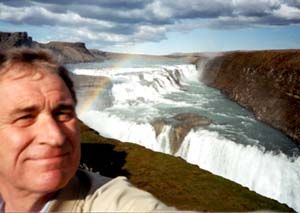 Ray at Gulfoss Falls, Iceland; May 2000 |
I’ve thought about it for years. You can get out to Alaska, then over toHokkaido Island, but up until just recently there wasn’t enough parking to stayovernight on the island. You wouldn’t want to just refuel and press on toHonshu. At past NBAA shows there was a Japanese government booth promotingflying to Japan, but at the same time they’re telling you that it isn’t reallypractical. They were very apologetic about it, but offering no real solution. SoI had decided Japan would wait until we got the Swearingen. Then at this lastNBAA show I heard that you can stay overnight at Hokkaido now, so maybe we willplan a trip there.
The half-duplex AM VHF radios in airplanes must be at least as frustratingto you as they are to the rest of us. Did you ever consider designing a Dolbyline of com radios or headsets?
It’s not enough just to put one’s brand name on a product. You have to bringsome new technology to the table. And it’s possible to think about veering offin many directions in one’s business, but I think you have to stay focused tostay in business. If you veer too far off the original track you can lose yourway. We know the players in the business that we’re in, we know themanufacturers, and we know the distributors, we know how the business works. Butaviation is an entirely different thing. I’ve been to NBAA and I read aboutwhat’s going on, but I wouldn’t say I know enough about that business to getinto that market and compete.
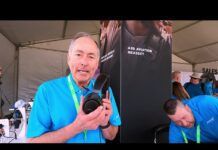
I noticed Bose headsets in the cockpit of the Pilatus. Did you try a lotof brands before you settled on the Bose?
I tried a lot of them in the 206, and I still have a lot of them. It’s asix-place airplane and I think each seat has a different brand. I have the BoseSeries II in the Pilatus and the X in the helicopter.
You moved through the private, instrument, commercial, multi andhelicopter ratings pretty fast. What other goals have you set for yourself?
I’m saving the glider rating for when the FAA takes away my medical.
You talked about spin training for the private. Are you interested inaerobatics?
Not really. Chandelles and lazy-eights are about as close as I’ve got toaerobatics.
Would you like to teach flying?
I’ve thought about it, but I’m not sure I would be a good teacher. You haveto be able to speak effortlessly and have a constant stream of wisdom, but it’smy nature to keep my mouth shut most of the time, and that wouldn’t make me avery good teacher.
How did you get to be an Officer of the Most Excellent Order of theBritish Empire?
It’s a mystery. You aren’t told why, and you don’t ask why.
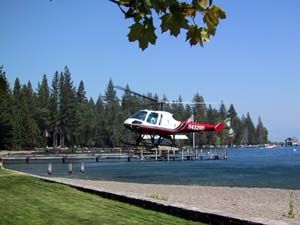 The Enstrom approaches the Dolby lakeside lawn at Lake Tahoe, California |
How were you notified and what’s the ceremony like?
The ceremony took place at the British embassy in Washington, with theAmbassador and an assistant. That was all I could fit into my schedule at thetime. I’ve met the Queen on other occasions. Princess Anne is a real film buff,and was good enough to come and open my new factory in England a few years ago.
What was the very first record that used Dolby noise reduction?
It was Ashkenazy playing Mozart. It started out as an audiophile, classicalmusic thing, then it caught on with other styles.
What’s on the drawing board at Dolby Labs?
Some years ago we reached the point at which we can make the output soundequal the input sound. For about a century we pursued the goal of being able tomake a perfect recording, and now that problem is solved. The goal now is tomake it more accessible, cheaper, more compact, more convenient, and that’s whatwe — and, I suppose, other audio companies — are working on.
Do you listen to music when you fly?
I’m usually too busy. By the time I land someplace I don’t stay on the groundtoo long because before I landed I’ve already got the weather for the next legand filed my departure flight plan from the air. Even on the long trips Iusually find that I’m too busy flying, talking to ATC and planning ahead andmusic and sound would just be a distraction.
