














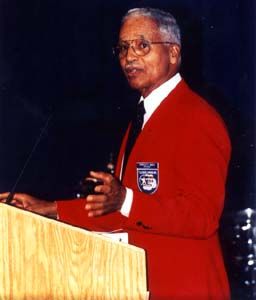
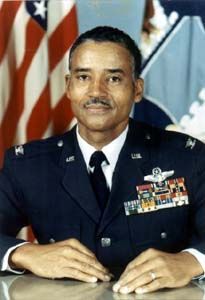
Charles Edward McGee was bornDecember 7, 1919, in Cleveland, Ohio. His mother died giving birth to his sisterwhen he was about a year old. On his 22nd birthday Japan attacked Pearl Harbor,and WWII soon interrupted his studies at the University of Illinois. McGee wassworn into the enlisted reserve on October 26, 1942, and entered Army Air CorpsAviation Cadet Training. He received his silver wings as a single-engine pilotand a commission as 2nd Lieutenant on June 30, 1943, as a member of Class 43-F,Tuskegee Army Air Field, SE Flying Training Command.
McGeebecame a career aviator. In his 30 years of active duty he became a commandpilot with over 6,100 total hours. He flew fighter aircraft combat tours inthree major military conflicts, the P-39, P-47 and P-51 with the 302nd FighterSquadron in Italy during WWII, the F-51 with the 67th Fighter Bomber Squadron inKorea, and the RF-4C with the 16th Tactical Reconnaissance Squadron (TRS) inViet Nam. He commanded the 44th Fighter Bomber Squadron in the Philippines in1951-53, the 7230th Support Squadron in Italy 1961-63, the 16th TRS 1967-68, andthe 1840th Air Base Wing and Richards-Gebaur AFB, Missouri, in 1972. He retiredfrom active duty on January 31, 1973, with 409 missions— the highest three-wartotal in USAF history.
Colonel McGee’s awards include the Legion of Merit with Oak Left Cluster,Distinguished Flying Cross with Two Clusters, Bronze Star, Air Medal with 25Clusters, Army Commendation Medal, Air Force Commendation Medal with Cluster,Presidential Unit Citation, Korean Presidential Citation, The Hellenic RepublicWWII Commemorative Medal and several campaign and service ribbons. He holds a BAin Business Administration. After his military career he became Director of RealEstate and Purchasing for ISC Financial Corp., and VP of Real Estate for itssubsidiary, Interstate Securities Company. He managed Kansas City Downtownairport before he retired in 1982. Since then he has been active in church andcharity work, and served as President of the Tuskegee Airmen Inc. from 1983-85.
Colonel McGee and his late wife, Frances, raised three children. His daughterCharlene is Associate Dean for Administration and Finance at the OsteopathicHospital at Ohio University in Athens, Ohio, and wrote ColonelMcGee’s biography. His son Ronald is a Captain with Continental Airlines andis an instructor and check airman for the Boeing 777. His daughter Yvonne is atelevision editor and producer who recently began taking flying lessons.
What was your childhood like?
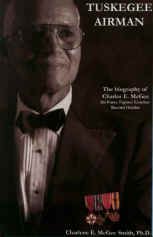 I don’t remember much about Cleveland, but I remember visiting mygrandparents in the mountains of West Virginia. I remember the smell of thebakery in the morning when they’d fire up for the new day. Life was pleasant. Wedidn’t have a lot but we managed and enjoyed family togetherness. We moved tothe Midwest in about the third grade, and I was able to get into the Boy Scouts andsome social activities. I don’t recall schooling in Cleveland, but my schoolingfrom the third grade to the end of high school was in integrated schools, orschools where the black population was so small that they didn’t have separateschools. That may have had some later bearing on my getting along with others. Iwas in good schools and that put me on track to finish high school and considerattending college.
When the war started, blacks needed a college degree to get into flying. Butby 1942, when we were deeply involved in the war, you could sign up for AviationCadet Training with two years of college. Because that opportunity turned out tobe a segregated opportunity, I didn’t get a call to begin training until lateOctober of 1942.
Had you been interested in airplanes and flying?
I had never been around one. My only experience was with paper airplanes andlooking the other way when the teacher would try to see if it was you that threwit. I was in Army ROTC at the University of Illinois, and since I was in thePershing Rifles I knew what the life of the footsoldier was all about, so Ifigured something had to be better than that. It was a good choice because Ifell in love with aviation from the start.
So your first flight was at Tuskegee?
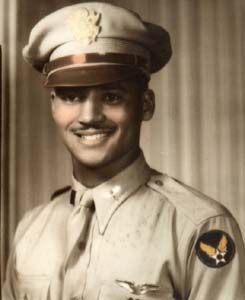 2nd Liuetenant McGee; 1943 |
My first lesson was in that PT-17 at Tuskegee Institute. We used theInstitute’s facilities while they were completing the Army airfield. The Army’sattitudes were that blacks could not fly and didn’t have the right demeanor, andthe Institute was one of six black colleges with a civilian pilot training (CPT)program. It was doing so well that they were moving into the second phase of theprogram, which was training flight instructors. It turns out that the Army wasallowed to contract the primary phase of flight training to a CPT. Tuskegeeapplied for and received the contract for the primary training for the 99th andthose squadrons that followed, and I was in one of those. So the Army’s positionwas that blacks can’t fly, but they contracted with a black college with blackinstructors to give us our first training.
Some pilots already had a private license from a CPT but the Army didn’t wantthem because they didn’t have black mechanics so they couldn’t use black pilots.When I graduated in June of 1943, my instructor said "It’s too bad there’sno bomber program of black pilots, because I think you would make a good bomberpilot." Little did he know, which I found out later, that about a monthlater they authorized the 477th bomb group and developed four squadrons. Theywere flying medium bombers like the B-29. Later, after my combat tour I rotatedback and became an twin-engine instructor.
Was your trip to Tuskegee your first trip to the South?
First trip as an adult. I had spent about a year in Jacksonville, Fla., whenmy father was teaching at Edward Waters College when I was in the third grade.At Tuskegee you learned to move about cautiously. You learned to avoid placesthat might spell trouble. I wasn’t looking for trouble but you never knew whatyou might encounter because of the attitudes in the South.
Did the hostility that surrounded you serve to solidify the cadets?
I would say that’s true. At that time there was no love between the Instituteand the town of Tuskegee, which was about nine miles away. The sheriff and thelocal police would stop people for whatever cause they might have thatparticular day. In the early days of the Tuskegee Army Airfield, the Commander— who was white because there were no blacks with Army experience — didn’twant the Military Police on base to carry sidearms because he didn’t want blackswith guns approaching the white civilians who worked at the base. That commanderdidn’t stay there long and Noel Parrish moved from Director of Operations to thecommand. He didn’t change the attitude of segregation but he did believe inequal opportunity and measuring one’s performance, and that helped a lot.
The fact that we did everything in segregation did meld us together in aunique way. We went through all phases of training together, we graduatedtogether, we formed a unit, the four fighter squadrons and the four bombersquadrons. The four fighter squadrons went into combat together, stillsegregated, both overseas and back at home, as we married and our kids camealong. So from 1941 until about 1948 we were all together. That led tofriendships that lasted a lifetime and gave our unit a togetherness that I don’tthink any other unit had. Other units would go one place for primary, somewhereelse for advanced, then might be broken up to different fighter and bomberunits. At Tuskegee we wanted the opportunity to train without standards beingchanged and be graded on that performance, and I think getting to know andunderstand one another eventually showed in our performance.
Which airplanes did you like to fly?
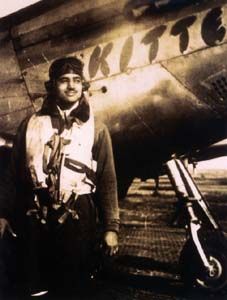 Captain McGee and "Kitten"; Italy, 1944 |
First I have to give credit to our mechanics and technicians. The fine printin the program said "and all the necessary support." Just like ourpilots had no previous experience, our mechanics may have been auto mechanics orsomething else, but they were trained and supported, too. Not only did theymaintain the training airplanes that we flew, from the PT-17 and the BT-13 forbasic, the AT-6 for advanced, the P-40 for initial combat — and that was thekey fighter in ’41 — then by ’43 we had the P-39 and the P-47 coming out. Threeof the fighter squadrons flew the P-39 in combat and the 99th flew the P-40 incombat for over a year. As we moved from tactical work to the strategic escortwork with the bombers they flew the P-47 Thunderbolt. Well, that was a newairplane to the mechanics and technicians as well as the pilots.
The 302nd was one of five fighter groups picked to begin the escorts. We flewthe P-47 for about 6 weeks from May until July of ’44, and then we got theP-51s. There was one P-38 outfit for a while but I think they did more specialmissions than escorts. I think most fighter pilots would say the P-51 was thebest of the fighter aircraft. I say that because of its maneuverability from theground all the way to 35,000 feet. Escorting B-17s we were often above 30,000.They would trim up and keep getting higher to stay above the antiaircraft fire,and we’d go up with them. The P-51 was ideal for that work. And there’s nothinglike the sound of that inline Merlin engine.
Tell us about some of your missions.
We had a variety of missions. I think my first P-51 mission was a fightersweep. Depending on the nature of the bomb raid and the weather we would sweepin and damage and destroy German aircraft on the ground. I think my longestmission was working with the Yugoslav underground evacuating some of our pilotsthat had been shot down over the Balkans. Around the D-Day timeframe, we flewthe P-47 in southern France to push the Germans back from the coast.
Many times in escort we’d see German fighters but if they stayed away fromthe bombstream we were escorting we didn’t leave the bombers just to chase them.But if they got close enough that they were a threat, we’d dispatch a group togo get them. That’s what happened in August of 1944 at the Pardubice aerodrome,north of Vienna , and I shot down an Me-109.
Is that your only air combat action?
Yes. I got credit for destroying one and damaging a lot of German airplaneson the ground but that was my only air action. I had 58 long-range escortmissions from January to November of 1944. I had a total of 136 missions. About80 were tactical and the rest were escorts.
Who were some of the pilots you flew with?
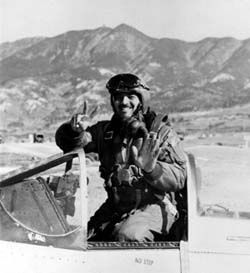 7,000th mission flown by 18th Fighter/Bomber Group; Korea, 1951 |
One of the hardest losses I had was my wingman, who got shot down on his 97thmission. He wasn’t lost to enemy action, it was an accident that happenedbecause of the location of our airstrip. When you lose somebody close itcertainly does impact you, but you go on, because the training is the mission isthere to be done and you can’t forget the task at hand. I found that out insubsequent actions as well.
Where did you go after the war?
Back to Tuskegee, because of the attitudes that were still prevalent. I wasselected to go into twin-engine training, first in the AT-10 and then the TB-25.They took out the guns and the armor plate and it made an excellent trainingplatform, because pilots were actually training in the airplane that they’d beflying on medium range bombing missions.
Did you enjoy being an instructor?
I found it very rewarding. I think you learn more about flying by teachingsomebody else than any other way. You have to be able to explain all theelements, and keep yourself on your toes to be able to impart the righttechniques. So yes, I enjoyed teaching a lot.
With the war over in Europe we were preparing to send the 477th to thePacific and the 302nd had been disbanded. The 477th composite group became twosquadrons of B-25s of the 477th, and two squadrons from the 332nd, and P-47sfrom the 99th and the 100th. When Tuskegee closed in 1946 we were all sent toLockbourne Air base in Columbus, Ohio. I became Base Operations and Trainingofficer, which put me in charge of test work on aircraft, and instrumenttraining for the annual proficiency of the rated base pilots. When the Air Forceseparated from the Army they deactivated the composite group and reactivated the332nd Fighter Group and Wing. Colonel Benjamin O. Davis, Jr. became ourCommander under the Tactical Air Command.
About that time they said "You can’t fly all the time," so I wentoff for ten months of training to Chanute field as a maintenance officer. When Icompleted training I went to my first integrated assignment. In 1946 the AirForce had decided to integrate and use manpower and talent and they could savemoney by not maintaining separate facilities and training. A year laterPresident Truman signed the famous Executive Order integrating all the servicebranches. I feel that our performance helped bring that about because we showedthat it’s not about race or color or ethnic origin, it’s about training andopportunity.
Speaking of opportunity, were there any opportunities open to a blackpilot outside of the military?
No. Not a bit. Because of my love of flying and the joy it brought me, Ielected to stay in. We had all the elements, like any other segment of thepopulation. Some, as soon as they could get back home to civilian life, didthat. Others went back after they closed the base. I stayed in because I enjoyedthe flying and even though I was a maintenance officer I still had the rating.In the ’50’s I thought a time or two about getting out and going to theairlines, but they weren’t ready. In fact it wasn’t until the early ’60’s, aftera couple of lawsuits, that the first black airline pilot was hired. By that timeI had a Korean tour behind me and a promotion and I still enjoyed the work I wasdoing and the flying so I stayed in.
How did the organization of Tuskegee Airmen get formed?
 Wedidn’t start the organization until 1972. There had been a couple of reunionefforts in Detroit, Los Angeles, Chicago, New York — big cities where you’dexpect a concentration of people — and people had kept in touch. But, theorganization was started in 1972 as a Veteran’s organization. Four years laterwe amended our charter to be educational and charitable. Our focus has been topreserve our heritage and history and what it has meant to civil rights in ourcountry, and to promote the opportunities for youth in our country in aviationand space. Ours is a very diverse country, but our diversity doesn’t show up inall areas of our economy and culture. So those two things have been our focus.
We now have 44 chapters. This year our convention is in San Antonio. Nextyear, Memphis. Our national scholarship fund, which began in 1979 with five$1,000 scholarships going to needy youngsters leaving high school and going tocollege in an aviation and space career, is now up to 45 scholarships of $1,500 each. Our goal is to get to 50, then maybe we’ll look at two-year andfour-year scholarships. Our goal so far has been just to spur some interest inthat field of study.
Some of my classmates are still living, but our Lone Eagles memorial growsevery month, it seems, because of where we are in our lifespan. We’ve beenmeeting annually since 1972, and because of the way we organized we’ve nevermade a list of the many hundreds that were involved in the Tuskegee experience.When we showed up at Tuskegee to serve our country, we didn’t start out to beTuskegee Airmen — that’s just the way things happened. The fighter squadrons ofthe 302nd have been picked up in the Air Force Heritage program and eithercurrent active or reserve units are carrying on the number and the history ofthe squadron. And being a 30-year veteran means I’ve got lots of friendsscattered around the country.
Are you still flying?
If someone’s got a seat open, I’m ready. I stopped flying when my wife tookill a few years back. I’ve tried to live by two rules. One, when you think youknow it all you’d better quit flying; and two, to fly safely you do itfrequently and regularly. When I couldn’t do that I began to back out of activeflying. I keep up the interest so I can talk firsthand to youngsters. And if I’mat an airshow and somebody’s got a seat open, I’d love to go.
Chicago’sDODO Chapter of the Tuskegee Airmen, Inc. and EAA’sYoung Eagles Program have teamed up at Meigs Field. So far they’ve givenover 3,500 rides to inner-city youth. For more information or to schedule a ridecall 312-409-5621.
The Tuskegee Airmen website isunder construction. You can reach the national headquarters at888-875-3433.We’ll provide the link as soon as it’s up.