



















| Check out AVweb’s “Airmanship” section, where Paul offersan article about deadly spiralsthat could save your life. |
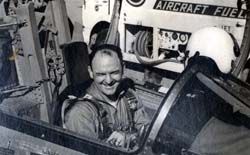
Paul A. Soderlind was born August6, 1923, in Billings, Mont. He took his first flight lesson at age 12, earnedhis private certificate on his 18th birthday (which was then the CAA minimumage), and earned his Commercial and Instructor ratings three months later. In1942 he was hired by Northwest Airlines to teach instrument flying to newpilots. In 1944 he took two years of military leave from Northwest to become aninstructor and check pilot for the Naval Air Transport Squadron. When the warended he went back to Northwest, but at age 22 was still several months tooyoung to hold the Air Transport Rating. On his 23rd birthday he checked out andbecame the nation’s youngest airline captain. Many of the standards andprocedures he developed as a line pilot were adopted by the airline, and in 1954Paul was named Northwest’s Director, Flight Operations-Technical. In that job heflew all the types Northwest operated from the Boeing 247D up to and includingthe Boeing 747. He also flew the acceptance test and delivery flights onNorthwest types from the Douglas DC-6B up through the 747. In his 30,000+ hourshe has flown some 350 types of airplanes, helicopters and gliders, about 25different types of airliners, about 20 bizjet and turboprops, and some 50different GA types, including Molt Taylor’s Aerocar.
He retired from Northwest in 1973, and has given lectures at ICAO, IATA,Boeing, NBAA, ALPA, IAA, Embry-Riddle, the U.S. Air Force, and the FAA Academy.He has served as a consultant to FAA Administrators Alexander Butterfield,Langhorne Bond and David Hinson, Associate Administrator Richard Skully, and(sadly for us) turned down an offer from the Reagan administration to head theFAA. His list of bizjet consulting jobs reads like the Fortune 500, and his listof airline consulting jobs reads like the Dow Jones Transportation Index. He hasflown over most of the Northern Hemisphere (and some of the Southern), from HongKong on the west to Paris on the east, including the Philippines, Taiwan, Japan,Alaska, Canada, Hawaii, and most of the contiguous United States. These dayshe’s working closer to home implementing The Bug System and other procedures andsystems for Corporate Air in Billings. He has won bookcases full of awards,including the 1964 ALPA Air Safety Award, the first FAA Citation and Gold Medalfor Extraordinary Service to Aviation Safety, the 1979 Laura Taber Barbour AirSafety Award, the 1985 General Billy Mitchell Award, a 1994 FAA SpecialRecognition Award for Lifelong Commitment to Aviation Safety, and in 1997 wasinducted into the Minnesota Aviation Hall of Fame. In 1999, Aviation Week andSpace Technology honored Paul and his partner, Northwest’s Chief MeteorologistDan Sowa, for the Turbulence Plot program they developed in 1965.
How did your life in aviation begin?
I don’t remember this but when I was about one year old my folks moved fromBillings out to a little town called Rapelje, which was about half as big as acity block. Jumping ahead, when I was doing the acceptance and delivery test forthe 747s for Northwest and I’d do a gentle buzz job over Rapelje I remembercommenting that I never thought I’d fly an airplane bigger than my hometown. Idon’t remember this either but my mother did and she’s usually right. She saidthat when I was about two years old I used to poke at the flies on the windowand say “airplane.” We lived in Rapelje for eleven years, and when Iwas twelve we moved to Billings and I moved to the airport. Literally. Iwouldn’t come home at night if I could sleep in an airplane or a hangar. Myfolks got used to that and it kept me out of their hair.
I worked as a flunky. The fancy term for it now is “lineboy.” I wasa general pest to everybody and bugged people to wash their airplanes and getsome flight instruction. I graduated slowly from washing airplanes to pushingthem in and out of the hangars. I got paid $3.50 a week and they said I wasworth it. The flight service- today we’d call it an FBO- was a one-manoperation and I would pester this fellow into giving me some of the flightinstruction that I had earned. So it took me from May of 1939 to December ofthat year to get enough time to solo. I also worked as an apprentice mechanic.I’d do just about anything around the airport to get some flying time.
What airplanes were you flying?
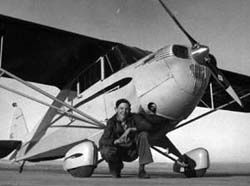 Icouldn’t pick and choose. I had to take what was available. One was an E-2 Cub,which was the Taylor Cub, before the Piper Cub. C. G. Taylor owned TaylorAircraft and sold it to Piper. It had a 37-horsepower engine. Like the J-3 Cub,it had a little crank to move the stabilizer. On the E-2, there was no crank. Itwas clothesline rope that ran through two pulleys and back to the jackscrew onthe stabilizer. It took two hands to move it because you had to pull on one ropeand push on the other, so you had to let go of the stick.
Here’s a weird story but I swear every syllable of it is true. Let me leapahead to the early jet airliner days. There were several airplanes lost, andunfortunately Northwest was the first, to lose an airplane to something calledthe Jet Upset Phenomenon. In those days no one knew much about Mach number andcompressibility and shock stall and mach buffet. I was deeply involved in theinvestigation of the Jet Upset Phenomenon because the first airplane was aNorthwest 720B in the Florida Everglades. The 720B was really nothing more thana 707 with a different name. They went straight into the ground from about20,000 feet. The airplane was found with the stabilizer trim in the extremeairplane nose-down position.
In the 707/720 series airplanes you were able to split the spoilers extendingonly the inboards or outboards. You used the emergency spoiler switches to dothis, and you learned the rule “inboards UP” (turn the inboards OFF),then when you pulled the spoiler handle back you extended only the outboards.With the jet’s wing swept back, the outboard spoilers were aft of the inboardsand if you extended the outboards only it “spoiled” lift aft due tothe extended spoilers and preserved lift forward since with the inboards turnedOFF they did not extend thereby causing a nicely controlled nose up pitchingmoment. While Northwest had the first known jet upset crash it was followedalmost immediately by several others in the airline industry, the military andbizjet operations. We did a great deal of flight and simulator testing both inconjunction with Boeing and many “on Northwest’s own.” In the processwe sorted this all out and I became somewhat of a – you’ll pardon theexpression – “expert” on phenomenon, its cause and how to recoverfrom same.
Jet transports have a trimmable stabilizer, the aerodynamic function beingthe same as in Taylor and Piper Cubs. If you trim nose down but counter anypitch change with up elevator, opposing air loads on the stabilizer jack screwjam the stabilizer so you can’t move it. The classic jet upset begins with theairplane pitching up upon entering a gust – the term “gust” isnot technically correct but use of the term here usually makes the phenomenaeasier to understand – to what pilots who lived through the phenomenon said was”the vertical.” While the pitch-ups seldom if ever really went all theway to the vertical, 30+ degrees nose-up in an airliner can look like vertical.The pilot would try to counter the pitch-up with down elevator, and when thisdidn’t stop it the pilot would intuitively begin trimming the stabilizer AND(Airplane Nose Down).
When the “gust” reverses itself the airplane pitches violently nosedown under the influence of, by then, full down elevator and full ANDstabilizer. To counter the developing steep nose-down attitude and rapidlyincreasing speed, the pilot applies up-elevator which, with the stabilizer stillfull AND is not enough to get the nose-up without the greater aerodynamic forcestabilizer trim provides. The pilot tries to trim ANU but finds the stabilizerjammed just like I discovered in the E-2 Taylor Cub in 1938, 68 years ago! Aweird story but absolutely true, syllable by syllable! Airspeeds in the dive cango well beyond the Barber Pole, the jet’s “red line” airspeed limit,and rates of descent can exceed 50,000 FPM. The stabilizer trim can be”un-jammed” only by momentary release of elevator back pressure, hardto do when diving toward Mother Earth at such speeds, but this “cure”is guaranteed assuming the stabilizer drive system is otherwise normal.
With what I had learned in investigation of the upset cases I developed asix-hour lecture for Northwest pilots. The FAA made the lecture mandatory forall U.S. carriers and it was followed by similar action with the foreigncarriers. Having been the only one fortunate to learn these things at firsthand, I was the one to give the foreign carriers the lecture myself; it helpedthat there were nowhere near as many then. And they made it convenient byassembling all together at an ICAO conference in Montreal in 1964.
I hope I am not going too deep with this but it all was a very productive andexciting interlude in my career.
Not too deep at all. If I can follow it anybody can. Sounds quite relevantto today’s turbine pilots.
It is unfortunate that how and why the classic jet upset occurs, what to dowhen it does, stabilizer drive stall and how to “cure” it, and other relatedfactors we learned the hard way – “on the job” yet they are not being passedon to today’s airline and other pilots. I have done my own private,unscientific survey and have yet to find a single airline that teaches thesethings. It’s even more important today because of the greater number offlights, often lower level of pilot experience and the explosive rate ofgrowth airlines are experiencing.
I am utterly convinced this sad state of affairs is due to the NIH (NotInvented Here) syndrome. I have seen it at work over and over for years. Inone case, I made a presentation on The Bug System (TBS) to another carrier. They operated several fleet types and with TBS could fly them all with thesame simple procedures. TBS has saved Northwest “tons of money” in trainingcosts alone, not counting the obvious reduced costs related to the improvedsafety they’ve enjoyed over the 40 years they’ve used the system.
Several years ago the Vice President of another airline asked that I make apresentation on TBS to his management pilots, including his instructor andcheck pilot groups. I had to travel 1,000 miles to do this but that was noreal problem since it was for the good of his operation. At “show time” theyhad to find a larger room to accommodate the standing room only audience. My”speech” went very well and was received graciously. The whole process took$1,000 from my own pocket. To this day I have never heard a word of eitheracknowledgment or appreciation from that airline.
It is not the first time I’ve had such a disappointing experience.
That airline – and several others – still plod along today flying theirairplanes with a different system for each type in the fleet. Somehow thisevokes memories of my wonderful, now-departed mother-in-law (who did not lookkindly upon drinkers) who poured the dregs of several different wine bottlesinto one “to save space.” One can imagine how pleasant the taste of thatmixture. But with procedures, it’s much worse.
What has been said here about TBS is all the more true of Northwest’sTurbulence Plot (TP) system. It has given Northwest the best turbulenceavoidance system of all U.S. carriers, a fact that has been well documented. Two of the most highly respected pilots in the industry – your own JohnDeakin, a JAL 747 Captain, and TWA’s retired Chief Pilot Bob Buck knownworld- wide for his down-to-earth, ham and egg language on how-to-fly andrelated weather books, not to mention his deliberate thunderstorm and icingpenetrations as safety-advancing research – call the TP program respectively”a program that is admired worldwide” and “(giving Northwest) the mostenviable safety record as to turbulence in the industry.” Painstaking,careful calculations – not wild guesswork – shows Northwest saves some$700,000 a year, more than $22 million in the 32 years since the system wasdeveloped. Well-documented cases demonstrate how, where and why othersexperienced fatal accidents while transgressing Northwest TP “do not fly”areas. I am astonished other carriers cannot see the obvious competitiveadvantages the program gives Northwest.
One should note that I no longer have any connection with Northwest exceptfor a fierce loyalty to my alma mater who gave me opportunities I would neverhave enjoyed otherwise.
I expect much of the above will be called “sour grapes” by some, even make afew enemies. But it has badly needed saying for too long and no one else hasbeen as intimately involved in both programs; any blame can be put on me.
One last, probably unpalatable-to-some comment: The very worst thing thatcould be done is to expect either the NTSB to recommend the FAA make thesystems mandatory, or the FAA to do it “on their own” for that would simplybe a disaster! It would only make operators dig their heels in against itmore deeply. If an operator cannot see the obvious benefits, safety andeconomy, in either program, being forced to adopt them would be a fiasco.
You may draw your own conclusions about NIH. Sigh!
Let’s return to earlier days. When did you get your private certificate?
I got my private license on my 18th birthday and got my instructor’s ratingshortly after that. War was building up and for a few months I instructed inBillings in the Civilian Pilot Training Program. The army would contract withlocal flying services to give them their private licenses and some aerobaticsand instrument training. Then I went to a flying service in Spokane, andinstructed until about July of 1942. I wanted to go with an airline andNorthwest was interested but I had to get my instrument rating before they wouldhire me. So I went to Chicago to a little airport which was long ago swallowedup by O’Hare and did that.
How big was Northwest in those days?
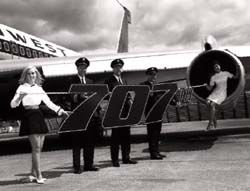 Theywere desperate for pilots because they had just gotten a pretty large contractto fly cargo and army personnel into Canada, Alaska and the Aleutians. Pilotsweren’t able to get their own instrument ratings fast enough so Northwest set uptheir own instrument school in Rochester, Minnesota. I instructed there for afew months and then signed on as a co-pilot and flew the AlCan route for a whilebefore I went to the mainline. That was a great education because it was all iceand instruments in Canada and Alaska and you learned in a hurry.
Before the army contract Northwest had seven DC-3s. Here’s an interestingsidelight. When Northwest got the first 747s those low-profile tugs that we usedto move them each weighed 125,000 pounds and cost a dollar per pound. That wasthe cost of a DC-3 in 1940.
How reliable was the instrument flying you were doing?
All we had then for enroute instrument guidance was the low-frequency radiorange and the ADF. If we had one in an airplane now and you could go out and flywith it you would think “Well, these guys were crazy.” And we were.
How reliable were the flight instruments?
Actually they were surprisingly reliable. All we had the was the turn andbank and airspeed indicator, thus the term “needle ball and airspeed”as the system was called. But it wasn’t long before the artificial horizon anddirectional gyro came along and a handful of ILS systems were sprouting atlarger airports such as Seattle, Minneapolis, Chicago, etc. These were a godsendfor instrument approaches to low weather minimums. The LF range was all audioand you followed the solid tone that made up course that pointed to where youwanted to go. Each LF range had four legs two of which pointed each toward thenext closest LF range. The range had four quadrants, two with an “A”signal (dit dah) and two with an “N” signal (dah dit) and where theyoverlapped in a solid tone defined on course. Your instrument instructor wouldget you lost somewhere between the four legs and you had to do an”orientation problem” to find which of the four quadrants you were in;only then could you pick the leg you wanted to travel along.
The “orientation problems” were odd and complicated. You had noidea where you were except that you were in either an “A” or an”N” quadrant. To find out which of the four it was you used one of twobasic procedures: the “fade parallel” or the “fadeperpendicular.” You took up a heading parallel to the quadrant bisectorline and of course didn’t know whether you were headed toward or away from thestation. You clamped the earphones down tightly and listened for a fade orincrease in volume (thus the term “fade parallel”). If the signalfaded out you were going away from the station and you would turn 180 degreesand listen carefully for the increase that would confirm you were now headingtoward the station. When you got over the signal would fade to zero and you wereover “the code of silence” and turned to whichever of the legs pointedto where you wanted to go.
How did WWII change your career path?
In July of 1944, in a fit of patriotism that was brought on by the draftboard getting close, I went into the navy. The navy was short of pilots and Ihad a fair amount of experience in DC-3s and C-46s so they made me a squadroninstructor and check pilot in Naval Air Transport Squadron (NATS) VR-3. Here’sanother coincidence. While in the navy at Corpus Christi I married a Minnesotagirl on July 3rd, 1944, not knowing at the time that we had both gone to workfor Northwest the same day two years earlier. We were married shortly before Imade captain and she rode with me on my airline captain rating ride on my 23rdbirthday. While checking out on one’s birthday may have been a first, her ridewith me on the rating flight must surely be a real first. We’re still happilymarried 57 years later!
When the war ended and I went back to the airline I was still too young -probably too immature – to meet the airline captain minimum age of 23. Itturned out to be a great opportunity since as the senior co-pilot I could choosethe captains I would fly with. I chose those that were known as excellentinstructors and again: what an education! I remember one Captain I flew with whotold me I wasn’t holding altitude so good on instruments. I was holding itwithin about ten feet and I thought I was doing okay, but he said I would haveto shape up on my altitudes. I had been with him long enough that I could talkback a little bit and I said “You’d bitch if you were hung with a new nylonrope!’
After serving as a Captain on the DC-3, the DC-4, the DC-7, the BoeingStratocruiser and the Martin 202, in 1954 I was given the position of Directorof Flight Operations-Technical. A better title would have been Technical ChiefPilot, but I was in charge of writing procedures and teaching pilots how to flybig airplanes. I had a lot of authority because I just took it. I didn’t ask theboss if I could take an airplane out and mess with it.
What did you do in that job?
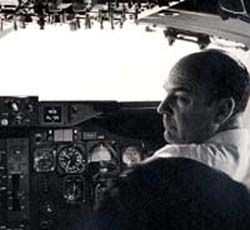 Itwas my job to manage the technical (how to fly) side of the Northwest operation.I developed standardized checklists and procedures for the various typesNorthwest flew, and determined what kind of instruments and how they werearranged. One of the most pleasant responsibilities was the acceptance tests anddelivery of each new type Northwest acquired. The airplane was mine until I wassatisfied at the factory that every gizmo operated perfectly. The deliveryflight to our Minneapolis headquarters was without passengers and I had thefreedom to run any tests and experiments I thought necessary. These includedprobing – in a cowardly manner – of mountain wave and other Clear AirTurbulence [CAT] as well as thunderstorms. There was no other way to gain a fulla truly full understanding of the weather phenomena an airline pilot faces dayin and day out. The experience allowed me to write practical”how-to-fly” procedures with the background to do so while gaining theconfidence of the line pilots.
I instructed in every airplane that Northwest had. As the acceptance pilot, Ididn’t have a type rating. You’d get that by flying the airplane first, thenyou’d give type ratings to the other pilots. I did the initial instruction oneach of the new airplanes that Northwest bought from the DC-6 up through the747.
How did the Turbulence Plot system get started?
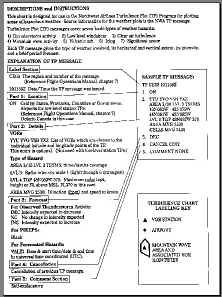
Dan Sowa, Northwest’s Chief Meteorologist, and I recognized the governmentweather services were badly behind the times, especially concerning timelydissemination of severe weather information on thunderstorms, for example. Weconvinced Donald Nyrop [then president of Northwest] to let us obtain directconnection to both the civil and military ground weather radars. In this way wecould bypass the typical one-hour-plus delay in getting the information to ourpilots. There is much more to the story but in a nutshell the Turbulence Plotsystem that we developed allowed Northwest to get severe weather data into thecockpit of any Northwest flight anywhere in the world in as little as eightminutes form when a storm was aborning on the ground weather radars. The systemwas put into use in 1968 and since that time Northwest has had the bestturbulence avoidance record of any operator. With a “picture” of thestorm or CAT area in their hands Northwest flights were able to detour severeweather in the immediate area of where other operators suffered fatal accidents.
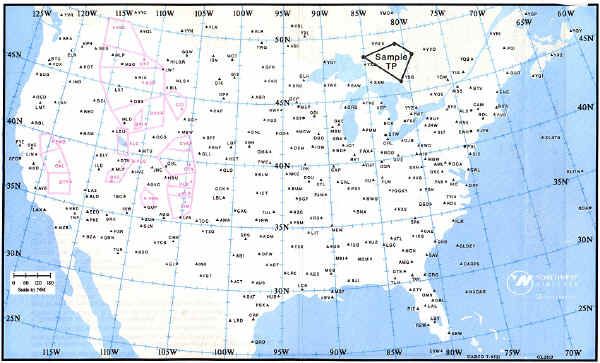 | |
| Turbulence Plot System (click for larger images) | |
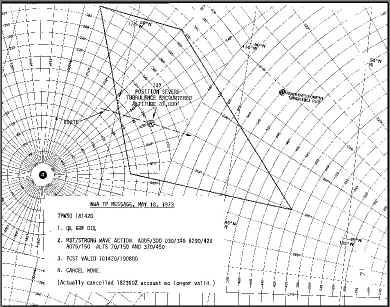 |  |
Do the plots plot more than active thunderstorm cells?
While thunderstorms are number one, the T.P. system covers mountain wave andother Clear Air Turbulence, low-level wind shear, microburst areas, icing areasand on the rare occasions it is required, areas of ozone and volcanic ashconcentrations. Ozone is a hazard to passengers and crew and volcanic ash is aserious hazard to the engines and airframe.
When did you retire from Northwest?
In 1973 the doctors diagnosed a mild case of atrial fibrillation which hasproven nothing more than an occasional annoyance. Mild annoyance in this casestopping my airline career of 32 years! I wasn’t quite 50 years old but becauseof the terrific education of my Northwest position, both as line pilot andDirector of Flight Operations – Technical, I have a relatively good reputationin the industry. Not knowing what in Heaven’s name I was going to at such atender age, I went to the small Montana ranch- 200 acres, by Montana standardsjust a very small lot- we had bought circa 1972 to brood about my future.Strangely enough I began to get calls. The first call offered me the job ofFlight Operations VP for National airlines, now defunct. I passed that up as Iwould be a miserable failure in any kind of administrative position. But thecalls have kept coming at more or less regular intervals.
Perhaps the weirdest assignment was serving at the request of General PublicUtilities in investigation of the Three Mile Island nuclear accident. I havealso served as an expert witness for Boeing’s law firm and several others, againwonderful educational opportunities. During the Reagan administration I wasasked to be the FAA Administrator but – thankfully – my better judgment gotthe edge over my ego and I turned it down. No place for a practical,technically-oriented, no-red-tape kind of guy.
One morning when I was still in bed I got a call from Langhorne Bond, thenthe FAA Administrator. When I answered the phone and heard who was calling, Inot only stood up but stood up at attention! He had just grounded the DC-10s andasked that I meet him at Douglas in Long Beach at 1000 the next morning to workas his adviser in the investigation. On hearing that I had a 75-mile drive justto bet to Billings and couldn’t get an airline flight in time to meet his 1000goal in LAB he said “Yes you can; I have Sabreliner on the way to pick youup!” Wow! My own personal executive jet!
During certification of the MD-80 (originally called the DC-9-80) ALPA raiseda fuss about FAA’s intent to certify the airplane with a two-man crew. Bondcalled again: Would I conduct an independent flight test program in theyet-uncertified MD-80 and give him my opinion on the two-man vs. three-man crewmatter. I agreed on the basis I could run a thorough flight evaluation withsimulated engine failures, instrument system failures, operation in congestedareas, a full workout. He gave his complete blessing to that and I spent avaluable education two weeks of flying a brand-new MD-80! And get paid for it!When it was all over I gave him my opinion the a two-man crew was entirelyadequate. The MD-80 was much more highly automated than prior DC-9s and hadbetter flight characteristics, it was much easier to fly.
Who are you tailoring The Bug System for?
Some of my present and recent-past clients are General Mills FlightDepartment, Cargill FD, Owens Illinois FD, H..S. Zachary Company FD, MinnesotaMining and Manufacturing (3M), Qantas Airlines of Australia, several FAAAdministrators, and Southwest Airlines.
Perhaps most of the calls have been from executive airplane turboprop and jetoperators to tailor The Bug System to their fleets, T.S. being a simple systemthat optimizes performance, essentially eliminates the need for memory, and isvirtually identical for the Cessna 152 and the 747. Learn it on one type andwhat has been learned is directly transferable to other types, no matter howlarge or complex.
Any chance of getting some of your wisdom in a book, or maybe some AVwebarticles?
 Ofcourse. I like to write and given the wonderful and unique opportunities tolearn I’ve had I truly want to pass on some of the practical stuff I’ve learned.I want to write a book but seem to have too little time. I recently wrote anarticle on “The Deadly Spiral” that explains the cause and simple one-step”cure” of the often fatal spiral dive. Too few pilots understand anairplane’s spiral mode and virtually all conventional- and mostunconventional- airplanes are spirally unstable.
There are dozens, maybe hundreds, of myths about how to fly and/or why anairplane does what it does and these need to be exploded. My good friend JohnDeakin is probably the greatest exploder of such myths, at least up to now. Justkidding John.
To mention a few such myths (Deakin calls them OWTs, Old Wives Tales):Airplanes do not stall at a single of attack; you can’t see where you’re goingin a “maximum gradient” climb; the conventional procedure on how torecover from the deadly spiral has steps that are detrimental and some deadwrong; in the GA airplane partial flaps should be used for all – or most -takeoffs; the everyday landing will be shorter with full rather than approachflaps. And a shocker to most pilots: absent an inertially driven attitude systemor its equivalent you have never had accurate attitude indications and willcontinue on that sorry path. And on and in ad infinitum. I want to explode themall.
What should the average pilot know about wind shear?
Everything, of course! But I’ll try and pack some practical advice in thesmallest nutshell I can devise.
In an INS-equipped airplane – like the 747s I flew across the Pacific foryears – you have a continuous and instantaneous readout of wind direction andspeed. If these values are correlated with time and IAS (or Mach number) you canliterally see the aerodynamic effect of half a knot of shear on the airplane.Shear is nothing more than a change in either wind direction or speed and youcan never get away from it. Not to scare anyone with the last remark but it isliterally true; no matter how stable or strong the wind is it is constantlychanging in speed or direction or both which should probably called “minorshear,” not the kind that can take an airplane out of the sky. If half aknot changes things on an 800,000 pound 747, will it effect the smallerairplane? In spades! Shear that causes the mischief is properly called “lowlevel shear” and it has brought down many airplanes, large and small, butrather than calling them “shear accidents” they are more properly”thunderstorm/microburst” accidents. It’s the microburst that’s thereally bad guy here.
The worst possible exposure is trying to penetrate the heavy rain outflow ofa thunderstorm below 1,000 feet AGL on either approach or takeoff. Dry microbursts on the other hand are usually less dangerous; so far as is known no onehas yet been killed in one. Two key rules should keep you out of shear/microburst trouble: Never penetrate the outflow of a thunderstorm at less than 1,000’AGL either on takeoff or landing. In a thunderstorm environment never base yourgo/no go decision on a report from a report from the airplane ahead that he”Had a smooth ride.” If the guy ahead reports an airspeed fluctuation,expect yours to be at least three times as bad. If you’re in such a hairysituation the worst mistake in the word is think the answer is to “just toget in on the ground and you’ll be O.K.” If on the ground in a potentialmicroburst condition, set the brakes and wait it out.
I am in debt to pilot and good friend Captain Dave Akeman for synthesizinghis extensive pilot experience and knowledge gained from exhaustive study ofthese phenomena into the above superb rules, and for much else I have learnedfrom him about the phenomena. There’s no doubt he is the most knowledgeablepilot in captivity. The propeller airplane is considerably less susceptible todifficulties produce by shear and/or microbursts, but that is rather academic asa practical matter. The demon can snatch propeller airplanes out of the skypretty easily. If you want to delve more deeply into the subject look for a copyof the University of Chicago’s T. Theodore (TED) Fugita’s book “TheDownburst,” the one man who has literally dissected the shear/microburstfactors in hundreds of related accidents.
Are you still flying?
Yes and no. Having lost my medical I cannot legally fly alone except in anultralight or glider and have done considerable flying in both. Whenever I getthe urge to fly – and that is often – my great boss and good Bob McIver, VP ofFlight Operations for a hundred-airplane fleet flying for FedEx and UPS, etc.-who I have worked with as a consultant now for fourteen years – will offer methe chance to fly in any airplane in the fleet of fourteen different types. Thebest part? He won’t take his share of any of our flights together since “helikes to watch me fly!”
Read Paul Soderlind’s article “The Deadly Spiral.” Read John Deakin’s column “Sometimes There’s Bad Air Out There (Pelican’s Perch #28).” |
