


















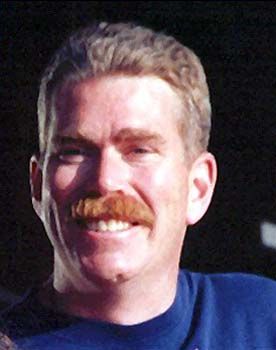
Bob Norris was born on March 20, 1955 inGermany, where his father Bill (a test pilot for the Air Force), was stationed. He learnedhow to fly in the Navy and spent the next 19 years flying fighter jets. In January of 1996he went from one doctor to another trying to find out why he was suffering paralysis andlosing his senses of smell, hearing and taste. The answer was a rare brain condition thatrequired eight and a half hours of the most technologically advanced brain surgery. Forthe next four days he lay awake, pumped full of steroids to keep the brain swelling down.That’s when he kept his mind busy by falling back on his POW survival training. He tackledan “impossible” task … he wrote his first novel. “Check Six” soldwell enough that the publisher commissioned another book, “Fly Off,” and nowhe’s writing books three and four in the series.
Bob’s books are especially popular with pilots because of the accuracy of the flyingscenes. And that brain must have a touch of Nostradamus, too. “Check Six” waspublished in October of 1998. His fictional hero, Randi Cole, is ostensibly the firstAmerican woman fighter pilot to see combat. She’s a 26-year old Navy Lieutenant flying aHornet off a carrier in the middle east, her mission was to strike at a suspected chemicalweapons plant, and her father was a Vietnam aviator. In the real world a few weeks later,on December 16th, 1998, 26-year old Navy Lieutenant Kendra Williams became the firstfemale American pilot to drop bombs in a combat mission when she dropped 1,000-poundlaser-guided bombs on a suspected chemical weapons plant in Iraq during Operation DesertFox. Her F/A-18 Hornet launched from the USS Enterprise and her father flew F-8 Crusadersin Vietnam with VF-211.
When did you know you wanted to be a pilot?
From my first concious thought. I think it must be in my DNA. I grew up in a militaryenvironment, went to five different high schools. My father flew with General Yeager andthen transitioned to a number of “black” projects which he couldn’t tell usabout. By the time of Vietnam, my father was working for a civilian company, still doingthat “black” stuff. My sister married an F-4 pilot who gave me an ops manual andsome other unclassified military information. I read that manual cover to cover, dry as itwas. My brother was flying Super Connies doing Red Crown work. Vietnam was on TV at thedinner table every night, and my family was involved. I just never considered anythingelse. My dad had over 10,000 hours of jet time, and I figured there was nothing I could doto eclipse that. But he had never landed on an aircraft carrier, so I decided to be a Navypilot.
Did you have any flight training before the Navy?
Zero. The first time I took off was on day one of FAM 1. I was competing with studentsthat had logged, in some cases, hundreds of hours. Back then the screening process wasjust a handful of flights before they decided if you were going to multiengine prop or tohelicopter, and I knew I wanted to be a fighter pilot. I had ridden motorcycles for yearsand been good in sports, so fortunately I had enough coordination to compete.
I was also fortunate to get a TAC AIR instructor, because they were very rare inprimary. If you’re a fighter pilot, teaching in a T-34 isn’t exactly a prime assignment.What they had found was that some of the really good students were getting handed over tothe P-3 and Helo classes and TAC AIR was getting what was left over. So they sent somegood TAC AIR guys down to remedy that. My instructor could see that I was a kindred spiriteven though I didn’t yet have the skills of some of the other students. I think I learnedmore in the debriefs over a pitcher of beer than I did in the cockpit when I was focusedon the mission at hand.
I got an F-14 slot right out of flight school. The older F-4 pilots were transitioningto the Tomcat and there weren’t a lot of slots open, so the typical path for an ensign wasto get an F-4 then make the move when an F-14 opened up. The timing was just right for meand I got a Tomcat right away. One of the rewards for graduating number one was gettingsent directly to cruise. Several of us were neck-and-neck when we went out to the boat todo our day and night work. Whoever finished first would presumably get their choice of theavailable squadrons. Then there was a mishap at sea, so now they were looking for areplacement for a ship halfway through cruise. They needed someone who could handlelandings right away and I had done well at that, so I got the nod.
Which carrier was it?
The Kennedy. On my second flight off the Kennedy, I was flying on the skipper’s wingand we got a vector to intercept a pair of MiGs. So here’s Ensign Norris, who can barelyspell “fleet,” chasing a MiG on his second flight, thinking “this is whatit’s like all the time.”
I was naive. My squadron had very colorful helmets that they taped themselves. When Iarrived they gave me an incredibly gaudy gold one and told me that mine wasn’t ready yetbecause they were still taping it. I was at the office morning and night bugging them toget my helmet ready. I didn’t find this out until the next new pilot arrived on the cruiseand they gave that gold helmet to him, but that gold helmet was to tell everybody from theboss to the lowliest person on deck that I was the rookie.
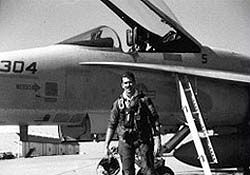 What other ships did you fly from?
I was on the Independence, and we joined the Kennedy for the Granada mission. Fromthere I went back to the Kennedy for attacks on Lebanon. We got our nose bloodied on thatone. We lost an A-6. My airwing commander was shot down but we recovered him.
For one thing, we were using the classic Alpha Strike from the Vietnam days. The targetlist was a little obscure – like triple-A sites – and we could only attack from west toeast and only in the morning.
Was that to reduce civilian casualties?
No, honestly, the morning attack was so we could finish the mission before the eveningnews back home. The highlight for me was when Admiral Tuttle finally got permission toshoot the New Jersey. We had permission to take two air wings over the beach, but not tofire on a battleship that was three miles out in the water. It was strange.
My Tomcat squadron, VF-32, was flying reconnaisance. Our job was to drag a recon podacross the beach we had been bombing and get shot at. I was still out flying the beachwhen the New Jersey fired on the SA9 sites that were shooting at me, and it got a littlecrazy. It was surreal, too. In Beirut, life was going on as normal, with people sunning atthe beach, and skiboats in the water, and five miles south we were in combat.
Take us through a textbook catapult … a carrier launch.
Let’s start at the beginning. The flow of the crew moving around a flight deck is likea ballet when it’s done well, and it’s chaos when it’s done poorly. The carrier deck ispitching in the sea, and the non-skid coating is gone by about halfway through the cruise.So you put fuel, hydraulic fluid and saltwater on raw metal and it’s easy to startsliding. You probably haven’t preflighted the whole airplane because on a carrier the tailis out over the water, so there’s a lot of trust that goes on between the pilot, the planecaptain and the crew.
When you climb in and strap up, the airplane is still chained down with about a dozenheavy tie-down chains. When they break down the chains, the adrenaline starts … rightthen. Typically as the cruise goes on, not all of your systems are working”perfectly,” especially on a machine as old as the Tomcat. So you’re thinkingabout the mission and planning contingencies for a nav system that might be drifting or aHUD that isn’t working quite right.
A good launch starts with a good taxi, and getting to the catapult with the leastamount of agony. You’re passed from crew to crew, other airplanes are blasting up andblowing you around. You may sit there and inhale somebody’s exhaust for a while. Theyellow shirts – the directors – own their little chunk of real estate on the deck, andhave a godlike quality of control, but if you take their helmet off you find that it’s a20-year old kid.
Once you’re in place, you bring the motors up to full power and it’s amazing that youcan sit there in place at full power churning and raring to go. Then you give your salute,and the catapult officer gets a thumbs up from the final checker. On the old carriers, thecatapult officer is out in the elements with you, on the new carriers he’s in a kind ofbubble. The catapult officer is always an aviator, and there’s another element of trust.If you’ve got a pitching deck, you’ve got to trust his timing not to shoot you into thewater.
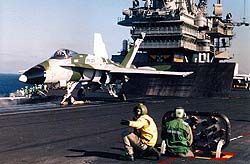 With a flourish, he kneels to one knee and points to the bow, andfirst you get a jolt that snaps your head back, then you get a kick in the butt as youaccelerate from 0 to 140 knots in 1.9 seconds or so. If you were an observer watching thisfrom outside, you’d think it was too violent and that you wouldn’t have control. But afteryou become acclimated to it, you’re very much aware and in control. What you’re lookingfor is a sufficient rate of acceleration.
How the airplane behaves is controlled by what you’re carrying. On the Hornet, you haveto have your hand off the stick. They won’t shoot you unless they can see your right handon the windscreen handle. So in addition to everything else, you’re monitoring four flightcomputers to see if they’re in agreement about setting the takeoff attitude.
This is the best part. Once you’re in the air, you get the airplane cleaned up, gearup, flaps up, you’re required to stay below 500 feet out to 7 miles. Your first stop isprobably going to be the tanker, so you if you’re light you can really rage there for alittle while.
Does any particular rage come to mind?
The best catapult I ever had was out in Puget Sound, about eight miles from WhidbeyIsland. The water was filled with sailboats. I was on the Nimitz and we were cooking alongat about 30 knots. I get shot off, and now I have to stay below 500 feet for the nextseven miles and I’m flying through all these masts. Maybe, for the first time in theirlives, the people on the sailboats felt like their tax dollars were spent well that year.
What was your worst catapult?
It was my first cruise. It was night. At night we taxi with lights off and the”ready” signal is turing the lights on. I taxi into place, lights off, and Ifeel the launch bar hit into the box, and I see the wands giving me the signal to powerup. I just start advancing the power from idle, and the catapult fires. For an instant Ithought I had split the shuttle and I had to stop the airplane. But then I realized whathad happened and I kept bringing the power up. Then I got on the radio to my RIO (radarintercept officer) and say “I’ve got it,” because I don’t want him to eject us.Ejecting at that point typically works out well for the RIO and hardly ever works out wellfor the pilot. We eject in canted directions and I’m pretty sure that if he punches usout, I’ll be run over by a 90,000 ton ship at night. So, at the very least, I want toglide the airplane as far as I can, knowing that every foot will count.
We settled pretty badly but we had had a good stroke and the power came up and we wereokay. Then they call from the ship and say “214, do you have a problem? 214, turnyour lights on!” and my RIO, who’s pretty cool and collected, says, “We will assoon as we’re ready to go.”
Two things are really interesting about this launch. First, there’s a green shirt, akid, whose job is to make sure the launch bar winds up in the box. So he is knelt down bythe nosewheel and there’s no chance that he had time to get out of the way. Not long afterI get airborne I realize that we’ve run over someone, and I’ve got a two hour flight aheadof me. So we call back and ask for his status, and they tell us he’s fine. My RIO and Italk about it and we’re pretty sure they’re lying to us, but we’re glad they are, so we gofly our mission. It turns out the kid really is fine, because instead of trying to dive tothe left, which would have been the instinctive thing to do, he laid down. The ventralfin, which is a sharp blade that hangs from the bottom of the engine nacelle, is onlyseventeen inches off the ground, and it went right over his head. He quit being a greenshirt after that.
The other interesting thing is that my friends back in the ready room, being theconcerned and sensitive people that they are, got a tape of the launch and my very calmradio transmission, and looped it so it was playing when I got back to the ship. Iwould’ve sworn to you that I spoke in the calmest Chuck Yeager voice I could muster, butwhat you heard was almost a soprano voice saying “I’ve got it, I’ve got it, I’ve gotit.”
Now take us through a perfect carrier landing.
I lead a division overhead at 450-plus knots, and break at the bow of the ship whilethe launch is still in progress.I pull the airplane in a screaming high-G turnthrough the one-eighty, drop the gear at the 90, flaps in the groove, and roll wings levelfor the first time on short final just as the deck turns green and the lens comes to lifewitha centered ball.Nobody says a wordasI trap on the three-wire.The airwing LSO gives me a double-mike click, I look up in the tower and catch a thumbs-upfrom the boss, and my wingmen trap behind me in precise 45 second intervals, each with anOkay three-wire.
In the LSO logbook, my Okay-underline has Sierra Hotel scribbled next to it. The masterchief invites me to eat at his mess (where they’re serving lobster) and theskipperasks me to pick the movie. Oh yeah, it’s clean sheet day and the laundryreturns all my lost underwear and socks. Pinch me, Joe, I must be dreaming…
The thing about the Navy is no matter how good your mission was, the last 30 secondshas a lot to do with how you feel about it. It’s on video, you’re going to be debriefed infront of the whole ready room, and the greenie board will have your grade up there for allto see for the rest of the cruise.
How did you wind up in an Air Force F-15?
Those were my orders after that cruise, and I’d have to say I arrived in pretty saltycondition. I had been fired on, fired back, done three cruises, feelin’ pretty good. Iwent to Luke AFB outside of Phoenix, and as a Navy guy I was a fish out of water for aboutsix months. My first solo flight in an F-15, I had a hydraulic failure that required me toblow the gear down and take an arrested landing. In the Navy, a field-arrested landing isroutine and certainly no cause for concern. At Luke, I was on a 30-mile straight-in, Icould see the runway, and the gear was down. I was kind of enjoying the challenge, and Iwas shocked to see so much angst over it from below.
First, the arrested landing was a big deal, and second, the Air Force considers me astudent pilot. And it is true, the Air Force does talk more than the Navy. So on the radioI hear this voice say to me, “This is Sun One. In the event that you miss thearresting gear, I’m going to transmit ‘cable, cable, cable’ and I want you to add powerand rotate the nose to about ten degrees and hold it there…” Now I’m laughing and Ibreak in and tell him “This is your Navy pilot and I’ve done a few of these and theonly thing different about this one is the runway is 12,000 feet long and it isn’t movingin the water.” Then it got real quiet.
I landed and we towed the airplane, because I couldn’t taxi it with no hydraulics. Thenthey picked me up in my flight gear and drove me to Sun One’s office. He happened to be aBrigadier General. I was trying to remember whether the Air Force salutes inside or not,and whether it’s covers on or off. So I go in and I’m still thinking maybe he wants tocongratulate me. That wasn’t the case at all. He wanted to make it clear that this was anAir Force base and he wasn’t going to let any squid screw things up.
Unfortunately, I hit the Air Force during a period where appearance was everything.They’d send out two F-15s but only one of them could use afterburner. Well that’s no wayto train. I call it “legislating safety.” It’s much better now, but I think mostpilots who were there from ’83 to ’86 will tell you the same thing. The pilots wereterrific, but the bureaucracy was horrible.
One thing I think I brought to the Air Force was working in maintenance. A Navy pilottypically grows up in maintenance. Up to that point, the Air Force had practically noexposure to the troops. I did have to wear a scarf and polish my boots, which I try not toadmit in mixed company. One thing I will say is that the Air Force’s training is excellentand their standardization is impeccable. An F-15 pilot from one base could jump on thewing of an F-15 pilot from another base and, without talking on the radio, could execute amission. At that time, the Navy couldn’t do that.
Where did Sun One send you next?
Rather than go back out to sea, which is where I should have been going, they countedmy Air Force time as a deployment and made me the fleet introduction officer for theF-14B. I worked with the teams at Bethpage and Lemoore and literally introduced theairplane to the fleet. Wrote the training manuals and set up the simulators. The big thingabout the B was the new engine, which really increased performance. At that time it wascalled the “A-plus,” but it was the B. For the next two years I did airshows andthat was a blast.
It was 1986 and TopGun had just come out. It was guaranteed fun doing soloTomcat demos in the new airplane after that movie came out. The Blue Angels and theThunderbirds are awesome, but 1986 was a Tomcat’s year. It’s a terrific airshow airplane.The wings move, a lot of flame comes out, it’s a big airplane. Granted there are a lot ofairplanes can outperform it, but that airplane with a good pilot and a well choreographedshow with the TopGun theme was pretty great.
Then I got an opportunity to go fly F-18s on the west coast. At this late point in mycareer, with a zillion hours in the Tomcat and a slot open in a west coast squadron of Bs,I came out to Lemoore in central California where nobody knew me at all. It was kind of ahumbling experience to fly the Hornet in a way I’m not sure God intended – pointing thenose at the earth and throwing bombs.
And that’s when you started feeling strange?
Yeah. At first my hearing on the left side started to go, then I noticed I couldn’tsmell anything, and I lost my sense of taste. And these things would come and go. My facewould be paralyzed in conjunction with this and I’d have what I was calling these”episodes.” The Navy wanted to keep me going and I wanted to keep going, so Iwent to every doctor I could think of, including some civilian doctors at Stanford, but itkept getting worse and worse. I wound up in a new MRI system at Travis [AFB] and that’swhere I found out I have what’s called “vessel looping syndrome.” A group ofblood vessels were looped around three different cranial nerves and they were causing noend of problems. That’s why it was erratic … I was kind of shorting out.
Is this something you had always had that just now showed up?
It is considered to be a congenital defect. What caused it to trigger is anybody’sguess.
I’m sure you considered all the Gs you had been pulling.
Sure. Twenty years of pulling Gs, all those airshows … who knows? The important thingto me was what we could do about it. I would work hard and get back on flight status, thenbe grounded, then work hard and get back on … it was rough. And every time I got hitwith an episode, it was worse. You can deal with a loss of taste and even a loss ofhearing on one side … but when I got vertigo, I couldn’t hide it. I had been flying allmy life, and I got vertigo so bad I’d get sick walking form the bed to the bathroom.
The Navy had a neurosurgeon at Balboa Hospital in San Diego who was doing his paybacktour. He had studied at the University of Pittsburgh, where they had pioneered anexperimental surgery for this problem. Because these cranial nerves run so deep in thebrain, they can’t observe the surgery even with fiber optics. So when the operate, theyinstrument your face. I had over five hundred sensors on my face and neck. In the surgery,a neurologist sits at a console watching the current in your face, and he tells thesurgeon where he is. Eight and a half hours later, the surgery was over and my brainstarted to slow from the trauma. So they pumped me full of steroids, and I was awake forfour and half days. My face was completely paralyzed, both sides, so I couldn’t blink orswallow. Steroids have an effect kind of like amphetamines. My mind was working a millionmiles a minute, but I couldn’t move.
In POW training, they tell you to tackle an impossible task in your mind. Some peoplebuild a golf course, some build a house, I wrote a book. After four days when they finallytook the drugs away and I could feel sleep coming, I thought it would be a shame to loseall that work. About three months later I could use a keyboard again so I decided to tryand write it down. I had lost the word-for-word, but what I had in my head were memories,as if “Check Six” had actually happened. Six weeks later I had a manuscript.
You were at Tailhook 1991. How much of what you saw there influenced “CheckSix”?
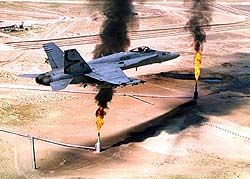 I consider myself a victim of Tailhook. My promotion was held upfor three months, and my family was at Miramar while I was at Memorial while I was underinvestigation like everybody else. Any commander and above that was there went throughsevere scrutiny. I went through a series of interviews that started relatively civil, andwe got into chair throwing, screaming, late-night TV, horrible sessions. I was toldeyeball-to-eyeball that I had no rights, which is an interesting thing to tell somebodywith 20 years in the Navy.
When I heard about the gauntlet – and I became convinced that it actually happened -I was horribly embarassed for my service and my brother pilots. I can’t tell you how muchit offends me that someone would do anything like that. There is no excuse, under anyconditions. What made it hurt more was that we had finally buried the spectre of Vietnam.Tailhook ’91 was an incedible event. I had students and old friends who were on the Midwaywho, after Desert Storm, continued their cruise. They had set foot on U.S. soil for thefirst time the opening day of Tailhook.
These guys had not benefitted in the glow of post-Desert Storm like the rest of us had,they had a job to finish. It was the first war we had won in our lifetimes, and to thinkthat a few wannabes were up there pulling those stunts is just outrageous. There were5,500 people there, and at the very most there were 150 people in that hallway. It doesn’tmitigate it, but it was a tiny percentage of the people that caused the trouble.
I had a lot of problems with the Navy leadership. The senior Marine stood up and said,”I was the senior Marine at Tailhook. I accept full responsibility for the Marinesthere, and if you’ll allow me, I’ll get to the bottom of it and correct the problem.”The Secretary of the Navy and the Chief of Naval Operations were at Tailhook. They spent ayear trying to avoid responsibility and allowed Congress and a whole host of agencies totreat every one of us like criminals. If the Chief had taken the heat and then asked forcooperation from us, we would’ve acted under a direct order and delivered the names. Butthat’s not what happened. We’re still feeling repercussions of that because some very,very good officers’ reputations were trashed. We lost Admiral Tuttle, the Rickover ofNaval aviation. With control comes responsibility. That’s why they give you a sword. It’snot to kill somebody, it’s to fall on.
The hero of “Check Six” is a female fighter pilot who comes up againstsome pretty rigid ideas about who should be flying off a carrier. How did you arrive atyour viewpoint?
I had a kind of epiphany about the issue of mixed gender in aviation. It was patentlywrong for the Navy to lower standards to allow women to pass, because you can’t lower thehostility of the environment. On the other hand, no pilot becomes a successful carrierpilot without mentoring. No pilot, I don’t care how talented they are … you can’tcapture in procedures and simulators the environment and all the variables of the carrierenvironment. It’s not just the coaching, it’s helping you to overcome self-doubt and otherthings. The pressure is immense. Your grade for the thing you value most in life is postedin your living room for all to see. I’ve seen very talented people get crushed, getulcers.
Even though it was wrong to lower standards, the men were acting hypocritically by notmentoring the women that did make it through. Those two themes are what I try to tackle inmy books. I see Randi Cole as a fighter pilot who just happens to be a woman. She hastraits in common with other fighter pilots. I try to convince the reader early on in”Check Six” that she’s not a superwoman, she’s not a sex object, she grew uplike a lot of us, wanting to fly, and she’s willing to put up with all the gender B.S. toget her shot at it. Her actions are because of her hard work, not because of some innatetalent.
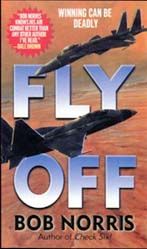 Tell us about your newest book, “Fly Off.”
“Fly Off” is a contest between the first of a new generation of fighters,like the F-22, and end of a pedigree of fighters using older technology, like the F-18. Ithought it was intriguing to have the Super Hornet flown by a highly experienced pilot whostill tapes everything to his kneeboard and turns off the voice-automated devices, and thenewer generation of pilots who grew up with computers are more comfortable in the newairplanes. It starts as a competition between the hardware and progresses to a competitionbetween the pilots. And there’s an event that happens that brings them all together.
Congress just cut the budget of one of your main characters. What’s the future likefor the F-22?
The good news is it’s still flying, but that’s about the only good news. When you’relooking at the tax dollars – and that’s what they get elected for – you can have a wholefleet of Hornets for the cost of one F-22. I think part of this is the percieved threat.We just executed a bunch of missions in Kosovo and we lost one airplane, and the stealthyone at that. We encountered MiG 29s and blew them away, although they were probablypiloted poorly. When you look on the threat horizon, there isn’t a lot there that can evencompete with what we have today. We, as aviators, want to see the newest, coolest stuff,but as taxpayers, we have to look for what we need to counter the real threat.
I think we’re sensor poor. I think in Kosovo we proved that we have the ability tostrike with precision a building about which we know nothing precise. We can put a bomb ona building, but we don’t know if that building’s empty or not. So we ought to be spendingmoney on intelligence and sensors. We’ve also got some ancient support aircraft out in thefleet that guys are flying everyday, like the H-46. We could be looking in that direction.That’s easy for me to say from my easychair.
What are you doing when you’re not in the easychair?
I’m working on books three and four simultaneously. One’s a prequel, one’s a sequel. Inthe sequel, Randi gets sent to a failing squadron with a bad attitude to clean them up. Bynow she’s a MiG killer and she doesn’t have to prove herself as a woman and she can moveto the next level. She’s going to find out if she can be a leader.
I think the true value of gender integration has not been realized … and won’t berealized until we have women in senior positions where they can contribute to our tacticsand our leadership. The cycle for tactics for men is we face a challenge, we respond withinnovation, we have a success, and the next time we get a challenge we do that again.Here’s an example that I’ve lived. In Vietnam we created the Alpha Strike. So the nexttime we drop bombs in anger, eleven years later, what do we do? An Alpha Strike, and weget a bloody nose from a bunch of knuckleheads.
The tactics of target-rich Iraq didn’t work in Kosovo. Bombing from 15,000 feet withthe target on a four-inch green CRT didn’t hack it, and that’s when you hit what you’retrying not to hit. You can argue that those were good tactics because we didn’t lose anyairplanes, but there’s the other side saying yes, but you weren’t as effective. I thinkit’s possible that women in leadsership positions can help us break that tactical cycle.Predictability is the worst thing you can have in tactics. So I think there’s room forother viewpoints on what we should do from women who have earned that right to give it tous.
Back to Tailhook for a second. We opened the decade with Tailhook. We closed the decadewith an operation in Iraq where every single type of Navy airplane involved in the strikefrom the E-2s to the S-3s to the EA-6s to the FA-18s, every one of them had womencrewmembers. I’m not sure anybody knows that. And the fact that it wasn’t a big deal is astatement in itself about how far we’ve come.
In addition to writing, I’m also an information systems architect at the NavalPost-Graduate School. After my operation, the Navy sent me to the school and I got myMasters degree in information technology. I’m very grateful for that. I design databasesystems that enable learning over the Internet.
With what you know about simulators, is there an Internet flight training site inyour future?
I’m interested in flight safety and I can see doing something with that. I can’t flyanymore. You can have a pacemaker, but you can’t have a plate in your head. But when I wasflying airshows, people would come up to me, in all sincerity, and ask me what it feltlike. Young, old, white, black, women, kids, teens, everybody. And some of them werepilots who would just never have the opportunity to fly in one of those machines. At thetime I didn’t really have an answer, but in one of life’s ironies, I’ve traded the abilityto fly for the ability to put readers in the cockpit and tell them what it’s like.
Catapultyourself to Bob’s website. You can order his books from there.
