








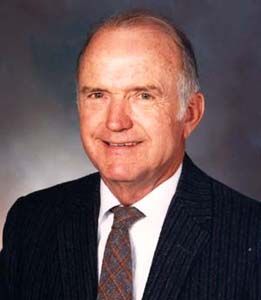
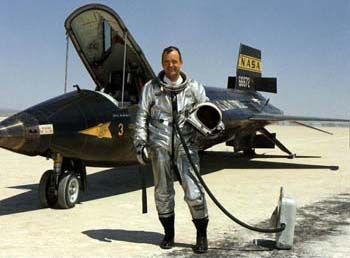
Bill Dana was born November 3, 1930 inPasadena, Calif. He graduated the U. S. Military Academy at West Point and served fouryears in the U. S. Air Force. He joined NASA on October 1, 1958, the day it was founded,which makes him NASA’s first official employee. As a test pilot he flew the triple-sonicYF-12 (precursor to the SR-71) the wingless M2-F series (precursor to the Space Shuttle),and the X-15. He flew the X-15 sixteen times, reaching a top speed of 3,897 mph and a peakaltitude of 310,000 feet. He flew the X-15’s last flight above 300,000 feet and the lastflight of the program.
After the X-15 he returned to the M2-F3 program and won the Haley Space Award from theInstitute of Aeronautics and Astronautics in 1976. Later, he was a project pilot on the F-15HIDEC (Highly Integrated Digital Electronic Control) program and the F-18 High Angle ofAttack program. In 1997 he received NASA’s Distingushed Service Medal. Bill was ChiefEngineer at NASA’s Dryden Research Flight ResearchCenter from 1993 until his retirement in 1998.
How did you get interested in flying?
We lived in Bakersfield during WWII and the B-25s and the P-38s out of Burbank wouldcome up over Bakersfield on their test flights and I was inspired watching them. Iremember seeing a flying wing — it would have had to have been a B-35 because it was apiston-powered flying wing — fly over Bakersfield one day, and then the first jet squadronin the United States Air Force formed at Bakersfield airport in the fall of 1945. Theyflew P-80s. I don’t think it was any one thing, but I think it was a mixture of beingexposed to airplanes that much, plus the glory of aviation in WWII, which I wasn’t oldenough to fight in but I was certainly old enough to read about.
Where did you learn how to fly?
I graduated from high school in 1948 and left immediately for West Point. At that timethere was no Air Force Academy, so the Air Force got its Academy graduates from West Pointand Annapolis and 25% of my class at West Point went into the Air Force. I started AirForce pilot training at Marana, Arizona in August of 1952, and the first airplane I everflew was an AT-6. They were having propeller problems with the T-28s so they left me inthe T-6 through what ordinarily would have been the T-28 phase of flying, the first halfof advanced, and I flew the second half of advanced in the T-33s. I found the T-33 easierto fly than the T-6, tricycle landing gear and very little torque. I finished the firsthalf of combat crew training in Del Rio in the T-33, and the second half at Luke AFBtraining in the F-84G.
Did you ever fly in combat?
No, I got my wings three days or four days after the Armistice was signed with NorthKorea, so by the time I got into advanced combat crew training the war was over. I spentthe entire year in 1954 in Korea flying recon. The only significant military activitythere was we were all packed and ready to go to Indochina during the Dien Bien Phu crisisbut the whistle never sounded.
 |
How did you wind up becoming NASA’s first employee?
I just finished my four-year commitment to the Air Force in 1956 and I knew I wanted toget into some kind of flying job and test flying sounded like fun just because I had neverbeen on the leading edge. I was flying F84s when other guys were flying F-86s. I wasflying F-86s when other guys were flying F-100s, and I could never seem to quite get tothe top of the ladder, and I think that was probably the appeal of test flying to me. So Iwent back and got a Masters degree in Aeronautical Engineering after I got out of the AirForce and graduated in June of ’58. Then I started looking seriously for a job and Iinterviewed with Lockheed (Palmdale) and North American (Palmdale) and others, and inSeptember of ’58 I set up an interview at Edwards with General Dynamics in the morning andGeneral Electric in the afternoon. I got out of my interview with General Dynamics rightat straight up 12:00 noon and it struck me that that wasn’t a very good time to be goingand knocking on General Electric’s door, so I drove around the base for awhile.
I happened to drive up to the NACA X1 building and I didn’t even know NACA had afacility at Edwards. The first person I met was the personnel officer who walked me aroundthe building and the hangar, and they had two or three F-104s and an F-107 and an F-105, anF-102, and all this stuff I’d heard about but never flown. They offered me a job on thespot as a stability and control engineer with the promise that I would be transferred intoto the pilots’ office when they needed someone. I agreed to the position that day and theysaid, ‘What day do you want to start work?’ and I had to get a civilian pilot’s license.All I had was a military flight certificate, so I had to get a pilot’s license and thenmove my apartment from Van Nuys up to Edwards, so I said, ‘Well, how about the first ofOctober?’ and they said, ‘Fine,’ and I came to work the first of October, and it was theday that NASA was officially founded under the Space Act, so I am literally the firstemployee of NASA.
I did interview at GE later that day but I told them I had already decided to come toNASA. GE didn’t have a hangar full of F-104s.
What were the early days of NASA like?
I spent a year in engineering and then September 1st of ’59 I was transferred into thepilot’s office with JoeWalker, who was chief pilot, and Jack McKay,Neil Armstrong, andMilt Thompson, and allfour of those guys ended up flying the X-15. I knew I was in the company of giants when Igot here. Joe was a veteran of WWII and a very capable leader. Jack was second inseniority and was a veteran of the X-1 and Douglas Skyrocket programs. Milt was senior tome and came up with the idea of using a parasail rather than a parachute to recover theGemini capsule. He would tow a paraglider demonstrator airplane behind a crop-duster. Miltwas never injured in the parasail but others were, so NASA abandoned the idea. Neil wasthe middle-seniority pilot and he was a very bright engineer and I’m not surprised at allthat he was selected to command Apollo 11.
My first research program was Variable Stability F-100 with the flight control systemmodified so you could program it to fly like anything you wanted it to. It would fly likea transport or like a higher performance airplane, programmed by fiddling with the analogflight control system. I’d probably spent a year as project pilot on that when I was giventhe A5-A Vigilante as a project. I flew it up and down the airways supersonically, workingwith FAA in a joint NASA-FAA research program to see if FAA was going to have any troublewith the air traffic control of the supersonic transport, which we thought was going to beflying nation-wide.
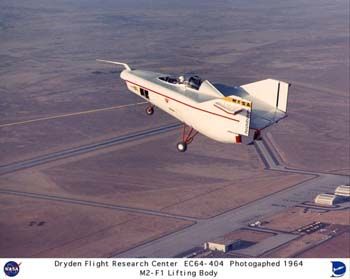 |
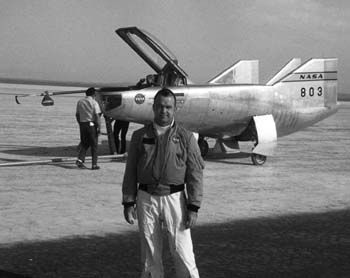
Shortly after that the plywood lifting body came upand although I was not a project pilot on the M2-F1, I was a tow pilot. I towed it with aC-47. I remember standing out on the lake bed watching the first take-off with it on the1,200-foot tow line behind the C-47, and to see that thing actually in the airkind of validated the whole thing and proved that, yeah, this is a real airplane, not justa kite. I had shown a lot of interest in the plywood M2-F1 and when the heavier weightM2-F2 came up Milt Thompson was project pilot on it and Bruce Peterson was thealternate project pilot. For some reason I was offered the chance to be an alternateproject pilot, too, and I remember reading droves of material on the M2 which had somevery odd-looking curves, a lot of side force with side slip and a lot of roll with sideslip. Sometime in the spring of ’65 Milt Thompson decided that he couldn’t fly both theX-15 and the M2; he just didn’t have enough hours in the day to do both, Joe Walkeroffered me a slot on the X-15. It wasn’t long before I realized what Milt meant about nothaving enough hours in the day to do both, so I resigned the M2-F2 program and flew theX-15 from the fall of ’65 to the last flight in the fall of ’68, although we didn’t knowit was the last flight at the time.
Take us through an X-15 flight from suit-up to shutdown.
It always knew when I went to bed at night I knew I had a flight the next morning andit never bothered my sleeping but when the alarm went off there wasn’t any lying in bedlike most people do on most mornings; you knew you had a full day’s work to do. I flew myown weather flights. I wanted to check the condition of the lake beds, both the surface tosee there wasn’t water on the dry lakes, and the X-15 took anywhere from three to fivelake beds to support a mission. You’d always prefer to land it at Edwards, and dependingon where it launched there were one to three intermediate lakes because you could get somuch speed going that you couldn’t get back; you couldn’t turn the airplane around and getit back to the launch lake, but you didn’t have enough energy to glide straight ahead toEdwards either, so you had to have someplace to fall in the middle. And, of course, youneeded a place to go if the engine didn’t light. I also wanted to know the wind conditionsat each lake because in a power-off landing a little windshear can make a bigdifference.So there were three to five lakes to check every flight.
 |
I usually got up around 4:00 and got out to work maybe at 6 and was airborne at 7 andback at 8, something like that. And then I’d get out of the weather-check airplane andclimb right into the suit van where I’d change from a flight suit to a pressure suit.
About two hours before launch I’d climb into the X-15, which was hanging under the wingof a B-52 and it took about 20 minutes to methodically go through a checklist of all thecockpit switches with an inspector looking on. With that done we’d shut the canopy and theB-52 would start its eight engines and start pre-taxi checks and that took another 15minutes or so. Then it took about 15 minutes more to taxi out to the departure end of therunway.
We’d take off and always do one climbing circle over Edwards to about 35,000 feet andthat let us check the operation of the pressure suit. Then we’d head up to the launchpoint where the B-52 would turn around and point the X-15 towards Edwards. Ordinarilylaunch altitude was 45,000 feet.
With 20 minutes to launch we’d start up the auxiliary power units and check theballistic controls and we’d countdown to launch and the flight planners had a ground tracklaid out. At about eight minutes to launch was where we’d turn back towards Edwards and rolledout at 4 minutes to launch and then counted down and flew inbound for four minutes. At oneminute the control room called one minute to launch and the pilot would start his 8-dayclock on the dashboard of the X-15, which was the only clock I had. I didn’t have awristwatch when I was in my pressure suit, and then there were checks down 30 seconds, 20seconds, 10 seconds, and then finally to launch, and the X-15 pilot launched himself,using a toggle switch.
| QuickTime and MPEG movies of HL-10 Lifting Body After Landing With Pilot Bill Dana |
I don’t understand this phenomena but it felt like you were actually fired off thepylon; you were actually only falling away at zero gravity, but it felt like you werefired away, and it was quite a shock at launch. Then the engine revved and things reallyhappened fast after that. The X-15 weighed 33,000 pounds at launch and the engine put out60,000 pounds of thrust, so we had almost 2 Gs when you lit the engine. As the fuel burneddown by burn-out you only had 15,000 pounds of gross weight and a 60,000 pound engine, soexcept for drag, if you’re on a high altitude mission where there wasn’t much drag, you’regetting almost 4 Gs of pure acceleration. We had about 85 seconds of fuel and in those 85seconds we went from Mach .8 to Mach 5.5 or 6.0 on some flights. That’s a pretty wildride. Milt Thompson once said — and this is the best line that came out of the X-15program — the X-15 was the only airplane he ever flew where he was glad when the enginequit!
You’d be pinned back in the seat there wondering how long you were going to be able tosurvive this and then the engine would burn out and you’d feel like ‘ahh,’ you were backat zero G. On an altitude mission as you climbed out, the air went away and pretty soonyou were really at zero gravity. The coast home was pretty routine, whether it was aheating mission or an altitude mission. I had always thought that the power-off landingwould be the hard part of the flight. I had never done power-off landings in anything buta sailplane, but we had practiced landings so much in and F-104 that landing the X-15 wasfairly easy. We flew the traffic pattern with the landing gear up, then after we’d reducedthe rate of descent we’d extend the gear. It was a drag reduction technique so ourapproach wouldn’t be any steeper than it had to be.
Our glide angle at 300 knots was about 15 degrees, so we kept the gear retracted untilwe were almost level, then landed almost immediately. Touchdown was about 170-175 knots,and the slide-out on the skids on the dry lake bed was 8,000 to 10,000 feet. It wasalways right then, after completing a successful mission, that I wanted to go right backup and fly it again.
Did you ever have an emergency?
I had one engine malfunction so I shut the engine down and landed at the launch lake. Ididn’t consider that an emergency because we landed with power-off anyway and whether youlanded at Edwards or at Baker didn’t matter much.
We had some serious incidents in the program. The X-15 we lost had some electricalproblems which deprived the pilot of some instruments and he may have misinterpreted otherinstruments and he re-entered the atmosphere sideways and went into a spin and was killed.That was Mike Adams and that was our most serious accident. I was flying intermediatelakebed chase and I was the second airplane to the scene but the X-15 had broken up inflight so there wasn’t much left to see.
The second most serious accident was when the landing gear collapsed on touchdown atTonopah, Nevada. The airplane rolled over several times and broke the tails and the wingsoff, and that airplane was rebuilt into the one that was going to Mach 7, and did go toMach 6.7. Jack McKay was injured in that accident but he recovered and got back into theprogram.
The most interesting flight of the whole program was probably Pete Knight’s flight inShip 1 in the summer of 1967. He launched at Smith’s Ranch about 100 miles north ofTonopah, lit the engine and got to about Mach 4 at 100,000 feet on the boost. Then he hada complete electrical failure which not only took all his electric instruments but alsoshut the engine down. That left him with one steam-driven hydraulic pump. He climbed to180,000 feet, then when he re-entered the atmosphere enough to turn, did a 180-degree turnback to Mud Lake at Tonopah, without ever having an electron flowing in the airplane. Peteearned the Distinguished Flying Cross for that flight.
What does the world look like from 300,000 feet?
It’s a beautiful view. You’re in dark sky. The atmosphere appears as a bright bluering, just like the you see in the movies. It’s peaceful. It’s quiet. There’s no gravityso your heart isn’t working as hard to move the blood, so it’s kind of relaxing.
What did you do when the X-15 program was over?
I flew the 199th flight of the program on the 24th of October of 1968. We knew theprogram was ending in December of ’68 and we were flying about once a month, so I thoughtPete Knight would probably fly in November and maybe I’d get another flight in December. Ihad an absolutely routine flight to 250,000 feet and came back and landed. Betweenresearch problems and weather we never got the 200th flight off.
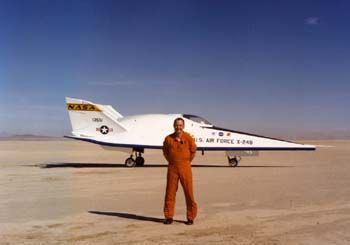
I went back to the manned lifting body program. The first one I flew after the X-15 wasthe HL-10, designed by NASA Langley. I flew that in 1969, then in 1970 flew the firstflight of the M2-F3, which was one of the Northrop designs. I flew that for three years, andlater got a few flights in the Air Force’s lifting body, the X-24.
 |
How had the lifting body program changed in the three years you were flying theX-15?
The M2-F2 had come to grief. Someone had landed gear-up and the airplane rolled overseveral times. That footage was used in the intro to the Six Million Dollar Man.That airplane was rebuilt into the M2-F3 which I was the first to fly, about three yearslater. It flew 27 times. The zealots for the lifting body design felt that theSpace Shuttle should have been a lifting body. It didn’t work out that way because therewas a requirement for a long, narrow payload bay and that worked better with a traditionalwinged fuselage.
Those that were advocates of the lifting body thought that maybe the idea had come andgone and it has been very gratifying to see the success of the Lockheed X-33 single-stage-to-orbit rocket which should beflying next year. And NASA Houston is building theX-38 lifting bodysimilar to the Air Force’s X-24A, which is a prototype for a Space Station recoveryvehicle. Scaled Composites is working on that so thoseof us in the original group have seen the program evolve from plywood to composites.
How much flying have you done outside the government?
I’ve done some soaring and some light-plane flying and that’s the sum total of it. Mywife learned to fly in 1968 and we flew a Cessna 150 for a few years. I live in Tehachapi,just west of Edwards, at the southern end of the Sierras. We have good mechanical liftingon windy days so I’ve done some soaring there.
What’s going on at Edwards these days?
The X-33 is not being built at Edwards but it’ll be launched there and fly up to theDugway Proving grounds. The first flight will be to Mach 9. The X-43 is an unmannedvehicle with a hypersonic air-breathing engine. An L-1011 mothership will carry a Pegasusrocket that will fire the X-43. It will fly two different missions; one to Mach 7 and oneto Mach 10. NASA is not involved in the F-22 but it’s flying regularly at Edwards now.
It’s exciting to see how digital computers are driving airplane and spacecraft design.We developed computers in great measure to complete the Apollo missions, and thecapabilities are much greater than we could have imagined back then. We’re seeingairplanes that are not inherently stable, but the computer allows us to achieve thatstability. We’re flying pilotless airplanes that can use GPS and fly-by-wire to find therunway. I believe that these technological breakthroughs mean that aeronautics willadvance as much in the next century as it has in the past century.