



Preview
Reno 2000: What’s New This Year
AVweb‘s Reno 2000 Coverage |
The pits at Reno’s Stead Airport are filling with airplanes, trailers and equipment. The temporary signs on Rt. 395 are up directing air race traffic. The skies north of Reno are alive with the sounds of Merlins, Wrights and Pratts. It’s air race time in Reno and the 2000 National Championship Air Races are about to start.
Actual head-to-head racing starts Thursday, but qualifying has been going on all week. So far, thankfully, there have been no major incidents or problems on the field.
The Reno Air Racing Association has made a few changes for this year’s races, but fans probably won’t notice much difference. In response to last year’s fatal crash of Gary Levitz’s Miss Ashley II, the number one and number eight pylons of the Unlimited course have been moved in toward the center of the race course. This will have the effect of rounding the turn in front of the grandstands and will cut down on the G-loading on the aircraft.
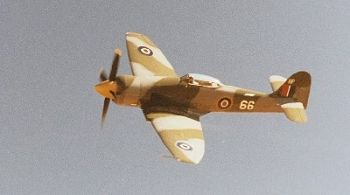
There are some new racers at Reno this year. Perhaps most colorful is the Sea Fury Miss Merced, an airplane with an equally colorful history in air racing. Furias, the R-4360-powered Sea Fury and another familiar name to air race fans is back. The “Brown Racer,” another Sea Fury, is also in the field racing under the name September Fury.
Missing from the field is perennial favorite Rare Bear. The modified Bearcat had many problems last year, and owner Lyle Shelton worked hard during the off-season to secure the funding necessary to get the Bear back in race-ready condition, but wasn’t able to get it all together for 2000. Alan Preston was reported to be bringing an authentic Mitsubishi Zero to race, but it has been scratched. Bruce Lockwood, ’98 and ’99 Unlimited Gold Champion was supposed to fly a Yak 3 but it also had problems and isn’t in the pits.
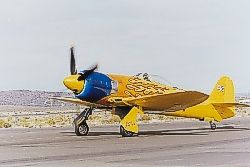 Still, the Formula 1 class should be interesting this year following the retirement of Nemesis and Jon Sharp from the class. Sharp will be flying this year, however, assisting with piloting one of the Sports class entrants.
The weather has been great so far, and is forecast to continue to be good through race week. The stands and pits are beginning to fill with fans. It’s time to go racing at Reno.
Qualifying: The Field Shapes Up
Reno. The name conjures up images of craps tables, quickie marriages and desert. But to air racing aficionados, Reno means the National Championship Air Races, which begins officially tomorrow. Fans watching the 37th edition of these air races have a lot to look forward to this year, besides a bad case of sunburn from the bright Nevada sunshine.
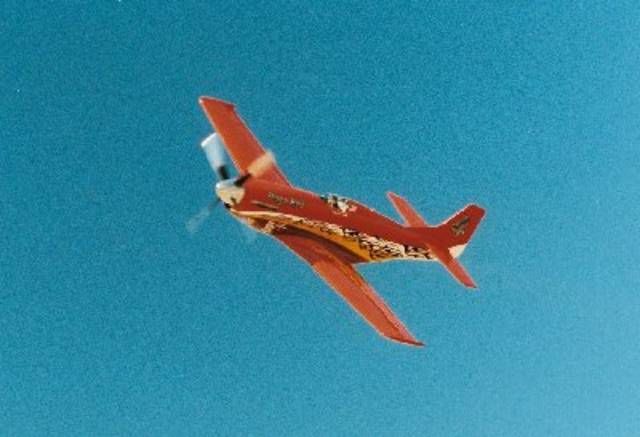
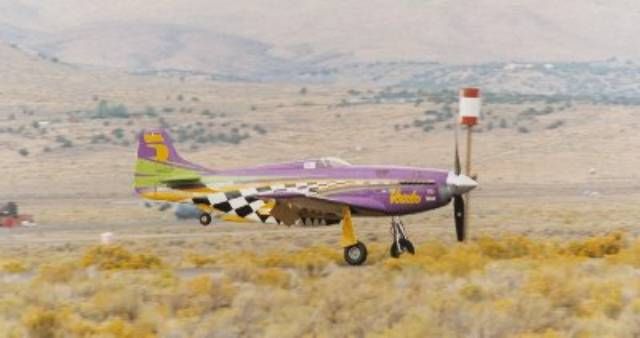 In the Unlimiteds, fans should see some great head-to-head racing if all the preliminary front-runners stay healthy. Three top ranked racers – all Mustangs – should have a shot at the winner’s circle. Dago Red, the winner each of the past two years, looks as strong as ever, especially after posting a blistering qualifying time of 489 mph on Monday. Instead of Bruce Lockwood flying, though, Reno racing veteran Skip Holm is aboard.
Strega, always competitive with owner Bill “Tiger” Destefani flying, should also be in the hunt. Strega and Dago were neck and neck in last year’s Unlimited Gold final before Strega’s engine let go on the last lap. Strega was absent from the pits on Tuesday with engine troubles suffered during a qualifying run, but qualified late Wednesday.
The third contender is Voodoo, which has suffered bad luck the past two years with mechanical problems and a frightening control system failure during the 1998 Gold semifinals. Voodoo appears healthy and qualified with no problems. Seven-time Unlimited Gold champion Darryl Greenamyer was supposed to fly her, but he and Voodoo owner Bob Button couldn’t agree on the financials. Instead of Greenamyer, Matt Jackson will be flying the modified P-51.
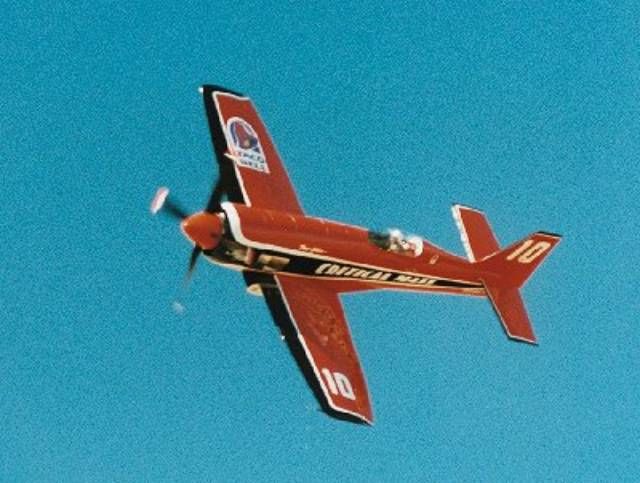
A flurry of Sea Furies will be challenging the Mustangs. Tom Dwelle’s modified Fury, Critical Mass, and perhaps Art Vance and his R-4360-powered Furias will bear watching. Two-time Unlimited Gold winner Dreadnaught had the second fastest qualifying time through Tuesday’s runs, but reportedly suffered major engine problems.
In the T-6 class, the fastest airplane in qualifying through Tuesday was Jack Frost’s Frostbite. Although the airplane was disqualified last year after a series of protests and counter-protests, apparently Frost and the RARA committee have mended fences. Nick Macy in Six Cat, last year’s winner, will be defending his title.
The Formula 1 Class will be wide open this year, with the retirement of Jon Sharp and Nemesis. Veteran F-1 driver Ray Cote had the fastest time through Tuesday.
 Three pilots in the Biplane class broke the 200 mph mark in qualifying through Tuesday. David Rose turned in a 209-mph speed, and Tom Aberle and Stephen Brown both qualified at 206. The Sports class will be interesting this year, also, and is attracting greater attention every year – witness Darryl Greenamyer’s early entry but subsequent scratching of his Lancair, and Jon Sharp’s announcement earlier this year that his Nemesis NXT project will be a Sports class racer and kit plane. This year, race fans will get a chance to see if the much-publicized Thunder Mustang is competitive with the speedy Lancair IVs, Questair Ventures and Glasairs.
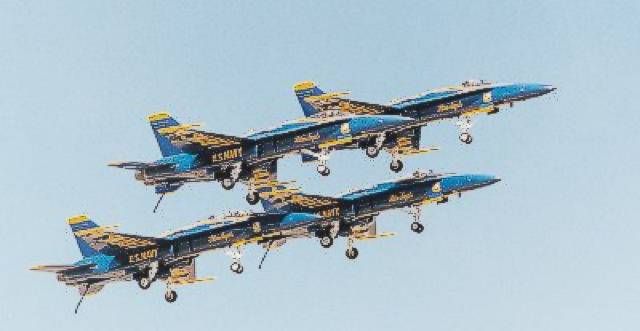
Between races, RARA has assembled a first class group of airshow performers to entertain the crowd. Top billing goes to the U.S. Navy’s Blue Angels, appearing at Reno for the first time in 15 years. Also on the program are Sean Tucker flying his signature “Sky Dance” program, Jimmy Franklin with his jet-powered Waco, Kent Pietsch flying an Interstate Cadet, and the Stoli MiGs.
Day One, Thursday, September 14
Ever imagine blasting around the race course at Reno in a hot airplane, scant feet over the sagebrush, with the wind whistling and the engine roaring full bore? What pilot hasn’t? I never thought I’d get the chance to experience something like what a real race pilot sees, feels and hears, but Thursday I got to fly with Jim Eberhardt in his T-6 Texan after the races were over for the day. I was briefed and strapped into the back seat of the Texan. Jim explained that we would fly north over some hills beyond the race course, and he would show me what it was like flying down near the ground on the course. Then, we’d come back to Stead and fly the T-6 course, but at altitude. We taxied out to the runway, Jim S-turning to keep the taxiway ahead in sight. Cleared for takeoff, the old trainer’s P&W R-1340’s rumble rose to a growl and we accelerated down the pavement, Jim dancing a bit on the rudder and keeping us straight in spite of a gusty crosswind. After liftoff and clearing the runway, we turned north and I could see the entire valley used by the various class courses.
We flew through a pass between some hills and on the other side began to descend and pick up speed into a deserted valley. As we got down to race altitude, about 150 feet, Jim explained that this was a lot like a race start, coming down what is called the chute onto the course. He said that the racers line up abreast of the starter aircraft and, at the bottom of the chute, if the airplanes are lined up properly, the race is on. We leveled off doing a bit over 200 mph and Jim pulled the T-6 into several turns simulating turned around pylons. I’m not sure the G-meter in the back seat was working but I’d guess were pulling about 2 Gs.
The T-6 isn’t the fastest by any means, but with visibility afforded by the big greenhouse canopy and the sound of that thumping radial out front, I can see why pilots love racing these old warhorses. We did a low pass down the runway in front of the grandstand, and too soon, we were short final and landing right into the setting sun. Matt Paxton |
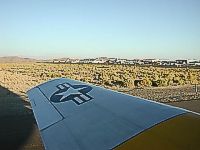 The Unlimited course is the longest at over 8.2 miles, stretching back to the hills north of Stead. The Sports class course is closer in, but still over 6 miles long. The T-6 and Biplane-Formula One courses are shorter still. One result of these four overlapping courses is a large number of pylons scattered out through the sage and sand. To the uninitiated, it is hard to figure which pylons belong to which course.
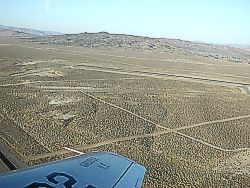 After completing a circle around the deserted valley, we headed back to Stead, where Jim pointed out the pylon the racers turn around first after coming down the chute. We remained at 1,000 feet AGL and pivoted around that pylon, number 5 and then around pylons 6 and 7 to the start-finish line at the home pylon. The turn around pylon 1 is sharp after passing in front of the grandstands onto the east side of the course. Pylon 2 forces a left turn of about 30 degrees on the east side, and then number 4 turns the racer west on the back stretch. The turn at pylon 5 puts you back to where we came onto the course.
Thursday at Reno was the first day of head-to-head competition, and it served only to foreshadow what was to come. The weather was beautiful; sunny and clear with temps around 90, with some added wind later in the day.
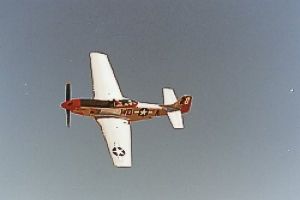 In the Unlimited Medallion heat, Nelson Ezell in his Sea Fury held off Dennis Sanders in Argonaut. Thomas Camp in his Yak 11, Maniyak, was third. Meanwhile, Ike Ens in Miracle Maker was disqualified for forcing a pylon cut. The Bronze heat saw Bill Rheinschild in his P-51 Risky Business run away from a field comprised mostly of Sea Furies. Stewart Dawson was second in his Fury, Spirit of Texas, and close behind him was September Pops with Randy Bailey aboard. In the Silver heat, Dan Martin and his Mustang Ridge Runner jumped out to an early lead and was never seriously challenged. Brent Hisey in Miss America and Howard Pardue in his Sea Fury trailed, and then a second group composed of John Bagley in a Fury, Stu Eberhardt in his Mustang Marlin’s Magic, and Hoot Gibson in Riff Raff kept dueling each other, but never could get close to the lead pack. Eberhardt and Bagley cut the east deadline, an imaginary course boundary, and Eberhardt was disqualified.
Sports class is developing a reputation for exciting competition, and Thurday proved that reputation is being earned. Livio Bognuda won the first heat in a Lancair IV, followed by Jon Sharp in the SX 300, Wright’s Wride. Mike Jones was close behind in a Glasair III. In the second heat, the race got off to a shaky start when three racers declared maydays in rapid succession. The top qualifiers in the class, David Anders in a Venture and Dave Morss in a Lancair IV were both out; Anders flipping his airplane after a hot downwind landing. Anders was not seriously hurt. Michael Dacey also had a problem with his main gear, but the gear held when he set it down on Runway 26. Later, Lou Meyer in the Thunder Mustang won the heat with a speed of over 305 mph, which was a quite respectable speed in the Bronze Unlimited not too many years ago. Lee Behel actually crossed the finish line first in his Questair Venture, but a pylon cut added a 12-second penalty and put him second. Bob Schmidt was third, also in a Venture.
The T-6 class ran two heats on Thursday. In the morning race, Thomas Campau in Mystical Power edged Lee Oman in Four Play by a couple of seconds. Jim Bennett and Tinker Toy were third. In the afternoon, Nick Macy and Six Cat never relinquished an early lead and beat Warlock and Alfred Gross by six seconds. James Good was third.
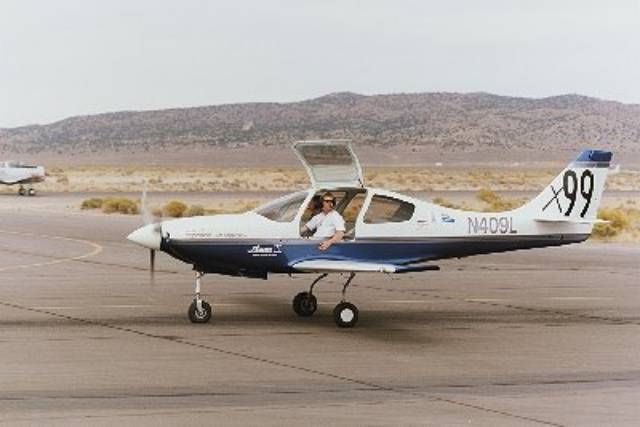 The biplanes ran both their heats in the morning. In the first race, Cliff Magee in Pitts S-1 Tin Buddy won the heat when Mike Taylor in another Pitts was penalized 10 seconds for a pylon cut. Andrew Buehler in his Mong Sport Mistress was third. Chris Ferguson and his Pitts Let The Good Times Roll won the second heat with a speed of 177 mph. Frank Jerant was second, and Bob Blackwood third.
In the first International Formula One class heat, Bobby Budde and El Bandito took first, followed by Carl Swenson in Annie. Ray Sherwood was third in the Okie Stroker. Ray Cote, the class’s top qualifier, won the second heat with a speed of 243 mph. Gary Hubler was second and Scotty Crandlemire’s Cassutt Outrageous was third.
The big airshow event was the midday Blue Angels show. The Blues entertained the crowd for over an hour, and as they were getting out of their F-18s following the completion of their routine, the Air Force Thunderbirds did an unannounced formation pass over the show. Rumor has it that the ‘Birds were on their way to a show in Oregon and took the opportunity to buzz their seagoing counterparts. The Blues will perform daily during the rest of the races. Not so the Thunderbirds…
Day Two, Friday September 15
What a difference a day makes.
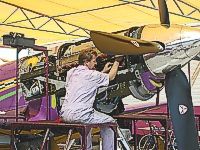 When Friday dawned, the Unlimited Gold field looked to be Dago Red, Voodoo, September Fury – Michael Brown’s new Sea Fury – Strega, Critical Mass, Dan Martin’s Ridge Runner, and possibly Miss America. As the sun dipped below the western horizon at the end of the day, Strega was out with metal in the screens – a possible main bearing failure. September Fury and Miss America didn’t start the Gold heat on Friday. September Fury’s problems appeared to have eliminated it from further competition, but Miss America’s troubles turned out to be only several bad spark plugs. Critical Mass was set to start, but a fuel leak caused Tom Dwelle to shut it down on the ramp. These three popular racers may be able to climb back into the Gold field, but nothing’s assured. So, by the end of Friday, the Unlimited Gold field included Dago and Voodoo, as well as Dan Martin’s Ridge Runner and Stu Eberhardt’s Merlin’s Magic, both close-to-stock Mustangs.
This strange day for the Unlimiteds started with a pretty straightforward Bronze heat, in which Art Vance in an R-4360-powered Sea Fury, Furias, took the lead from the start and held it for the entire six laps of the race. This heat ended with Furies finishing 1-2-3. Nelson Ezell took second and Curt Brown was third in Argonaut. Miss Merced, the newly-restored Fury with the bright yellow with flames paint job, didn’t start.
The Silver heat in the afternoon provided the crowd with a great race between Howard Pardue in his camouflaged Fury and Stu Eberhardt aboard Merlin’s Magic. Bill Rheinschild in his P-51, Risky Business, jumped out to an early lead coming off the start, but pulled up with a throttle control problem in lap four. Pardue and Eberhardt had been just behind Rheinschild, and they battled all the way to the finish, with Eberhardt never able to quite get even, finishing a quarter-second behind. John Bagley in Sea Fury Southern Cross was third. Hoot Gibson aborted on lap one, and his Fury, Riff Raff, appears to be out for the duration with an unspecified problem.
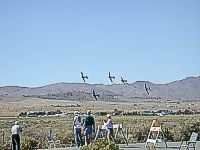 It was the Gold heat late in the day that led to all the movement in the Unlimited Gold field. With Critical Mass, September Fury and Miss America not starting, that left only Dago, Voodoo and Ridge Runner to contend in the heat. Dago won easily, with Voodoo second and Ridge Runner third.
In the Sports class, Mike Jones took the morning heat in Cheeky Charlie, a Glasair III, with a speed of over 275 mph. Tommy Rose in a Lancair was second, closely followed by Earl Hibler in a Glasair. The afternoon heat saw Dave Morss smoke the field with his speedy Lancair, and then be sent to last place because of pylon cuts and a deadline cut. Lou Meyer in the Thunder Mustang was declared the winner, with a very respectable speed of more than 304 mph. Lee Behel in the Questair Venture was second and Will Rittner in anther Venture, Fast Fun, was third.
Even the casual follower of air racing knows the names of the top race planes and pilots. While not exactly household names, Bill “Tiger” Destefani, Skip Holm, Darryl Greenamyer, and Lyle Shelton are known and recognised by anyone familiar with the Reno air races. But, there are a lot of pilots at Reno who aren’t as well known, but who compete most every year. Many of these teams aren’t sponsored by large companies, and the owner, and often the pilot, has to fund some or all of the expenses. Stu and Marilyn Eberhardt, and their sons Bill and Jim race a Mustang and a T-6 at Reno. They don’t have big time sponsors but do get some sponsorship from a Reno area restaurant that caters lunch for the crew and pilots during race week and also from a Reno casino hotel which, among other benefits, provides accommodations for the crew.
After a two-year search, they found a P-51 in Wisconsin, and then waited a year for the dentist-owner to decide to sell it to them. It was a stock Mustang, and even though he had never flown a P-51 before, Stu flew it back to California. The first year they raced at Reno, 1986, they took the Mustang and a station wagon, and had no crew. Now they have a paid crew chief, Steve Lamb, and a cadre of volunteers. The crew gets its hotel room and meals covered. Several years back, the Mustang, named Merlin’s Magic, got its distinctive yellow rudder. The airplane suffered a trim tab failure in a race and it looked like the team was finished for the season. As luck would have it, Old Yeller, then owned by Bob Hoover, had suffered a taxi accident. Hoover lent Merlin’s Magic the rudder off Old Yeller to allow the team to continue to race. As a salute to Hoover’s generosity, the permanent replacement rudder was painted yellow. Hoover later autographed it, and his signature is still visible.
The Eberhardts have many friends among the other competitors and also among fans. Team members help sell T-shirts and also talk about the airplanes with interested fans. The team arrives in Reno on Saturday before the races. This year, they have a new Dwight Thorn-built Merlin race engine in Merlin’s Magic. Both Stu and Bill clocked over 400 mph laps on the Unlimited course, a first for both of them in the Mustang. Jim and the T-6 crew were busy early in the week chasing down a persistent hydraulic leak. With that fixed, the T-6 was hopping rides for guests of their hotel sponsor. Jim wasn’t scheduled to race until Friday. The Mustang was scheduled to run in the Silver Unlimited heat race Thursday afternoon, and Stu chose to fly the race himself. The team thought Merlin’s Magic had a chance to win the heat, and get into the Unlimited Gold field. But at the start, Ridge Runner, Miss America and Howard Pardue’s Sea Fury pulled ahead of the group of Southern Cross, Merlin’s Magic and Riff Raff. Eberhardt wasn’t able to get around Southern Cross without crossing a deadline, or course boundary, and was disqualified on lap 6. It was a disappointing finish for him and the crew. Friday, however, the fortunes of racing ran in the other direction. Stu flew Merlin’s Magic in the Silver Unlimited heat, and ran a good race, coming in a very close second to Howard Pardue. This second place finish, coupled with the inability of several other Unlimited Gold aircraft to start the race, put the team into the Unlimited Gold bracket, a first for the Eberhardts. They have won both the Unlimited Bronze and Silver in past years. Additionally, on Saturday, Jim Eberhardt flew a good race in the T-6, battling for third place in his heat, but getting bumped to last for a pylon cut. After some worries about the Mustang’s engine on Saturday morning, Stu flew Merlin’s Magic in the Unlimited Gold heat Saturday afternoon. He came in fourth, but ran well for a basically stock Mustang. He beat Pardue, Bagley and Dawson and clinched a spot in Sunday’s Gold finals. There was celebrating in the Eberhardt pits Saturday evening. The engine problem, a small crack in cylinder head’s water jacket, was still a worry for the crew and family on Sunday prior to the Gold final. In the Silver finals, Bill Rheinschild won in Risky Business, a fast P-51, and elected to run in the Gold final, increasing the number of racers in the Gold to nine. The field included Dago Red, the top qualifier, Voodoo, Dan Martin’s Ridge Runner, Howard Pardue’s Fury, John Bagley’s Fury Southern Cross, Tom Dwelle’s modified Fury Critical Mass, Rheinschild and Steward Dawson’s Fury Spirit of Texas. Eberhardt had a good start, and was in fourth place as the came by the home pylon to start the first lap. He was able to hold on to fourth or fifth place for almost seven laps, but then he experienced the same throttle problem his son Bill had had earlier in the week. He declared a mayday and got the Mustang safely on the ground. So, race week at Reno ended on a bittersweet note for the Eberhardts. They had gotten Merlin’s Magic into the gold bracket for the first time, and had run well Saturday and Sunday until the throttle problem. On the down side, the new race engine had troubles that needed fixing. Their week at the Reno air races probably mirrored those of many of the teams there which didn’t win their class but were still running the end of the week – both the good and the bad. But, with any luck, they will be back next September, hoping to better their record from 2000. Without such optimism, racing would never have lasted, and it appears to be alive and well at the Reno air races. Matt Paxton |
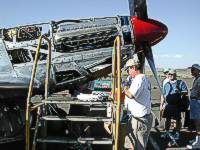 Stu is a retired airline pilot who flew for Pan Am and later Delta Air Lines. He had prior military flying experience and became interested in racing after going to Reno as a spectator. He told Marilyn, “I can do that.” The family had owned airplanes over the years, starting with a glider and moving on to a Cessna 170 and a Stearman.
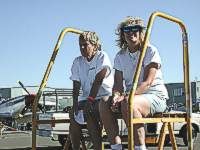 Marilyn Eberhardt says that racing at Reno is a “family thing.” It’s a chance for Stu and Marilyn to be with their sons, Jim and Bill, who both also fly in the races. Jim, a textile business owner, flies the T-6, and Bill, an airline pilot, switches off with Stu flying the Mustang. Marilyn doesn’t fly, and says she is the official support system. She does admit that she worries. A mayday involving a broken throttle linkage while Bill was flying the Mustang earlier in the week was scary, she admitted.
The morning Formula One heat was a great race. Scotty Crandlemire got a great start and was off first, but was overtaken by Gary Hubler in Mariah early on. Ray Cote, the veteran pilot in Alley Cat, edged up on Crandlemire and went high on a pylon midway in the race and passed. Cote wasn’t able to catch up to Hubler, though. In lap seven, Crandlemire’s prop spinner disintegrated and he was out. David Hoover in MacDaddy took third.
John Housley won the second F1 heat in Aero Magic, followed by Carl Swenson and Annie. Holbrook Maslen finally got his replacement engine running well and took third.
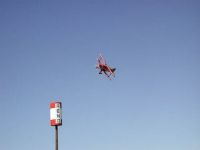 The first Bipe heat went to David Rose in his own design, the Rose Peregrine, Rags. Rose appears to have set a record, winning the race with a speed of over 213 mph. Tom Aberle was second in a Pitts, followed by Stephen Brown, also in a Pitts. Del Schulte won the second heat with his Pitts, Hummbaby, followed by Steve Deckard and Frank Jerant, both also in a Pitts.
In the morning T-6 race, Gene McNeely edged Mary Dilda in Two of Hearts by less than a third of a second. Robert Jones was third. The second T-6 heat went to Alfred Grose in Warlock. Tom Campau was a less than a second behind at the finish and Mary Dilda was third. The Medallion heat was won by Doral Graves in Slo-Yeller. Richard Siegfried was second and Thomas Martin third.
For the second year in a row, the fastest qualifier, Jack Frost’s Frostbite, was disqualified from competition, reportedly for violations of the technical standards of the T-6 class.
Day Three, Saturday, September 16
Saturday at Reno was one of those beautiful Nevada days, with hardly a cloud in the sky. Warm temperatures were accompanied by a cooling breeze, one that became somewhat blustery by late afternoon. The accident gods also smiled, as there were no bent airplanes or hurt pilots. Mechanical problems were also not as frequent as previous days, which saw a number of high qualifiers either bumped to lower brackets for non-starts or put out of competition altogether. One exception was the Blue Angels, who have had to either replace outright or perform repairs to engines on two of their F-18 Hornets while at Reno.
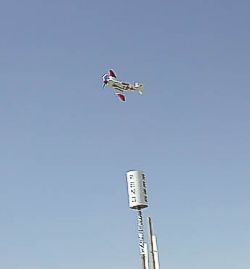 The Unlimited class ran three heats on Saturday. The Bronze, in the morning, was won by Bill Rheinschild in Sea Fury Bad Attitude. Steve Bolander gave him a race for the first few laps, but fell back slightly toward the end. Thomas Camp and his Yak 11 Maniyak was third.
The Silver heat was a critical race for several competitors who had lost seeding Friday because of mechanical problems. Critical Mass, Risky Business and Miss America were all seeking to move up to Gold by winning the heat. Risky Business jumped out to an early lead over Critical Mass, but Tom Dwelle kept the pressure on and Critical Mass, the clipped-wing Sea Fury, took the lead midway in the race. He held on to win with a speed of 423.8 mph. Brent Hisey’s Miss America was third.
The Unlimited Gold race was mostly Dago. Skip Holm jumped out to a lead at the start over Matt Jackson and Voodoo, but Voodoo pulled even and led for half a lap. Dago retook the lead at pylon 2 and never looked back, winning with a speed of over 441 mph. The stock Mustangs – Dan Martin’s Ridge Runner and Stu Eberhardt’s Merlin’s Magic – were three and four, all at over 400 mph for the race. Howard Pardue was fifth, followed by the other two Sea Furies in the race: Bagley’s Southern Cross and Dawson’s Spirit of Texas.
Sports class’s first heat saw Tommy Rose in a Lancair IV defeat Livio Bognuda, also in a Lancair IV. Earl Hibler was third in a Glasair. The second heat in the afternoon started with David Morss zipping out to an early lead in his speedy Lancair, but developing a problem in lap 4, forcing him to land. Lou Meyer in the Thunder Mustang cruised to an easy win at just over 301 mph. Lee Behel was second in the Venture, and Bob Schmidt was third, also in a Venture.
Yesterday’s record-setter in the Biplane class, David Rose, wasn’t able to start in the early Biplane heat, which was won by Stephen Brown in a Pitts. Tom Aberle was second and Jeremy Chelfin third. Mike Taylor won the Bronze, Byron Roberts was second and Andrew Buehler third.
Ray Cote got back on track, winning the first Formula One heat with a speed of over 245 mph. Gary Hubler, who beat Cote yesterday, was second, and David Hoover was third. Scotty Cradlemire’s luck also improved from yesterday, when he suffered a prop spinner failure. He won the second heat. Bobby Budde was second and Holbrook Maslen third.
The T-6s ran two races Saturday. The first heat was won by Nick Macy in Six Cat. Gene McNeely was second and James Good and the Wyoming Wildcatter was third. Carl Penner won the Bronze race over second place finisher Lee Oman. Keith McMann and Jim Eberhardt dueled for third the entire race. Eberhardt held a tight line and McMann and Red Knight weren’t able to get by on the outside. Eberhardt cut a pylon in lap 1 and McMann was awarded third place.
Day Four, Sunday, September 17
Sunday at the Reno Air Races – the big day, the day the fat lady sings, the day all the class finals are run, including the grand finale, the Unlimited Gold.
But, there are often some great air races during the day in the other classes, and even in the Bronze and Silver Unlimited class. The Biplane Gold was a good example of a great race in another class. The bipes start from a standing start and fly to the first pylon. Tom Aberle jumped out to an early lead at pylon 1, with Stephen Brown in Tonopah Low second. Top qualifier and record-setter David Rose was third. Rose ran a masterful race, picking off Tonopah Low and then challenging Aberle in Class Action. Rose stayed high and slowly gained on Aberle until he converted his altitude to speed on the back straight and passed midway in the race. He maintained his lead, flying a good line and won the Gold with a speed of 209.434 mph. Aberle was second and Brown third.
In the Biplane Silver final, Jeremy Chellin won, Jeffrey Lo was second and Charlie Greer took third. All three top finishers flew Pitts.
 International Formula One Gold finals were held mid-morning, and, like the Biplanes, the favorite had to battle for the win. Ray Cote in Alley Cat came from behind, beating Gary Hubler in Mariah by four seconds. David Hoover was third.
John Housley won the Silver final in Formula One in Aero Magic, Holbrook Maslen was second and Carl Swenson was third.
Nick Macy in Six Cat repeated as T-6 Gold champion, beating Tom Campau in Mystical Power by a second. Alfred Gross in Warlock was third. The T-6 Silver final was won by Lee Oman in Four Play. Jim Bennett in Tinker Toy placed second and Robert Jones was third.
David Morss also was a repeat winner, taking the Sports class Gold in his Lancair IV, with a blistering speed of 328.045 mph. His was a difficult week in which he almost didn’t qualify for the event at all. On Wednesday engine problems forced him to abort takeoff during his qualifying run, but race officials said they’d give him another chance bright and early Thursday morning. After a long night of work, the engine was fixed-but on Thursday morning, when Morss and his crew got to the hangar, it was locked. Fortunately, they were able to break in and Morss was able to qualify. However he had to abort his Saturday heat when a gap seal between the wing and fuselage fell off the aircraft. Again the plane was fixed, but in the gold competition Sunday, Morss declared another emergency just after crossing the finish line. Fortunately he was able to land the plane safely. Lou Meyer was second in the Thunder Mustang at 312 mph and Lee Behel took third in the Questair Venture.
In the Sports class Silver finals, Dan Wright flew his SX300 to victory with a speed of 279.981 mph.. Jon Sharp flew some of the earlier heats in Wright’s airplane. Mike Jones was second in a Glasair III, Cheeky Charlie, and Arnis Luters placed third, also in a Glasair III.
The Unlimited Bronze went off late morning, and Miss Merced, the brilliant yellow with flames Sea Fury cruised to an easy win, averaging 388.403 mph. Ike Enns’s P-51 Miracle Maker was second and Thomas Camp third in Maniyak.
 The Unlimited Silver race was one with much at stake for several contenders. Because of non-starts, Miss America and Risky Business, both Gold-bracket airplanes before Saturday, needed the win to move back into the field for the Unlimited Gold final. Bill Rheinschild took Risky to the front of the pack from the chute and pushed the P-51 hard. Brent Hisey tried to keep up but never could close the distance. Risky took the win, and Rheinschild opted to forfeit the Silver prize and bump up to the Gold race. Miss America, second across the finish line, therefore became the Silver Unlimited Champion. Randy Bailey and the Sea Fury September Pops was third in the race and Nelson Ezell’s Sea Fury was fourth.
The Unlimited Gold had nine racers going down the chute. Dago Red pulled out to an early lead with Voodoo a second behind. Skip Holm kept the hammer down, but Voodoo tried to make a move in the fourth lap. Matt Jackson pulled Voodoo up around the back of the course, but couldn’t convert enough to pull even with the red P-51.
Instead, the action in the Unlimited Gold was back in the pack. Around the home pylon starting the first lap, Dan Martin’s Ridge Runner was in third, followed by Stu Eberhardt in Merlin’s Magic and Tom Dwelle’s Critical Mass. Critical Mass moved up on the first lap into third, and held onto third for the rest of the race. Ridge Runner maydayed on lap 6 with a smoking engine, and Merlin’s Magic was out on lap 7 with a broken throttle control bracket. Dago cruised to victory for the third straight year, albeit with a different pilot, followed by Voodoo and Critical Mass. Average speed for Dago was 462.007 mph.
Official results were delayed by the filing of a protest involving an improper start by Voodoo. As a result of the protest, Voodoo was penalized one lap, which dropped it to fifth place. So, the official finishes became: Dago first, Critical Mass second, Risky Business third, and Howard Pardue’s Sea Fury fourth.
 After the race, the starter T-33, an L-39 Albatross, the Stoli Mig 17s and Jimmy Leeward’s MiG 17 put on a jet race demonstration around the unlimited course. The crowd loved Leeward’s afterburning MiG, which threw out a 30-foot flame, and pushed him into a large lead. Eventually, he came out of burner, and the Stoli MiGs closed the distance. The run wasn’t official in any way, but if crowd reaction is any indication, jet racing at Reno would be a success.
Following the jet demo. Skip Holm was to try to break the elusive the 500 mph lap barrier, which has never officially been reached at Reno. He took off, but almost immediately declared a mayday and landed with engine problems severe enough to cause him to shut down Dago’s engine on the roll out.
All in all, Reno 2000 must be measured as a success. Attendance figures are unavailable at press time for Sunday, but Saturday’s crowd was reported to be a record. There were no serious injuries or deaths this year, and race fans were treated to some excellent races, particularly within the fields of some of the heats.
Don’t miss AVweb‘s exclusive collection of images
from the National Championship Air Races 2000
