





Myfirst exposure to “serious” simulator training took place in October of 1987,about six months after I’d purchased my T310R. My motivation was the usual one: insurance.Despite the fact that I had 180 hours in type, 4,000 hours total, and 23 years ofaccident-free flying behind me, I was having a heck of a time finding aircraft insuranceat reasonable rates. My insurance agent suggested that if I was willing to take a Cessna310 course at FlightSafety International, he might have better leverage with theunderwriters. Although the tuition was quite expensive, I rationalized that most of thecost would be offset by reduced aircraft insurance premiums and reduced wear and tear onmy airplane. I needed to renew my instrument currency anyway, and the opportunity to flyFlightSafety’s full-motion full-vision twin-Cessna simulator sounded exciting. So Idecided to do it.
I wrote a detailed chronicle of that experience (Trainingat FlightSafety) because it was a watershed event in my flying career. I’dconsidered myself a reasonably proficient pilot, but that initial experience in thesimulator was truly humbling. I had no idea just how poorly my previous in-aircrafttraining had been in preparing me to handle real-life emergencies. By the time the threedays were over, I became convinced that anyone who flies a multiengine aircraft withoutthe benefit of regular simulator-based recurrent training is an accident waiting tohappen. Since then, I’ve returned for regular sim training every six months.
What’s wrong with in-aircraft training?
Until you’ve gone through serious simulator-based training, it’s hard to appreciatejust what a poor training platform your aircraft is. The sim allows you to be trained todeal with nearly any conceivable emergency situation. Perhaps a third of the malfunctionsand emergencies we train for in the sim cannot be done in the aircraft, either becausethey’re impossible to duplicate (e.g., overvoltage trip, induction system icing, propelleroverspeed, left main gear won’t extend) or are simply too dangerous to practice (e.g.,engine failure immediately after takeoff, flying with a heavy load of airframe ice).
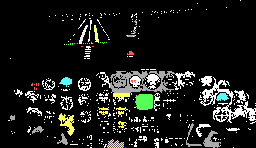 Other situations that we do try to practice in the aircraft can beaccomplished only in very unrealistic ways. Shooting approaches under the hood is woefullyinadequate preparation for doing the same thing in actual low-visibility conditions. Themost difficult parts of doing this in a single-pilot cockpit – scanning between thegauges and the windshield and deciding whether or not adequate visual references areavailable to make the landing – are never practiced at all. The dismal G.A. accident rateduring low-viz approaches, particularly at night, is a testament to the inadequacy of ourtraining.
Another example: it’s one thing for an instructor to slap a No-Peekie over the attitudeindicator, and quite another for the horizon to gradually develop the “leans”and then subsequently start thrashing around to the point of distraction. Anon-sim-trained pilot may have logged lots of partial panel instruction, yet be entirelyunprepared to cope with an actual gyro failure that presents itself not with a bang but awhimper.
A good simulator allows you to train for these and many other real-world challenges ina highly realistic setting. It may seem odd, but in the ways that really count, simulatortraining is far less contrived and far more “real” than training in an aircraft.
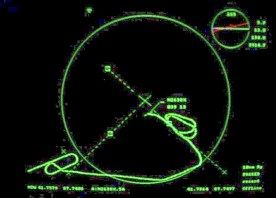 A simulator also provides a far more efficient trainingenvironment than an aircraft. You and your instructor don’t waste valuable time in taxiingout, waiting for an ATC release, or flying to the practice area or to an airport where thedesired approach is available. In the same time it takes to fly an instrument approach inthe aircraft and fly back to the FAF, you might do three, four or five approaches in thesimulator. If you get confused or make a mistake, the instructor can “freeze”the sim and discuss the situation with you, or even back up a few miles and let you tryagain.
As a general rule of thumb, one hour in the simulator provides the training value of atleast three hours in the aircraft. Sim training is such an intense experience that mostcurricula limit pilots to two hours of left-seat time per day. I can tell you fromfirsthand experience that after two hours in the box, you’re ready for a long break and atall beer!
Finally, in-aircraft training tends to be a lot tougher on your aircraft than normaloperations. Stalls, slow flight, missed approaches and especially engine cuts can generatea lot of wear and tear on the equipment. If you want to stay proficient while at the sametime treating your aircraft with TLC, you should seriously consider doing your recurrenttraining in a simulator…or in someone else’s aircraft!
Where to get recurrent sim training
Although a number of flight schools throughout the United States use simulators intraining pilots for certificates and ratings, there seem to be only three companies thatspecialize in sim-based recurrent training for pilots of piston-powered aircraft:FlightSafety International, Simcom Training Centers, and Recurrent Training Center.
FlightSafety International
 Founded in 1951, FlightSafety pioneered the use of flightsimulators in pilot training, and has grown into a huge enterprise that operates somethree dozen “learning centers” across the U.S. and Europe. The vast majority ofFSI’s resources are devoted to training airline and corporate pilots for jet and turbopropaircraft – piston training represents a very small portion of their business.
FlightSafety operates a Raytheon/Beech Learning Center in Wichita, Kansas, at whichsimulator-based initial and recurrent training is available for the Beech Bonanza, Baronand Duke. The Cessna Learning Center (also in Wichita) offers sim training for the Cessna210, 310, 340, 402, 404, 414 and 421. Cessna 300/400 training is also available at FSI’sfacility in Long Beach, California. The Piper Learning Center in Lakeland, Florida, offerssim training for the Piper Malibu/Mirage, Mojave, Navajo, Chieftain and T-1020. (FSI alsooperates a Mooney Learning Center in San Antonio, Texas, but no simulator training isavailable for Mooneys.)
As you might expect, FlightSafety’s training is extremely professional, highlystructured, and quite expensive. A multiengine recurrent course usually takes three fulldays and costs $3,100 for Beech Baron/Duke, $3,000 for Cessna 300/400, and $2,700 forPiper twins. Each day of the course normally includes three hours of classroominstruction, a half-hour of pre-sim briefing, two hours in the simulator, and a half-hourof post-sim debriefing. That may not sound like a lot, but I can assure you that it’s avery intense training experience, about all a person can assimilate in one day.
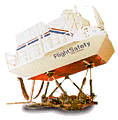 FlightSafety’s piston twin simulators are exceptionally good. Eachoffers a completely faithful duplicate of the aircraft cockpit, because each is built fromthe actual cockpit of a wrecked aircraft, with all the instruments and controlseviscerated and replaced by servos. The sims offer full motion and dynamic controlloading, both accomplished via hydraulic actuators. Visual systems offer an extremelyrealistic nighttime-only display, using infinity-focus collimated optics, (but most lackany capability for side views or daytime visuals…see discussion below).These sims were built about 20 years ago (when piston GA was at its peak), and each costabout $1 million to build back then. We’re lucky that FSI built these sims back then,because simulators of this caliber and cost could never be justified in today’s businessclimate.
Single-engine offerings include a two-day Cessna 210 refresher course ($1,200), athree-day Beech Bonanza refresher ($2,500), and a three-day Piper Malibu/Mirage recurrent($1,900). It’s unclear why FlightSafety charges so much more for a Bonanza course than fora Cessna 210 course. The single-engine sims are less than 10 years old, and have electriccontrol loading and no motion.
In addition to the type-specific courses, FlightSafety offers three “generic”instrument refresher courses that concentrate on instrument flying subjects (weather,chart reading, ATC procedures, etc.) instead of aircraft-specific systems knowledge. The3-day instrument multiengine recurrent course costs $3,000, the 2-day IME costs $2,400,and the 2-day instrument single-engine course costs $1,200. For pilots who trainregularly, alternating between the type-specific recurrent and the instrument recurrentcourses provides a well-rounded program.
The prices quoted above are FlightSafety’s 1998 “One Time” tuitions. Thereare also a number of alternative pricing plans for pilots who train regularly with FSI:
- “One Time Plus” is a reduced tuition for pilots who have taken the same course within the previous 12 months, and is between 15% and 25% less than the One Time price (depending on aircraft make).
- “Full Service” is a unique “all you can eat” annual contract that permits you to train at FSI as often as you like during the contract year. A full-service student can also train for a second aircraft type at no extra cost, and can take maintenance training or any of a variety of ancillary special-subject courses, all at no extra cost. The annual cost is about 60% higher than the One Time tuition, and the minimum contract period is two years. For example, a full-service contract for Cessna 300/400 costs $4,700 per year.
- “Partner Pricing Program” provides reduced tuition for two pilots who train together, taking the same FSI course at the same place and time. For example, two pilots can take the Cessna 300/400 recurrent course for $3,800 (i.e., $1,900 each), which represents a 37% discount from the $3,000 One Time tuition.
- “Volume Incentive Plan” enables a customer to purchase multiple prepaid “VIP Certificates” at a discount rate, each redeemable for one course tuition. The certificates may be used to train multiple pilots, or one pilot multiple times. For the Cessna 300/400 recurrent course, for example, you can purchase 3 VIP certificates for $2,000 each, 4 or 5 certificates for $1,900 each, or 6+ certificates for $1,800 each.
Until about ten years ago, FlightSafety was pretty much the only game in town forprofessional-caliber simulator-based recurrent training for piston-powered aircraft.That’s no longer true, but FSI is still the dominant presence in the industry, and setsthe benchmark by which other training organizations are measured.
Simcom Training Centers
 Simcom was founded about a decade ago to provide alower-cost alternative to FlightSafety for piston twin pilots. Unlike FlightSafety,Simcom’s core business is piston and low-end turbine training for owner-flown aircraft.Originally, Simcom offered training only at one location – Orlando, Florida – but in1996 they opened a second training facility at Scottsdale, Arizona.
After nearly ten years of training at FlightSafety, I decided to try SimCom for achange of pace, and have gone through two semiannual recurrent training cycles at SimCom’sScottsdale facility. SimCom offers simulator-based training for the Beech Baron and Duke,Cessna 300/400 twins, and Piper Aerostar, Mojave and Navajo. (They also offer turboproptraining for the Beech King Air, Piper Cheyenne, and Pilatus PC-12.) I found that SimComoffers the same sort of professional-caliber sim training as FlightSafety, but with a fewsignificant differences.
SimCom’s prices are at least 25% lower than FlightSafety’s. For example, Simcom chargesabout $2,200 for a three-day Cessna 300/400 recurrent course (compared with $3,000 atFSI), and $1,450 for a two-day generic multiengine instrument refresher course (comparedwith $2,400 at FSI). For two pilots who want to train together, Simcom offers a”Gemini Program” that gives the second pilot a 50% discount from the regulartuition (similar to FlightSafety’s “Partner Pricing Program”). During the summerbetween June 1 and August 30 (which are SimCom’s slow months), the second pilot gets awhopping 75% discount.
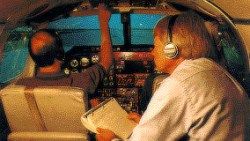 SimCom is a much smaller company than its behemoth competitor, andthis seems to be reflected in a more informal corporate culture. Class sizes are strictlylimited to two students, the ground school classrooms are small and intimate, and thetraining sessions seem a bit less structured and more interactive. At SimCom, you aretypically assigned one instructor for the entire duration of your course, and thatinstructor handles both the classroom and simulator portions of the syllabus; atFlightSafety, it’s common to get different instructors for ground school and simulator.The instructors at SimCom also tend to teach multiple airplanes – your twin Cessnainstructor might well have taught a King Air class the day before – while FlightSafetyinstructors tend to be more specialized. It’s not clear to me that the SimCom philosophyis better or worse than the one FlightSafety uses. It’s just different.
Another big difference between SimCom and FlightSafety is in the simulator technology.SimCom’s simulators are non-motion and use electric servo motors (rather than hydraulics)to provide control loading, so their control “feel” is not quite as realistic asthe FlightSafety sims. I also found them to be a bit less faithful in simulating variousaircraft systems failures. On the other hand, SimCom simulators offer a panoramicprojection-type visual system that permits daytime visuals and allows circling maneuversand other visual-reference maneuvers that are impossible to train for in the FlightSafetysims.
 If FlightSafety is the Rolls Royce of piston sim training and Simcom is theLexus, then Recurrent Training Center would have to be the Ford pickup or the Dodgeminivan. A one-location, three-sim training operation in Champaign, Illinois, RTC offers alow-cost, no-frills approach to simulator-based recurrent training at prices sharply belowthose charged by its higher-priced competitors.
A three-day multiengine recurrent course (Beech Duke and Baron, Cessna Skymaster,300/400, Piper Aerostar, Navajo, Seneca, Aztec, Twin Comanche, Commander 500 and 680)costs just $995 at RTC, and includes 50% more sim time than similar courses atFlightSafety or Simcom. An annual contract consisting of two semi-annual visits to RTC -a three-day recurrent course followed by a two-day refresher six months later – costs$1,585. For single-engine pilots (Beech Bonanza, Cessna 210, Mooney, Piper PA28 and PA32),RTC offers a two-day recurrent course for $785, or a two-visit annual contract for $1,335.
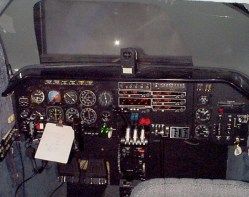 RTC keeps its prices so low by cutting costs every way it can. TheChampaign training facility is housed in an off-airport storefront building that RTCshares with a travel agency, and is functional but hardly plush. RTC’s sims are genericAST 300 twin-engine simulators that are not set up to duplicate any particular aircraft.The ground school component of RTC’s courses is largely on videotape, allowing RTC to getby with a smaller instructor staff. And when you arrive at RTC for training, they don’tgive you a personalized laminated nametag or a 200-page looseleaf binder or a customizedcanvas tote bag. You just sit down unceremoniously and get to work.
Appearances aside, how does RTC’s recurrent training compare with FlightSafety orSimcom? Well, it’s different. Because RTC’s sims are generic ones that don’t attempt tofaithfully reproduce the systems of your aircraft, the RTC curriculum doesn’t spend muchtime on aircraft-specific systems failures the way that FlightSafety’s and Simcom’s do.Instead, RTC’s training places its major emphasis on pilot decision-making and dealingwith the ATC environment.
 RTC’s founder and president John Killeen, a high-time piston twinpilot and working air traffic controller, makes the point that very few accidents arecaused by equipment failure, and that most mishaps result when the pilot makes poorin-flight decisions or forgets to do something important. Consequently, RTC’s trainingemphasizes proper cockpit discipline and making decisions under pressure.
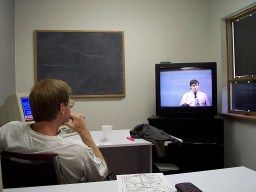 Every sim session at RTC is structured as an actual IFR cross-country flight. You startout by studying a printed weather briefing, reviewing the applicable approach and enroutecharts, and then climbing into the sim and flying the trip. Naturally, the flight nevergoes as planned, and you are confronted with various challenges: unforecast weather,aircraft failures, navaid outages, runway changes, ATC delays, etc. Your sim instructorevaluates how you deal with these problems, and points out areas in which yourdecision-making and contingency planning and use of available resources might have beenbetter. Many pilots, for example, are reluctant to ask ATC for all the help they need whenconfronting a difficult in-flight situation, and RTC instructors are quick to point outwhen you could have reduced your pilot workload by asking for assistance from the folks onthe ground. This is the sort of training that the airlines call LOFT (Line-Oriented FlightTraining), and is a significant departure from the sort of recurrent training offered byFlightSafety or Simcom. I found it extremely useful.
So did my friend Chris Wrather, a 1,500-hour pilot andBonanza owner, who accompanied me to RTC for his first taste of sim-based training. Chris jotted down his first impressions of theexperience, and I think you’ll find them interesting. AVwebpublisher Carl Marbach also wrote up his impressions after he went through recurrenttraining at RTC for his Aerostar 601l.
NOTE: In 1998, FlightSafety introduced a new “Operational Recurrent”course in its Cessna 300/400 program that offers a similar LOFT emphasis. I’ve not yet hadthe opportunity to take this course.
The sims: what’s important…and what’s not
Motion
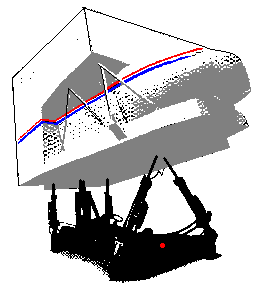 FlightSafety offers full-motion sims, while Simcom and RTCdo not. Many pilots seem to believe this is a big deal. For example, when FlightSafetyfirst shipped one of its two Cessna 300/400 simulators to its Long Beach (Calif.) learningcenter, the sim didn’t have a motion base. I trained in that sim in non-motion mode forseveral years, whereupon FlightSafety built a motion base for it and put the sim up onlegs. I didn’t find that the addition of motion added any significant training value tothat simulator. Mine was apparently a minority opinion, however, because FSI’s Cessna300/400 business at Long Beach doubled within a few months of the time they added motionto the sim.
Although full-motion sims have a lot of sex appeal, I’m convinced that having motion isnot at all essential in terms of training value. It’s a bit more difficult to fly anon-motion sim (because you receive fewer cues), but one could argue that this results ingreater pilot proficiency rather than less.
Visuals
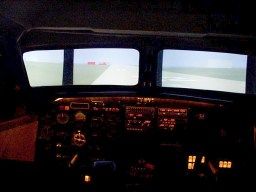 The vision system is a differentmatter. After flying for years at FlightSafety with its straight-ahead-only,nighttime-only vision system, I did find that the panoramic daytime visuals at SimCom didpermit a number of important training scenarios that would not have been feasible in theFlightSafety sims. In one instance, I had to deal with a total electrical failure justafter a nighttime takeoff, and had to visually circle back to the airport in a totallyblacked-out cockpit. In another particularly valuable scenario, the instructor simulatedan in-flight fire necessitating an off-airport landing on a freeway. SimCom’s trainingalso included circling approaches under low-visibility conditions.
FlightSafety has apparently taken note of this. Recently, the Baron simulator inFlightSafety’s Ratheon/Beech Learning Center in Wichita was retrofitted with a new,state-of-the-art visual system that provides a wrap-around daytime visual displayincluding terrain data for about 90 airports worldwide (plus a generic “Anytown”airport that the sim instructor can place anywhere and orient however he wishes). Ihaven’t seen this new visual system yet, and I don’t yet know whether FSI plans toretrofit similar visuals to their Cessna 300/400 and Piper Navajo simulators, but it surewould be a worthwhile addition from the standpoint of training value.
Fidelity to your aircraft
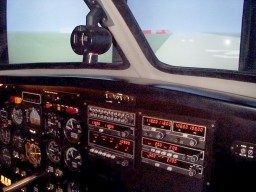 How about the fidelity with which a simreproduces the cockpit layout, control feel and systems of the aircraft you fly? On thisscale, FlightSafety has a clear lead, with Simcom offering somewhat less fidelity, and RTC(with its generic sims) trailing at a very distant third. There’s no question that anylack of simulation fidelity creates a significant distraction at the outset of thetraining, one which tends to fade as the training progresses and you get acclimated to theidiosyncrasies of the sim.
In the case of RTC’s generic AST 300 sims, it’s probably best to approach with amind-set of learning to fly a new aircraft, rather than thinking of the sim as a Cessna orPiper or Beech and then getting distracted by its lack of fidelity to the actual aircraft.In any case, by the second or third hour of sim training, you’ll find that you’ve prettymuch tuned out the differences between the sim and the aircraft and are fully immersed indealing with the “meat” of the training scenarios that confront you.
Incidentally, when I trained at RTC in April 1998, they were in the process ofinstalling a new-generation “Phoenix” simulator from AST that promised to offersignificantly better fidelity and visuals than the AST 300’s. I flew the new sim briefly,but it wasn’t quite “ready for prime time” so I did all of my serious trainingin the AST 300.
Is sim training worth the cost?
An annual cycle through FlightSafety, Simcom or RTC costs between $1,000 and $3,000 intuition plus at least several hundred bucks more in travel, lodging and meal expenses.Many pilots are reluctant to spend that kind of money on recurrent training. But I’mabsolutely convinced that it’s well worth the cost.
Training flights are relatively abusive on your aircraft, especially if it’sturbocharged. By eliminating 15 or 20 hours of training flights a year, it’s easy to saveseveral thousand dollars in operating and maintenance expenses, not to mention wear andtear.
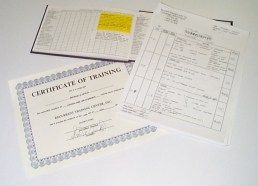 Your insurance company will be ecstatic that you aredoing this sort of training, and will almost always express its ecstasy through reducedaircraft insurance premiums. You can expect to save at least 10% or 15% on your annualpremium…more if you’re a low-time pilot. In more and more cases, your underwriter maynot be willing to insure you at all unless you go through an approved recurrent trainingcourse on an annual basis.
What value do you place on your life and the lives of your passengers? Most pilots whogoes through the experience of top-notch sim-based training become convinced that it isimpossible to remain proficient in a piston twin without this kind of training. Accidentstatistics back this up: pilots who get regular sim training are far safer than those whodon’t. Unfortunately, it’s the pilots who have never experienced such training (andunfortunately this includes the great majority of owner/pilots) who don’t know whatthey’ve been missing.
Finally, training in a good simulator is a helluva lot of fun. I always look forward tomy recurrent training cycles with great anticipation. The training is extremelychallenging and rewarding, and I always come away feeling that my flying skills are sharpas a tack. When that feeling starts to fade, it’s time to schedule another cycle.
Recommendations
Each of the three training facilities provide excellent training, and each offersvarious specific advantages over the others:
- FlightSafety‘s simulators offer unparalleled fidelity in reproducing your aircraft’s cockpit layout, control feel, and equipment failures of all sorts. They’re full-motion sims (if that turns you on). FlightSafety also offers the best aircraft-specific systems training, in my judgement. Of course, the price for all this is rather stiff.
- Simcom’s simulators are a bit less faithful than FlightSafety’s, but have panoramic daytime visual systems that offer unique advantages in training for circling maneuvers and other emergencies in which visual references are decisive. Simcom’s systems training is very good, and the tuition is about 25% less than FSI’s high-priced spread.
- RTC’s generic AST 300 sims have the lowest fidelity of the group, their aircraft-specific systems training is weak, and their ground school segments are largely on videotape. But RTC’s recurrent courses offer more hours in the sim for a lot less money, and a LOFT curriculum that provides far greater emphasis on cockpit discipline and in-flight decision-making than the other two training vendors.
I trained atFlightSafety for nearly ten years and – while their training is absolutely top-notch byany measure – after a while I started to feel as if I’d reached the point of diminishingreturns. It was that “been there, done that” feeling. So for the sake ofvariety, I trained at Simcom a couple of times, and most recently I went through thetraining at RTC. In each case, I came away with something different and valuable. Myconclusion is that if cost and distance were no object, the best possible trainingstrategy might well be to rotate among the three firms in order to obtain the best thateach one has to offer.
