
















Although nowadays I usually fly with my BoseANR headset, I still have the first aviation headset I ever bought: a venerable DavidClark H10-40 that I bought back in the 1970s, now covered with scratches earned duringmany years of faithful service in the cockpit. It has new gel ear seals, but has beenrelegated to back-up and passenger use since I switched to noise-canceling headsets in thefront office.
Recently, I became intrigued by the $169 active noisecancellation retrofit modules offered by Headsets, Inc., because it seemed as if itmight be nice to be able to offer my passengers some (if not all) of the advantages I havewith my expensive ANR headsets in the front seats. I also liked the thought of takingsomething that has done its job well for many years and making it new again.
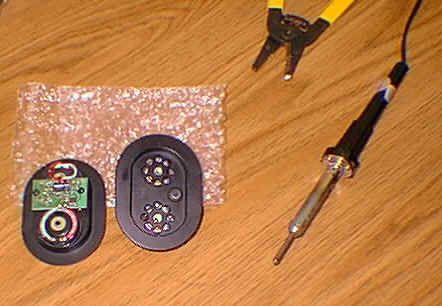 In an earlier life, I built a lot of electronic kits purchased from(now-defunct) Heathkit of Benton Harbor, Michigan, including two color televisions,several radios, amplifiers and some test equipment. I also built two portable intercomsfrom kits obtained from RST in Grass Valley, California. So although it had been awhilesince I used a soldering iron, I felt reasonably confident in my ability to install theANR conversion kit myself (rather than paying an extra $50 to have it factory-installed).In addition to a soldering pencil, my toolbox also includes a digital volt-ohmmeter, whichturned out to be invaluable during subsequent troubleshooting. If you find electronicsintimidating, you might want to send your headset to Headsets, Inc., and have them installthe kit for you.
Figuring out what to do
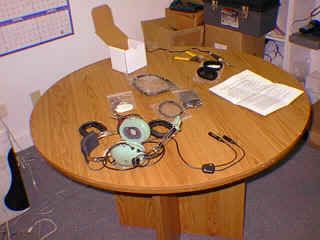 When my kit arrived, I opened the carton and spread all thecomponents out on the table. Compared to my first Heathkit, this looked easy. Theinstructions, however, were complicated and required a couple of passes before they madecomplete sense to me. The problem is that Headsets, Inc.offers their retrofit for a very wide range of headset models (all David Clark headsets,plus those from Telex, Peltor, Flightcom, SoftCom, Sigtronics, Pilot Avionics, RST,Hush-a-Com, AV-Comm, etc.), and the instruction sheets try to cover all of them. Some ofthese headsets have dual volume control, some have a single control, and others have novolume control at all. Some are wired for stereo, some aren’t. Different manufacturers usedifferent wiring schemes and color codes. In attempting to cover all possible cases, theinstructions are more difficult to follow than they should be.
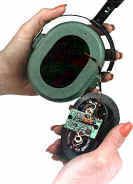 But after some study, it became clear what had to be done. Each of the twoANR modules in the kit must have three wires connected to it: audio, power and ground.Once you understand this, and determine which of the various alternative wiring schemesyour particular headset uses, it’s easy to figure out how to hook up the kit. Theimportant thing is to take plenty of time to look over the directions and think everythingthrough before you start cutting, drilling or soldering anything.
Most headsets have a cord that goes to one earcup, and a crossover cable that connectsto the opposite earcup. The ANR kit requires that the crossover cable have at least threewires (for audio, power and ground). Stereo headsets and those with dual volume controlsrequire more than three wires. As it happened, my David Clark had only one volume controland was not wired for stereo. Its crossover cable consisted of two wires plus a braidedshield, and that turned out to be sufficient. For headsets that don’t have enoughconductors, the Headsets, Inc. kit includes a newcrossover cable. Count on using it if your headset has dual volume controls and/or stereo.
Installing the kit
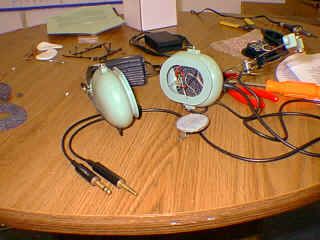 The first step in the actual installation process is to removethe old speakers and some of the sound-absorbing foam from the earcups. Discard thespeakers, but retain the foam and be sure to put back as much as you can so that thepassive attenuation characteristics of the headset are not adversely affected by theconversion.
Next, you must drill a quarter-inch hole in one earcup (the one with the cord) so youcan add the power cable required by the ANR modules (plus a rubber grommet to protect itfrom chafing). The new power cable will be tie-wrapped to the existing audio cord, and itsother end hooked to the battery pack supplied with the kit.
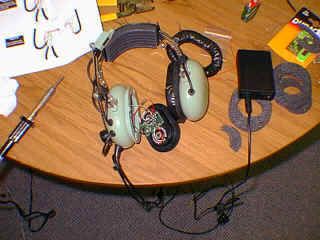 Now comes the installation of the two new speakers with theirattached noise canceling electronics. You’ll have to solder three wires to each module(that’s right: audio, power and ground). To do this, you’ll probably have to do a littlesplicing of wires so that the three can also be routed to the opposite earcup via thecrossover cable. There are more wires to worry about in dual volume control and stereoheadsets, but each speaker module still gets only three connections: audio, power andground.
My best-laid plans…
I carefully installed everything according to the instructions. Ithen installed fresh batteries, donned the headset, and flipped on the power switch. Uhoh! No active cancellation on the left side. (You should hear “the sound being suckedout of your head” when you power up the cancellation circuitry. In my headset, Iheard it on one side only.)
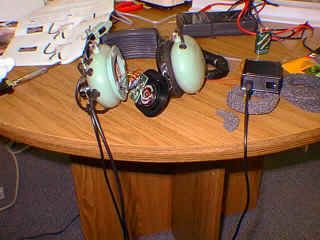 I phoned Headsets, Inc., and my call was routed to atechnician who led me through some troubleshooting steps with my volt-ohmmeter to verifythat there was continuity through the crossover cable (there was) and that both moduleswere receiving power from the 9-volt battery pack (they were). The inescapable conclusionwas that one of the two noise-canceling modules was bad. “I checked those myselfbefore I shipped them out,” he told me. “I’ll send you a replacement ASAP.”
Two days later, the replacement module arrived. I soldered it in place and repeated mytest. This time, the noise canceling worked perfectly.
Flight testing
After flying with Bose ANR headsets for years now, the passive noise attenuation of theDavid Clarks seem fair at best. Even with DC’s latest gel earseals, the headset lets a lotof low-frequency noise through – so much that in my Aerostar or my friend’s Aztec, Ifound the sound level on takeoff to be downright uncomfortable.
But with the Headsets, Inc. kit installed and theactive cancellation turned on, the Aerostar and Aztec both became very quiet. Frankly, thedifference in sound level between the modified David Clarks and my $1,000 Bose headsetsseemed hardly noticeable. I was quite surprised.
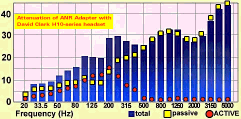 The company claims the retrofit kit provides 15 to 17 dB ofactive noise cancellation. Bose claims 20 dB or better, and 3 to 5 dB is a big difference.Why didn’t I notice it? Probably because a David Clark headset has substantially betterlow-frequency passive noise attenuation than does the Bose. (Frankly, mostdesigned-for-ANR headsets are pretty noisy with the ANR turned off.) The difference inpassive attenuation would explain why the modified DC seems very nearly as quiet as myBose. Keep in mind that I don’t have any fancy decibel-measuring test equipment…I’m justtelling you what my ears and brain told me.
Another friend flies a Cessna 310 and uses David Clark’s new lightweight H10-13.4headset. I let him try out my modified old H10-40 set. He was extremely skeptical beforethe flight, but afterwards told me that he’d decided to order a Headsets, Inc. kit to install on his H10-13.4. I’d guessthat the 13.4 with the ANR kit would be provide an excellent combination of comfort andnoise cancellation. I’m looking forward to trying it once he installs the mod.
Quiet isn’t everything
There are three important factors in selecting a headset. One is noise reduction (viapassive attenuation and/or active cancellation). On this score, my modified David Clarkheadset stacks up quite well. If it isn’t as quiet as my Bose, it certainly seems 80% to90% as quiet.
A second factor is fit, feel and comfort. These are very personal and subjective items.The Headset, Inc. kit does nothing in this area. If youconsider your passive headset to be uncomfortable, it will be just as uncomfortable afteryou install the mod. If you like how it feels, you’ll like it just as much after themodification. If the headset you are thinking of modifying is one you’ve used for sometime, you have a pretty good idea how it fits.
To decide if a headset fits well and feels comfortable requires that you wear theheadset for a long period of time. I have found that I can wear mine for 3-4 hours beforeI start to think about when it will come off. On the other hand, my wife can wear a DavidClark headset for all of about 45 seconds before ripping it off her head and announcingthat she could never wear this thing…and besides, look what it does to herhairdo! She insists on wearing a featherweight Plantronics earset that puts a tube in oneear and an earplug in the other. The Plantronics offers next to no noise attenuation atall, but it weighs next to nothing and you hardly know you have it on. Like I said, thisis a very personal and subjective area.
Finally you need to consider sound quality. My $1,000 Bose headset has the best audiofidelity I have heard in any aviation headset. Frankly, it’s probably a lot better than itneeds to be. Unless you spend a lot of time listening to classical music CDs while flying,the sound quality of the Bose is probably overkill.
A “stock” David Clark headset has a good deal less audio fidelity than theBose, and my modified David Clark (with the Headsets, Inc.kit installed) has even less bass response than a stock DC set. It has the sharp,somewhat “tinny” sound that seems to be a trademark of many noise-canceledheadsets I’ve tried (but not the Bose). Some time back, I tried a Telex ANR headset thathad a very similar “no bass, all treble” sound quality to it. Whether or notthis is a problem depends on what you expect from a headset. The lack of bass does notinterfere with speech intelligibility…if anything, it makes ATC easier to understand. Onthe other hand, if you listen to music in-flight, you probably won’t be too pleased withthe fidelity. Compared to the Bose, I would rate the sound quality of the Headsets, Inc. modification as fair.
Recommendations
Based on my experience modifying and flying with my old David Clark headset, myconclusion is that if you have a DC or other passive headset that you like, it’sdefinitely worth the time and money to do the Headsets, Inc.conversion. While the result won’t be as comfortable as a new ANR headset, it’ll be abig improvement in noise reduction over what you’re used to and the additional cost isquite reasonable for what you get. If you’re like me, you’ll be quite pleased with theresult.
On the other hand, if you aren’t happy with the comfort of your current passiveheadset, the modification won’t make it any more comfortable. Or if listening to music isimportant to you, you may not be satisfied with the audio response of the Headsets, Inc.speaker modules. In this case (or if you need one or more additional headsets), I’drecommend the $1,000 Bose or the $439 LightSPEED 20K (see MikeBusch’s review article).
 At $169.00, the price of the Headsets,Inc. kit is right, and it does everything they advertise it will do. I was more thansatisfied with my results, and I feel as if I have turned a 20-year-old headset into amodern noise-canceling instrument.
