



















It was a cool, not quitecold, day for my flight from Champaign, Illinois to Chicago’s Midway airport. Theperformance charts indicated that I would be airborne in about 2,200 feet at close togross weight. With the passenger load I was carrying, I had enough fuel to fly to MDW,then on to Milwaukee (the alternate) and then for about another hour; slightly more thanwhat was required by the FARs.
Weather at MDW was 600-2 and forecast to stay that way for the rest of the day.Champaign weather was almost the same and the enroute forecast looked like it was going tobe a routine flight. Winds aloft were not favorable, but icing was not in the forecast ornoted in any pilot reports.
 After takeoff everything looked fine except for a circuitous departure to the airwayand the groundspeed indicated stronger than forecast winds aloft. Chicago approach issueda short hold then we were vectored towards MDW. Fuel was a concern at this point as I hadused up any extra with the holds and headwinds…if I was going to consider Milwaukee itought to be now. The MDW weather was still 600-2 so I decided that to stay with theoriginal destination. Alternates are fine, as long as the option of going there remainsopen. As I learned on this flight, at some time the alternate option goes away.
 The ILS to runway 6 was working out just fine. The radar controllerhad nailed the intercept for me and 69N was now inside the marker, gear down and neatlytracking the glideslope. At about 1000 feet AGL, but still in the overcast, the toweradvised that the King Air in front of me had taxied into a snowbank and would I pleaseclimb to 2300 feet on the published missed approach. By the way, call departure on 123.8.
Minimum Fuel
I was starting to get concerned about fuel. I no longer had enough to get to Milwaukeeand make more than one or two full approaches, but if I was going to go there I hadto go now. Climb to 2800 and turn to 360. I elected to stay with MDW, but I advised thecontroller that I was now at minimum fuel. This meant that if there were going to be moredelays I needed to know about them and while declaring minimum fuel doesn’t get you anypriority, it does let the people on the ground know that you can’t take many more delays.
Back around for the next try, not quite as good an intercept but I was trackingsteadily on the localizer and down the glideslope when both needles centered and bothflags came on. No localizer, no glideslope. I switched NAV2 to the ILS frequency andconfirmed that there was no navigation signal. “Missed approach”, I told thetower, “there is no ILS”. The tower confirmed that a snowplow on the runway hadinadvertently “plowed” the ILS antenna and that it would be some time before itwas fixed.
I was now very concerned about fuel. My ability to go to any alternate except ones verynearby was gone, I had enough to make a few more approaches but I was uncomfortable withthe situation. “69N is declaring an emergency and I would like an ILS to anotherrunway”, I transmitted. I had about 30 minutes of fuel left, far too little in IFRconditions; I wanted down now with no further delays. “Roger 69N, you arecleared for the ILS runway 3 approach, you are number one for the field, turn right to 270and maintain 2000 feet until established, RVR runway 3 is now 4000 feet”, the towerreplied. I was feeling better already even if the visibility was dropping.
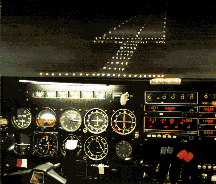 As I turned inbound toward the marker, my heading suddenly slewed sharply tothe right…the right engine had failed. I was very busy now: identify and feather thefailed engine, track the localizer, intercept the glideslope, secure the engine, and donot miss this approach! “69N has lost the right engine,” I reported to ATC.
The right engine of my Aerostar has the only engine-driven hydraulic pump, butfortunately, 69N is equipped with an electrically-driven auxiliary pump that should let melower the gear. Finally, I broke out, got the lights in sight, and put down the gearhandle when I felt landing was assured. Ah, three greens! Finally I was on the ground withless than 15 minutes of fuel remaining. That was too close for comfort…
Intense…And All Too Real
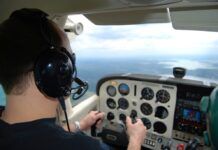
As 69N rolled to a stop, I took a deep breath…and the instructor turned up the lightsin the simulator. It seemed all too real and had been very intense, troubleshooting oneproblem after another while hand-flying the airplane in solid IFR conditions. This was thekind of session that felt different from my earlier simulator training at other trainingfacilities.
RTC’s program starts like most others: you practice standard IFR procedures includingholds, all kinds of approaches, unusual attitude recoveries and engine failures in allmodes of flight. But once you feel comfortable in the sim, the instructor shifts tovarious realistic X-C scenarios, one of which I just described above.
Another scenario included lost communications while I was on a vector for an ILS in themountains. Continuing on the vector would leave you headed toward some very high terrain.You had to realize that something was wrong, you were on your own, and you’d betterintercept the localizer and track it inbound rather than continuing as cleared.
Most simulator courses help you gain proficiency in the mechanics of IFR flight, buthere at RTC they also introduce the real-world weather and emergencies in a very realisticmanner.
Classroom Training
 In addition to the simulator training, there are audio-visualaids used to teach weather avoidance, FARs, procedures and all kinds of computations fromweight and balance to navigation. You also complete a systems workbook for the type ofaircraft you fly, and classroom sessions go over all the major systems of your aircraft.
RTC ‘s facility in Champaign is modest but functional. There are two simulators thatcan be configured as either single or multi-engine airplanes, along with two smallclassrooms. There are a couple of hotels just down the road with courtesy cars to take youto and from school. The airport (CMI) is almost within walking distance.
By the way, RTC’s boss, John Kileen, is also a tower controller CMI when he isn’tteaching or making videos, so don’t be bashful about telling the tower why you are comingto Champaign!
I spent three intense days at RTC, and came away with exactly the feeling I wanted frommy annual recurrent training: confidence. When things get tough in the cockpit, asthey did for me once shortly after I attended recurrent training at another facility, itwas my confidence that I could handle the deteriorating situation that made thedifference. We landed safely with only some extra dampness under the arms to show for it.Regular recurrent training is essential for safe flying, and too many general aviationpilots don’t take adequate advantage of it.
Realism At Rock-Bottom Prices
While there are certainly other firms that offer great sim training (and fancierfacilities), Recurrent Training Center gets the job done atrock-bottom prices, and gives you more than your money’s worth in challenging, intense,high-quality training that someday could save your life. For example, the tuition for mythree-day multiengine IFR recurrent training program was $950, less than half of what acomparable course would cost at FlightSafety International. Tuition for single-enginecourses are somewhat lower. RTC also offers annual recurrent training contracts, initialtraining and transition training.
If you have been thinking about simulator training, here’s your chance to do it withouttaking out a second mortgage to pay for it. With RTC’s very reasonable tuition rates,there is no excuse to put it off.