





























Our shop,Avionics West, sells handheld avionics andheadsets over the Internet on AVweb. Our satisfaction guarantee policy has alwaysbeen straightforward: if you don’t like the product, return it within 30 days and we willsell you a different item or refund your purchase price, whichever you prefer, noquestions asked.
Recently, an AVweb member asked me if this same policy applied to a panel-mountradio he was interested in – the II Morrow SL 40 – if we installed it in his aircraft.This was the first time I’d had the opportunity to sell panel-mount avionics via AVweband install it in a customer’s airplane. I told the customer that yes, our usual 30-daymoney-back guarantee would apply. I felt this was a good opportunity to install our firstSL 40 and see if the product lived up to the expectations of the customer and what IIMorrow claimed it will do. The downside was that if the customer wasn’t satisfied, I hadto refund the price of the SL 40! I decided to accept the challenge.
Company Background
 Avionics West has beenselling II Morrow panel-mounts for years. The company pioneered low-cost easy-to-use LORAN”C” units such as the 612B, 618TCA and various other user-friendly models.Later, they started making low-cost panel-mount GPS receivers such as the FlyBuddy, 2001,and most recently the new GX-55.
The Salem, Oregon-based company was founded by Chuck Morrow, but some years ago he soldout to a company called UPS. You may have heard of them. My understanding is that UPS haddecided to undertake an extensive vehicle tracking system for their huge fleet of browntrucks, and liked II Morrow’s technology so much that they decided to buy the company. (Iwonder if the folks in Salem have to wear those brown uniforms?)
Since the UPS acquisition, II Morrow has grown from a medium size company to a largeorganization. Years ago, I used to know just about everyone who worked there by name. It’sdefinitely different there nowadays. I remember the days when a real person would answerthe telephone instead of a computerized voicemail system! In all fairness, our II Morrowrep is Wayne McGee and I’ve found him to be very helpful. But I still hate their automatedphone system because it seems to me that the first person you talk to should at least havea pulse. Maybe that’s just me.
As I said, II Morrow is known for LORANs and GPSs. Some years back, II Morrow didintroduce a VHF comm but it didn’t sell too well because of the market in those days. IIMorrow was competing with King, Narco and Terra, and back then those three manufacturershad the market pretty well sewed up because they had a great product and excellentdealer/owner rapport. There just wasn’t enough room in the market for the new II Morrowcomm. In addition, that first II Morrow comm radio didn’t really have any bells andwhistles to set it apart from the pack. So it pretty well died on the vine.
Things are different today. In my opinion, Narco has alienated itself from both itsdealers and its customers. Terra fell on hard times and has now been purchased by Trimble,so we shall have to see what happens there. Bendix/King (now gobbled up by AlliedSignal)still produces a great product when you can get it, but lead-times are terrible on mostKing radios. Also, for all intents and purposes, King is still selling the same nav/commstoday as they did in 1981, at least as far as features go.
Units in stock, new features and fair prices are what the aircraft owners want today,and II Morrow has apparently decided to fill that niche. My crystal ball tells me IIMorrow is working on development of a full line of state-of-the-art avionics for pistonaircraft. Who knows what great things those squirrely software engineers in Salem aredreaming of at night?
Out with the Old…
The SL 40 arrived (via UPS!) the same day the customer showed up with his airplane forthe installation. The aircraft was a Cessna 152 with a 28-volt electrical system. Theowner told me that the factory-installed “Cessna-crafted” RT-385A nav/comm hadbeen a problem child for the three years he’d owned the aircraft. In fact, radio repairshad been costing him more than airframe and engine maintenance. This didn’t surpriseme…I know Cessna radios.
I also persuaded the customer to let us remove his SPA-400 intercom system which seemedto be a basket case. When using multiple brands of headsets, the audio level would droptoo low for one pilot to hear the other over the intercom. If both headsets were of thesame brand, the SPA-400 seemed to work marginally. It also seemed to pick up alternatornoise at low RPMs.
So out came the old nav/comm radio and intercomm. We removed all the wiring down to thecircuit breaker and removed the aircraft jacks. We were getting ready to install the newII Morrow SL 40 together with a reconditioned II Morrow 2001 GPS. The VHF comm antenna andcoax were replaced, proper circuit protection was installed and the GPS antenna wasinstalled. Now was the time to open up the SL 40 box. The radio was received in goodcondition, thanks to UPS and some good protective packaging. We found the SL 40 to be wellprotected inside of anti-static wrapping. II Morrow provides a “PackageContents” that lists everything that should be inside the box, and fortunatelyeverything was there.
…And in with the New
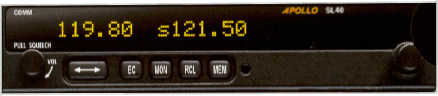
Our measurements showed the SL 40 to be just 1.30″ high, 6.25″ wide, and11.45″ deep. The width is industry standard, but in its other dimensions the unit isvery small. I wondered whether I be able to read the display of this tiny thing? Butavionics shops love small radios, because it means we can install more before we run outof panel space! Weight of the SL 40 was a stingy 2.1 pounds. Heck, I’ve eaten hamburgersthat weighed more than that (“after cooking” of course). The SL 40 also meetsevery relevant TSO and FCC reg. The knobs and buttons have a satisfying feel. So far, sogood.
Next step was to thumb through the installation manual. What a treat! The installationmanual is one of the best I’ve ever seen. I have no doubt II Morrow hired an actualavionics installer to write the manual, because no ivory-tower engineer could have writtena manual like this. The print is big and in plain English, perfect for a nearsightedwrench swinger like me. The wiring diagrams are excellent, easy to read. I have no doubtthat any home-builder or A&P could easily install the SL 40, and perhaps that’s whatII Morrow had in mind. The instructions clearly call out the use of shielded wiring whereit’s required by the wiring diagram. I reviewed the diagrams and installation stepslooking for mistakes, but I couldn’t find any. You’d really have to try hard to screw upthis installation.
The pins in the “D” connector are the crimp type and a special tool isrequired to do the crimping. This isn’t normally a problem because almost any avionicsshop has the necessary crimping tools. I’ve found the crimp pins are more reliable thansoldered ones. If you need to install this radio and don’t have the proper tool, asolder-type “D” connector could be used, but it’s not provided by II Morrow andshould only be used as a last resort. II Morrow even supplies the Allen wrench used toinstall and remove the radio from the rack. I found the rack assembly is strong and ofhigh quality.
A Look Inside
Before installing the SL 40, I couldn’t resist the temptation to open it up and have alook inside. Off came the covers and the faceplate. What I found inside was”typical” II Morrow, all surface-mount ICs and high-quality circuit boards. Itappears to be one of the best assembled radios on the market. But if the SL 40 ever fails,it would be best to send it back to II Morrow. The insides of the SL 40 is no the place tobe working with a blowtorch and chisel. I noticed the SL 40 had plenty of inside room andprovisions for some more connectors. You can bet II Morrow is going to be stuffing a GPSreceiver in this jewel later. Okay, enough fun, time to put the radio back together withall the parts. It went together as easy as it came apart, and it seemed as if I hadn’tbroken anything (which is unusual for me).
Next step was to hand the SL 40 to my chief installer, Tom Knoll. TK doesn’t likeanything new, so it was going to be interesting on his opinion of the way the SL 40 wiredand integrated with the 2001 GPS. Within three hours, he had the complete harness wiredfor the SL 40 and 2001, and ready to install in the Cessna. Next, he mounted the SL 40 and2001 racks and antennas, and ran new coax throughout. Power wiring was run to the circuitbreakers, and single point grounding was incorporated. We didn’t install any cooling ductsbecause II Morrow said it wasn’t necessary, something about the SL 40 being so efficientthat very little heat is generated. The SL 40 uses about one-third of the power of othercomms in the same class. Someone in Salem has been doing his homework.
After the installation was complete, we plugged an APU into the aircraft and turned onthe switches. My concerns about the SL 40 display being too small were soon gone. I lovethe display! It’s clear and easy to read. Comm radios with LCD displays simply aren’t inthe same league. I don’t usually get excited over something like a comm display, but youwould have to see the SL 40 display to understand. It’s the best on the market. Ipersonally like it better than the gas discharge displays that the high-end radios use.The little SL 40 has a photocell that dims the display automatically for night use.
Lots of Features
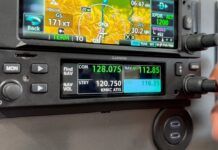
It was finally time to explore the SL 40’s bells and whistles. You’d better grab a cupof coffee, because the list of features is long. The display shows both the active andstandby frequencies simultaneously, and you can flip-flop the frequencies at the touch ofa button, just as with the high-end radios. The large knob controls the MHz and the smallone the KHz. The unit covers 760 comm channels from 118.00 to 136.975 MHz. Power outputtested out at 8 watts across the entire band, plenty of power for a VHF radio.
Power-on/off, volume and squelch are combined in a single knob. Rotate the knobclockwise to power up the unit, turn it further to increase the volume. Pulling out theknob opens the squelch. The squelch threshold is software-adjustable; no more benchadjustments needed!
Press the “EC” button and 121.50 is automatically loaded into the standbyfrequency and the “monitor” feature is enabled. What’s the “monitor”feature? Are you sitting down, you’re gonna love this! As with most radios, the SL 40normally listens to the active frequency. But if you push the “MON” button, thereceiver now monitors the standby frequency, but watches the active frequency in thebackground. So if there’s any activity is on the standby frequency, you’ll hear it. Butshould there be activity on the active frequency, the radio will automatically switch tothe active frequency. In short, you can monitor two frequencies at once with this radio.Is that neat or what? A small “m” appears next to the standby frequency displayto remind you that monitor mode is enabled, and a small arrow (“<>“) willpoint to whichever frequency you are listening to. Pushing “MON” again turns themonitor feature off.
This is a terrific feature, especially in a single-radio aircraft. You can monitortower and pick up the ATIS at the same time, for example, without needing a second radio.As far as I’m aware, the SL 40 is the only general aviation panel-mount VHF comm that hasthis feature.
Ready for another cute feature? Press the “RCL” button and turn the largeknob to display the “auto-stack list”. Now turn the small knob and you can scanthrough the last eight frequencies that you saved with the “MEM” button. Thislets you call up frequencies that you use a lot without having to dial in all the digitseach time.
Another highlight of the SL 40 is its ability to receive the weather band. Just pressthe “RCL” button, turn the large knob until the display says “WTH”,then turn the small knob to the desired weather frequency. Of course you can’t transmit onthe weather channel, but you sure can receive the local weather. This is a nice featurethat has been in handheld transceivers for some time, but I don’t know of any otherpanel-mount radio that covers the weather band.
Yet another feature of the SL 40 is its ability to interface with the 2001 GPS and toobtain frequencies from the 2001’s Jeppesen airport database. While this is a neat belland whistle, I personally found it easier just to read the frequency off the GPS and tuneit in manually on the SL 40. I must be old-fashioned.
Having removed the Cessna’s old SPA-400 intercom system, we wired the SL 40 to use itsbuilt-in intercom. I was really interested on seeing just how well the intercom wouldwork, because most intercoms built into previous comm radios have been poor performers. Wehad to install a separate switch on the panel so the SL 40’s intercom could be turned on.When we flipped the switch, the intercom worked a lot better than I expected. Standbyfrequency monitoring is disabled when the intercom is functional. An “I” isdisplayed next to the standby frequency to indicate that the intercom mode is active.Trying out the intercom in the hanger with the engine off, we found that it worked fineand the squelch was set about right.
Another helpful SL 40 feature is stuck-mic protection. We keyed the transmitter, andafter about 35 seconds the transmission ceased and “StuckMic” appeared on the SL40 display. Nice!
So far, the SL 40 seemed to work as expected on the ground with the engine off. But howwould it perform in the air?
Flight Test
The floor vacuumed, the APU unplugged, the little Cessna preflighted, and it was timeto take her up. We started the little Lycoming and turned on the SL 40 comm, the 2001 GPS,and the transponder (on standby). We tried the weather channel and picked up ATIS beforecontacting tower. I observed that the weather band and ATIS were at the same listeninglevel, so we didn’t have to change the volume level. The reception was very clear…butthen again, we were still on the ground.
We gave tower our spiel and got clearance to taxi out. I asked tower how thetransmission sounded and they replied “5 by 5”. Once in the run up area we triedthe intercom function, and once again I was pleased with it. The squelch level was perfectwith the engine at idle. Better yet, the alternator whine that used to plague the oldSPA-400 was not audible at all. Maybe a well-built radio, shielded wiring, or single-pointgrounding solved the problem, who knows, but the alternator whine was gone and the ownerwas delighted.
Tower said “go” so we let the Cessna develop all the power and noise that itslittle Lyc could manage. I’d forgotten what it was like to fly a Cessna 152: the noise islike being in a jar of bumble bees. At full power we found the intercom wanted to breaksquelch ever so slightly, but a couple pushes of a button to reprogram the squelchthreshold solved the problem. Now the intercom only worked when one of us spoke.
As we reduced power for straight and level, I found the intercom squelch setting wasstill good. The intercom sounded loud and clear, and worked better than I expected for anintercom built inside the radio. The King KY-96A does have an intercom (well sort of), butit’s a “hot mic” system and is poor at best. The SL 40 worked a great dealbetter. True, it’s not a NAT or some other top-end intercom with stereo music and pilotisolation and all that, but it’s not bad for the bucks. The SL 40 intercom is limited totwo stations and no stereo inputs. If you want to listen to Willie Nelson or need morethan two intercom stations, then you need to install a separate intercom system and notuse the SL 40’s built-in intercom. The system can be easily wired without the intercom.
During the flight we found the comm squelch, receiver and transmitter worked great.During our testing we found that at high engine RPMs and a great distance out, tower wouldsay they heard a lot of back ground noise. Of course the Cessna 152 cockpit has about 97dB of noise. We found that if we unplugged either the pilot’s or copilot’s headset, thebackground noise would go away. It appears both mic audio inputs are connected together sothe transmitter sees both mics when either one is keyed. I sure wish II Morrow hadinstalled boom mic isolation inside the SL 40, but it appears that isn’t the case. In aquieter aircraft the problem wouldn’t have been noticed.
The knobs and pushbuttons worked beautifully. They felt natural to use even inturbulence. The display was a delight to read under all lighting conditions. We tried thefrequency storage the SL 40s has and this works along with the down load of frequenciesfrom the 2001GPS, but I found it easier just to manually crank in the frequencies.
I was really pleased with the little SL 40 after we flew with it. I don’t like sellinga radio that I haven’t personally flown with first, I will sell the SL 40 with confidencein the future.
Once on the ground we installed a “boom mic isolator” to cure both mics beingon at the same time. We then made another test flight, and sure enough this took care ofthe background noise problem. Tower commented that we now sounded like an”airliner”! Funny what a $30.00 part will do.
Summary
What do I think of the SL 40? I like it! Do I recommend the product? You bet! It worksgreat, everything feels like it should, and it’s easy to install. It works on either 14-or 28- volt systems, so it’s great for fleet owners who have both. Expect to pay around$1,300.00 for the SL 40 but this is excellent value for product.
This product is the wave of the future. I think II Morrow hit a home run with the SL40. I’d love to see them come out with a complete radio stack that has the quality of theSL 40, and I fully expect them to do that. And if they ever fire the guy who wrote thosegreat installation and owners manuals, I’d hire him in a heartbeat.