



















Gone are the days when pilots were expected to know every nut and bolt intheir aircraft. These days, pilots aren’t expected to retain minute mechanicaldetails, but there is still much we need to know about our aircraft to staysafe_including enough systems knowledge to understand what the various cockpitannunciator lights and buzzers mean, and how to check them against otherindicators whenever possible.
Without this knowledge, an assumption can lead to misguided action that turnsa minor abnormality or a false warning into a full-blown emergency that seriouslyjeopardizes a flight. The following accident is a case in point:
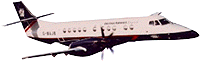 Early in the evening on Dec. 13, 1994, an American Eagle JetstreamSuper 31 was vectored for the ILS approach to Runway 5L at Raleigh-Durham,N.C. The airport had a 500-foot ceiling and two-miles’ visibility in lightrain and fog_well above the minimums for the instrument approach. After thetwin-turboprop crossed the final approach fix (BARRT), the captain advancedthe propeller speed controls, while the power controls were still in flightidle, and told the copilot to extend the flaps to 20 degrees and lower thelanding gear. He then noticed a light flash below the engine instrument cluster.”Why’s that ignition light on?” he asked. “We just had a flameout?”
“I’m not sure what’s going on with it,” the copilot replied.
“We had a flameout.” It wasn’t a question this time, but a statement.
“What do you want me to do?” the copilot asked. “You going to continue [theapproach]?”
“Okay, yeah. I’m going to continue,” the captain said. “Just back me up.”
The airplane began drifting to the left while maintaining altitude at about1,800 feet. Only a few seconds after announcing that he would continue theapproach, the captain decided to abandon it and told the copilot to “setmax power” for a missed approach.
The turn rate increased to about five degrees per second. Airspeed was decayingrapidly, and the stall warning sounded intermittently. The copilot repeatedlyadvised the captain to lower the nose. “You got it?” he asked.
“Yeah,” the captain replied. But the turn continued, airspeed kept dropping,and the airplane remained level.
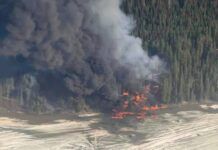
The last statement recorded by the CVR was the copilot saying, “It’s thewrong foot, wrong engine.” The airplane then apparently stalled and beganto descend at a rate that quickly reached more than 10,000 fpm. It crashedthrough a stand of trees on a heading of 290 degrees. Both pilots and 13passengers were killed; five passengers were seriously injured.
Series of Errors
During its investigation, NTSB uncovered a series of errors that began withthe captain’s interpretation of the ignition light, which he noticed shortlyafter advancing the propeller speed controls. The board believes that hemoved the prop controls rapidly, which caused a transient negative torquecondition in the left engine. For a very brief period, the prop blades werebeing turned by the air loads on them, rather than by the engine. This moretypically would happen, for a longer period, if the engine lost power (i.e.,flamed out).
The airplane’s negative torque sensing (NTS) system detected the transientcondition and automatically fired the engine’s igniters. If the engine hadflamed out, the sparks produced by the igniters could have restored power.But the evidence shows that the engine had not flamed out. Therefore, theigniters would have had no effect on the engine; but the cockpit annunciatorlight (“IGN”) would have stayed on for the 20-30 seconds the igniters werefired by the NTS in response to the transient negative torque condition.
No Verification
NTSB believes that the pilot assumed he had an engine failure because theignition light had always been associated with a flameout during trainingin the simulator. However, he apparently did not attempt to verify his assumptionby checking the engine gauges.
Propeller rpm probably was at or near 100 percent when the ignition lightcame on. Anything above 90 percent on this gauge is a positive indicationthe engine is running, according to the airplane’s manufacturer. Verificationof a flameout also could have been achieved by advancing the power leverand checking whether or not the torque indication responded normally.
Furthermore, the captain did not discuss his reasoning with the copilot,and the copilot did not question the assumption. And though they tacitlyagreed on a flameout, they did not follow through by feathering the propeller,securing the “dead” engine or cleaning up the airplane.
Investigators concluded that the CVR’s recording of intermittent activationof the stall-warning system and radar data showing that the airplane’s descentwas arrested at about 1,800 feet indicate that the captain was holdingsubstantial back pressure on the yoke_and continued to do so despite repeatedadvice from the copilot to lower the nose.
NTSB characterized as “puzzling” the captain’s decision to conduct a missedapproach. Though it had begun drifting to the left, the airplane was stillwell within the limits of the localizer course width and only slightly abovethe glide slope. If the crew had followed through with appropriate single-engineprocedures, it would have been easier_and safer_to continue the ILS approachand land than to try to go around.
‘Wrong Foot, Wrong Engine’
Although continuing the approach would have been the safer choice, the airplanecould have gone around on one engine if it was handled properly. However,after calling for the missed approach, the captain told the copilot onlyto “set max power.” He did not call for the checklist.
The copilot did as he was instructed, but he advanced only the right enginepower lever. “If he had advanced both power levers, both engines would haveresponded and the perceived emergency would have been resolved,” NTSB said.
Despite losing this last opportunity to discover that the left engine was,indeed, running, setting max power on the right engine was the proper firststep for a single-engine go-around. Unfortunately, no other steps were taken.With the flaps and landing gear extended, the Jetstream couldn’t climb.
“It is impossible to determine what control inputs were being made by eithercrew member, but they had little or no lateral or directional control ofthe aircraft for the next 13 seconds,” NTSB said. In an asymmetric thrustcondition, rudder is needed to counter yaw induced by “good” engine thrustand “dead” engine drag. Multiengine students are taught “dead foot, deadengine” to identify which engine has lost power; the rudder being appliedto counter the adverse yaw is on the same side as the “good” engine. Shortlybefore the airplane stalled and entered a steep descent, the copilot said,”Wrong foot, wrong engine.” Did he notice that the captain was applying leftrudder, rather than right rudder, to counter the adverse yaw? Possibly, butthere’s no proof of this.
Probable Cause
NTSB ascribed the accident to the captain’s “improper assumption that anengine had failed” and his “subsequent failure to follow approved proceduresfor engine failure, single-engine approach and go-around, and stall recovery.”The board also blamed the airline for failing to detect and correct “deficienciesin pilot performance and training.” Investigators found that the 29-year-old,3,500-hour captain had a checkered history. Records show that he had problemswith simulated engine failures and ILS approaches during his initial trainingwith Comair in 1990. After a year of flying as a probationary copilot onSaab 340s, he was given poor marks by line captains. One believed he hadbelow-average piloting skills, often got “behind the airplane” and might”freeze up or get tunnel vision in an emergency situation.” Another captainrecommended that he be dismissed. But, instead of firing him, Comair allowedhim to resign.
By that time, he already had accepted an offer to fly for Flagship Airlines,one of four regionals operated by American Eagle. No background check wasconducted_not that it would have mattered, because Comair told NTSB thatit would only have listed the pilot’s dates of employment and aircraft operated.The pilot flew right seat in Jetstreams until early in 1992, when he wasconsidered for upgrade to captain on Shorts 360s. Although he was writtenup for unsatisfactory performance on engine failures, single-engine proceduresand crosswind takeoffs and landings, he was given additional training andeventually passed his type rating and line checks. His performance as a captainapparently earned him a less-than-sterling reputation among other pilotsat American Eagle. A month before the accident, he talked with his base managerabout the situation. “The base manager offered to assist him in securingtraining time in the simulator, but the captain declined the offer,” NTSBsaid.
Lessons
The accident illustrates the potential consequences of not using availableresources in an abnormal or emergency situation. The captain did not verifyhis assumption that an engine had flamed out, and he chose not to get anyhelp from his copilot, a 25-year-old, 3,450-hour ATP considered by colleaguesand check airmen as an above-average pilot.
It’s important to keep in mind that only one minute elapsed from the timethe captain announced that an engine had flamed out until the airplane struckthe ground. This shows how quickly a situation can deteriorate when proceduresare not followed and control is not maintained.
Among NTSB’s recommendations following the crash is that airlines be requiredto maintain and share standardized pilot training and performance records.This has created a furor among airlines and commercial pilots who believeit would be an invasion of privacy. Many airlines depend on evaluation duringinitial training to weed out substandard pilots. But the record shows thatit doesn’t work that way; this was the fourth accident since 1987 that promptedthe safety board to recommend requirements for background checks.
Beyond biennial flight reviews, those of us who don’t fly for hire are ourown evaluators. We owe it to our passengers to do a thorough, objective jobin determining whether we truly are up to snuff.
