














I write this with considerable personal embarrassment, in thehopes that someone may learn from it.
Sunriver, Oregon, is a lovely summer and winter resort communityabout 20 miles from Mt Bachelor, a popular ski spot. We renta condo there for a week every year, during the kids’ Spring break.I usually fly down with one or both boys and the dog…and mywife drives the van down with the rest of the stuff. It’s almostimpossible to get it all in the van, and utterly impossible inthe Bonanza, of course.
After four days of great skiing, Thursday turned into a blizzard…alllifts closed. The family was skied out, so we were thinking ofgoing home early, and when we heard a "monster storm"was brewing for the weekend, we moved the departure date to Friday.
The weather Friday morning was zero-zero with snow and fog, afoot of fresh snow on the ground (on top of solid ice), and 15ºF.Hmmm, this is not good.
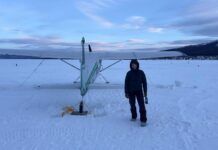
I drove to the airport Friday morning with my son Alex…carefully,using four-wheel drive! I was very concerned about the snow-coveredairplane, but was relieved to find that the snow brushed off easily,with ice only on the wing walk. I was also worried about cold-startingmy precious IO-550, but the engine oil pan heater and insulatedengine cover I’d used overnight had brought all EGT/CHT/OIL upto 50ºF.
The runway at Sunriver (18-36) is 5,500′ long, hard surfaced,at an elevation of 4,159′ MSL. Runway 18 is "the usual"runway in use, and appears to have a very slight upslope, withslightly rising terrain off the end, and high terrain left, rightand ahead beyond 5 NM. Runway 36 appears slightly downhill, withdropping terrain off the end, and it’s a straight shot to DSDVOR, 23nm away. The instrument approach is off that VOR, withminimums of MDA 5,480′ (HAA 1,322) and 1-1/4.
The runway was unplowed, but I figured I could charge up and downit a few times and make a path for a takeoff if they didn’t plowit first. The wind was 220, varying between near-calm for longminutes at a time, to 20 in the snow squalls blowing through.The weather was varying all over the place: it would pop up to1,000-and-3 or better for 15 minutes or so when the snow quit,then drop to zero-zero again in snow showers. The temperaturehad risen to 28ºF, so it was getting a little wet.
Go or no-go?
I reviewed what I needed in order to go:
A clean airplane,
A 36 departure (implying not much wind from 220, a tailwind),
Local weather good enough to circle and come back immediately,
Good weather at Redmond OR, 23nm away (ILS to 200′ available),
A decent pilot report of "no icing" at the lowerlevels.
The odds against all that happening at once were not good, butwhat the heck? Alex and I were well-dressed, with snow boots,were having a good time cleaning the airplane off (several times),several locals were sitting around gabbing, and the office waswarm and dry for breaks. So we kept the airplane pretty clean,fooled around, and waited. Redmond opened up early and stayedgood, according to Flight Service: two thousand overcast and five,with ten miles viz.
A Malibu landed during one of the breaks, I had him in sight 3miles out. He reported the only bad weather was within 5 NM ofSunriver, that Redmond was wide open, and there was "no icing"at all on the approach to Sunriver. He’d come from Seattle atFL210 with no problems. The Malibu pilot was very quiet and professional,told me exactly what I wanted to know, nothing more, nothing less.Hot dog, solid gold!
A Bonanza came in from the south, with a "hero" pilottalking about sneaking down the river, lots of icing, and advisedme how to follow the access road through Sunriver (prohibited,for noise), intercept the main highway, and follow that to Redmond.I didn’t ask, but got the feeling he wasn’t instrument ratedor didn’t like flying in actual. When I mentioned just climbingstraight out on the VOR approach course, he looked like he’d neverheard of that technique. I discounted him entirely.
No snow is falling, so we did the final cleanup, got the airplaneabsolutely clean…and then it started snowing again, heavily,temperature 28ºF, a little wet, weather back down to zero-zero.Rats!
"OK, tell ya what", I sez to the lineman, "I’dlike to fire up, taxi out away from the office, get it warmedup, checked out and all set to go, then come back, shut down andwait for a break in the weather. Then you shoot it with hot (180ºF)glycol, and I’ll fire up again and go". Agreed.
So I fired up, and darned if the snow in the prop blast didn’tblow right off! Hmmm, I’d thought it was too wet to do that. SoI told ’em on Unicom I’d go try a takeoff, and if it didn’t blowoff by 40 knots I’d stop and come in for glycol. Sounds likea plan.
The plan unravels
After a 20 minute delay for ATC, the snow quit and the viz andceiling came up nicely. ATC came through on schedule, and we werereleased. By now, the runway had been plowed and was hard packsnow on top of ice. Lousy braking but no drag.
I briefed Alex, and we started the takeoff roll. We had 1/2"or more of snow on the wings, so I fully expected to abort at40 knots and go back in to get deiced. But to my surprise, everythingblew off beautifully by 40 knots in the first 500′ of roll. Hotdog, it all came together…someone up there likes me! I dismissedthe wing contamination problem completely, checked for properairspeed indication, power settings, EGTs, etc.
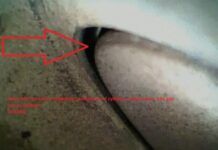
Just one problem. The leading edges back to the spar of my wingare painted a dark maroon (to help melt ice), and the wing aftof the spar is painted beige. At about 90 knots, just as I waslifting the nosewheel, Alex quietly said "Dad, the leadingedges are AFU". I looked, and looked again, and we had about1/64" of solid clear ice, EXACTLY covering ONLY the maroonpart, almost impossible to to see, with tiny bumps every halfinch or so, maybe 1/32" high. At the MOST.
It was too late to stop, so I babied it off, stayed in groundeffect, got the gear up, and went over the far end of the runwayat 110 knots and 5 feet of altitude. Kept it fairly level asthe ground fell away…thank heavens we departed runway 36! Imanaged to gain maybe 100′ or 200′, did a very gentle buttonhookturnaround, and landed on 18. The 300 hp IO-550 engine was atfull throttle the whole time, except backed off on very shortfinal to cross the fence at 110 knots. The airplane was NOT happy,and flew horribly.
Locals came out, glanced at the leading edges, and asked "What’dyou come back for?"
"It doesn’t fly so good with that ice."
"THAT little bit affected you?" They still don’t believeit.
We shot the whole airplane with 180ºF glycol, took another20-minute ATC delay, and the snow began falling again. Sigh. I didn’t figure we’d make it, but tried another takeoff roll,and this time, the mixed water, snow and glycol peeled off nicelyat 40 knots. This time, there was no question that the leadingedges were totally dry and clean. Believe me, we were looking!
We crossed the far end of the runway at maybe 200 feet and 120knots, climbed into the clag at better than 1,000 feet-per-minute,and popped out in good (but gloomy) weather over Redmond. We re-enteredthe soup at 9000′ and climbed to 16,000′ in clouds. At cruisingaltitude, OAT was -27ºF, not a sign of icing. We had a beautifulflight to Seattle, in and out of clouds, sometimes between layers,arriving just as full darkness fell. That’s the way it’s supposedto work!
What happened here?
I’m not positive, but I can take a guess.
Ice and water are funny things. Water can turn to ice in a heartbeat,and 32ºF is not always as significant as most folks think.Other factors come into play.
I suspect the dark leading edges of my airplane subtly changedthe dynamics just a tiny bit. What little radiant energy comingthrough the clouds from the sun (we could barely see traces ofthe sun once in awhile) might have warmed the maroon areas justa tiny bit, and there might have been a layer of water trappedunder the 1/4" of snow. When the airflow began, and thepressure dropped, that thin layer of water instantly froze intoclear ice, while the bulk of snow blew away. The main surfaceof the wing, perhaps a tiny bit cooler, didn’t melt the snow enoughto make water, and when the snow there blew away, it left thebeige portion of the wing clean.
There are two main lessons here. First, take a HARD look at ALLareas of the wing before committing to a takeoff. Two, unlessit’s happened to you, it’s hard to believe how little upper-wingcontamination it takes to spoil performance…big time! I thoughtI had learned that lesson long ago. Be careful out there.
Very, very invisible
And before you jump to any conclusions, let me tell you that therewas no "get-home-itis" involved here. I would have beenquite content to return to the condo, spend the night, and eithertry again the next day, or just drive home with the family, andcome back another day to get the airplane. I felt no pressureto go at all. The next day, faced with the same choice, perhapsthere would have been some pressure, but not enough to make medo something stupid.
I was absolutely, positively CERTAIN that wing was clean, or Iwould not have continued the takeoff.
Trouble is, I was wrong, and THAT is the point. It is very difficultto see clear ice on a dark-colored leading edge. Almost impossible.The only way I could see it at all (after Alex pointed it outto me) was by catching the reflections just right…and on thatgloomy day, there were not many reflections to be had!
This was perfectly CLEAR ice, and the line of demarcation couldn’thave been sharper if it had been masked off and sprayed. Iceon the dark part of the wing, none at all on the light part. Very,very invisible.
I think I may take a lesson from the DC-9 crews and tape a smalllength of yarn on the leading edge, maybe just inboard of my gascap. If the string is flopping, there’s no ice…if it’s motionless,there is ice. I thought of that as a joke when I first heardabout it…but suddenly, it ain’t a joke.