
























During the winter, dozens of aircraft come to grief on ice andsnow-covered runways, sometimes after completing an otherwiseuneventful instrument approach.
These accidents are rarely fatal but they do illustrate a harshreality of winter flying. We worry incessantly about airframeicing but slick runways, snowbanks and low visibility test thelimits of man and machine and very often, neither is up to thetask. A spectacular accident a few winters ago shows how condtionscan conspire to undo the best efforts of even an experienced airlinecrew.
Commuter Flight
USAir Express Flight 5108, a British Aerospace Jetstream, wason a flight from Charlotte, North Carolina to Beckley, West Virginia,an uncontrolled airport in the southern part of the state. Thedate was March 17, 1993, a few days after the infamous Storm of theCentury had dumped 31 inches of snow on the Raleigh County Airportin Beckley.
 As secondary airports go, Raleigh County is typical. It has tworunways and four approaches, including an ILS with standard 200-and-a-halfminimums to runway 19. Following the big storm, the airport wasclosed for two days but the weather had cleared enough for crewsto plow the runway. On the night of the accident, another weathersystem had moved in, bringing low ceilings, freezing drizzle andfog.
As Flight 5108 approached Beckley just after sundown, the NWSobserver on the field reported a measured 200-foot overcast, witha mile of visibility in light drizzle, light snow and fog. Runway19 had been plowed but a notam warned that the surface had beencleared to only 130 feet of its 150-foot width. Two-foot highsnow berms encroached on both edges of the runway but the edgelights were reportedly visible. The Jetstream’s flight from Charlottewas uneventful, although it overflew a scheduled stop at Bluefield,West Virginia because the weather was below landing minimums and because there were no passengers to drop or pick up. Flight5108 arrived in the Beckley area just before 7 p.m. local time.As required by the regulations, the crew checked the weatherand learned that it was above minimums, although they would havea 7-knot tailwind.
The crew performed its in-range checklist and the Captain briefedthe approach carefully with the First Officer. Shortly afterthe Jetstream turned onto the localizer, the First Officer confirmedwith the Unicom operator that the runway lights were at fullintensity. As the aircraft neared decision altitude, the FO calledoff altitudes. Seven seconds after calling "one-hundredabove," the FO announced lights in sight.
First Officer: "I got the lead-in lights, continue."
Firrt Officer "There’s the end of it."
First Officer: "There’s the REILs."
Captain: "Taxi light’s on, right?" (sound of click)
Captain: "Jeez…oh #, we’ve lost it…oh man, I don’t believeit…"
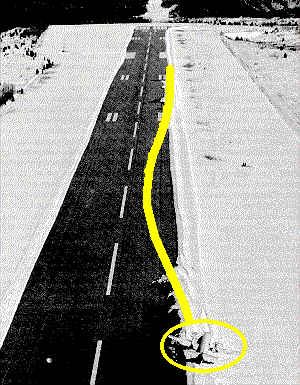
The next day, the NTSB accident investigator discovered thatthe Jetstream had touched down on the runway, but well leftof the centerline and on the unplowed portion of the runway.It rolled through the thick snow for 435 feet, at which pointthe right gear leg sheared off and the left gear began collapsing.
The airplane then slid out onto the plowed portion of the runwayand nearly reversed direction before coming to rest atop thesnow berm along the runway edge. The crew and two passengersescaped without serious injuries.
Not Unusual
As wintertime runway accidents go, Flight 5108’s wild ride wasunusual only in its severity. To put things in perspective, werecently looked at several years worth of icing accident data.The overall totals from two years-1988 and 1989-are typical.In 1988, the NTSB’s records show that there were 20 icy runwayaccidents; in 1989, the total was 15. Viewed against the bigpicture, runway excursions rank third behind airframe icing andcarb icing, the leading cause of icing-related accidents.
However, we suspect that the actual number of runway accidentsis much higher because many simply go unreported. We know ofincidents in which airplanes careened into runway lights orskidded into snowbanks with only minor damage. No accident reportswere filed.
Touch and Goes
If there’s such a thing as a "routine" runway excursionaccident, it’s probably the student pilot who suddenly finds himself parked in a snowbank while practicing touch and goes.Having an instructor aboard is no guarantee of a safe outcome,either. On a dry runway, an alert instructor can correct a student’sminor squiggles with a quick stab on the rudder. When the pavement is covered by snow or ice, a minor drift can instantly turninto a headlong careen off the runway.
Sometimes, an instructor’s attempts to salvage a landing gonebad only makes things worse. In one accident in North Dakota,a CFI was checking out a pilot in a Cessna 172RG. The studentwas attempting a touch and go on a 2800-foot, snowcovered runway.The trainee landed long, then caught the CFI by surprise whenhe attempted takeoff with only 800 feet of runway remaining.The instructor reacted, but too late. As the aircraft slid tostop, it departed the left side of the runway and nosed overin a snowbank, causing serious damage.
Earlier in the same week, a pilot attempting to land a Piper180 at a Vermont airport had a similar run-in with a snowbank.When he started to slide after touching down, he tried to goaround. The left main was sheared off by a high snow pile andthe pilot returned to land on the right main, significantly damagingthe left wing.
If the 1988-89 winter seasons are an accurate indication, themajority of slick runway accidents occur at uncontrolled fields.No surprise there. Outlying airports tend to have narrower, shorter runways and runway lighting tends to be minimal or non-existent.More important, as the crew of Flight 5108 discovered, a majorstorm can overwhelm the snow removal capabilities of small airports.
Give It A Try?
Knowing this, you’d think that pilots would give small, snow-covered airports a wide berth and most probably do. But there are alwaysa few who are willing to tempt fate by landing or taking offon short, snow or slush-covered runways. That’s exactly whatthe pilot of a Cessna 182 did at small Wisconsin airport. Heelected to land on a 2500-foot snow-covered grass strip butwound up nosed over off the end of the runway. He told accidentinvestigators that he flew the approach fast and touched downlong, virtually assuring that he would have insufficient distanceto stop.
With their wider runways and superior snow removal, towered airports-especially air carrier airports-have fewer runway excursionincidents. However, as in the case of Flight 5108, the mostdamaging runway excursions seem to involve faster, heavier aircraft,whether at towered airports or not. The NTSB’s records containnumerous accidents in which relatively fast airplanes (mediumtwins and up) complete an instrument approach only to touchdownin a snowbank or careen out of control off the end of the runway.Even if the crew is acutely aware of the hazards and preparedto counter them, suprises may yet lurk upon touchdown. Two accidentsillustrate the point.
In the first, an MU-2 on a cargo flight into Spokane, Washingtonhad completed an ILS just after dawn. Spokane is a towered fieldand even though the runway had been plowed, it was still coveredby 2 inches of ice and snow, some of which had been heaped upon the left side of the runway, burying the lights. The pilotsaid he thought he had landed on the centerline but the aircraftdrifted left and went out of control in a snowbank.
In the second accident, the crew of a Lear 25 was inbound to Bend,Oregon, an uncontrolled airport. The weather was clear but thecrew suspected the runway might be icy. Before landing, the crewmade a low pass to examine the surface and, seeing no evidenceof ice or snow, they returned for landing.
On rollout, some 2000 feet beyond the landing threshold, the Learbegan to skid. The aircraft was equipped with a drag chute butit was inoperative. Unable to stop, the Lear overran the 5000-footrunway, struck a fence and came to rest in a ditch. A post-accidentinspection revealed that the last half of the runway was coatedby black ice, which is all but invisible.
Avoid the Hazard
From the warm comfort of an armchair, it’s great sport to second-guessany pilot who comes to rest in a snow-filled ditch or tears offout of control, chopping off edge lights like so many bowlingpins. After all, isn’t the hazard obvious and anyway, why notjust cancel the flight entirely or land somewhere else? The hazardis obvious. But most experienced snowbelt pilots will tell youthat judging the degree to which a snowy runway will affect aircraftcontrol is next to impossible. Then there’s the challenge of actuallyseeing the runway on a snowy, gray day or at night.
In the case of Flight 5108, the Captain was no newcomer. He hadmore than 12,000 hours, some of it flown in snowy West Virginia.As we said, no cause has been deter mined but judging from theNTSB factual report and CVR recording, the crew carried out theflight professionally and with all due care and yet were caughtcompletely by surprise when the aircraft wound up in thesnow.
The all-time, bulletproof option is to just bag the entire flight.For-hire crews have that option, but it’s not always easy to exerciseit; there’s enormous pressure (often unspoken) to deliver thepaying passengers. The pressure is less for Part 91 pilots butit’s still there. One go/no-go test is this: how important isthe trip compared to the prospect of ending it nosed over in asnow drift? A variation of this is IFR contributor Bob Gardner’sall-purpose test: How will I look in the accident report?
Still want to go? Stack the odds in your favor by flying intoan air carrier airport or one that has known snow-removal capability.A long drive to the destination is better than a short skid intothe runway lights. Avoid short, narrow paved runways and turfstrips. Even if the runway and taxiways are dry, snowberms cando massive damage to wings and landing gear.
If you must use a small airport, try to arrive in daylight anddon’t rely on notams for field conditions. Call ahead for a detailedreport on conditions, including lights. Is the runway plowed toits full width and length? Is the asphalt dry or covered by thin,patchy snow? Has it been sanded? Are lights on both sides of therunway visible? Be extremely cautious when a sub-freezing duskfollows a warm day; the meltwater from plowed snow can freezeinto sheets of ice. If possible, have a vehicle check the runwaybefore takeoff or landing.
Stick to Daylight
Clearly, the accident record and common sense suggest that therisk goes way up at night, in low visibility or in a crosswindor downwind landing. If you attempt an approach in any of theseconditions (or all three), the risk is much higher. Again, thelong, wide and well lighted runways at air carrier airports arethe best option.
When approaching at night in the snow, it may be better to leavethe landing light off until just before touchdown. The reflectionoff airborne snow can be mesmerizing and will make it harder tosee the runway. When operating on snowy and icy surfaces, slowis better and that applies equally to landing and taxiing. Thoseslow, short-field techniques you learned as a student but probablyhaven’t used much since are suitable for landing on slippery surfaces.One fact of winter flying is that the same conditions that putice on the runway may put ice on the airframe. In that case, aslow approach won’t do. You’ll have to keep the speed up, landwithout flaps and take your chances .
Another technique-a low-level drag before actually landing- isn’ta bad idea, either. Although it didn’t help that Lear crew inOregon, dragging the field may reveal snow or slush that’s toodeep to chance. Or maybe it’ll scare you into landing elsewhere.
On a dry runway, touching down in a slight crab is sloppy techniquebut no big deal; once the tires grab, the aircraft cocks itselfstraight. Try that on a slick runway and you’ll all but guaranteea skid. If that happens, regain control with vigorous rudder inputand judicious power. In a twin, differential power may be moreeffective than rudder. Don’t try to steer with brakes; they’llprobably be useless.
Salvaging a skid by attempting an immediate takeoff would appearto be chancy, too, according to the accident record. On a slipperyrunway, the tires lack the traction to counteract torque and P-factorso unless you’re quick on the rudder, firewalling it could worsenthe skid. And if you don’t get airborne before hitting the snowbanks,you’ll do more damage because you’ll be going faster. A slow-speedslide into snow might be more acceptable.
The only good thing about snow on runways is that it eventuallymelts, sometimes in a matter of hours. Waiting for that to happenseems a small price to pay to avoid the ignominy of a surprisesleigh ride through the airport boondocks.