






























When AVweb approached me about writing this column, I really didn’t know what to think. I was flattered, of course. But I was apprehensive, too. First of all, I’m not a writer. Secondly, despite my title, I’m just a plain old everyday controller. I didn’t get any special training to be a Safety Representative for NATCA. As a matter of fact, I’ve pretty much made this job up as I went along. Oh sure, we have programs in place now, but there was a lot of “reinventing the wheel” when we first started.
That’s just one of the many results when you fire the majority of your workforce. There are very few people left to show you the ropes on what was done before. I was fortunate that my first trainer was one of the controllers that stayed on after the 1981 PATCO strike. Even more fortunate, he knew more about the technical aspects of ATC than anyone I’ve met before or since, and he was willing to share that knowledge. Monty, if you read this, thanks.
As I mulled over those thoughts it occurred to me – who really knows something about ATC? Who could talk to pilots about it and explain how the system works? A controller, perhaps? After that bit of rationalizing and justifying, I finally said “yes” to AVweb. I’m still not a writer but I guess we’ll just have to wing that part.
 Before we get down to business there’s a couple of ground rules I’m going to have to lay down. First, I’m a center controller. I’ve never worked at an approach control or a tower. I’ll do my best to talk about what I know. Please do your best to remember that doesn’t include approach controls and towers.
This is the important one. Pay attention. If EVER, and I mean EVER in your life, you find yourself talking to someone from the FAA that is involved in enforcement and the words “Well, Don Brown said…” fall out of your mouth, you might as well go ahead and hand over your ticket. My opinions are just that – opinions. What matters are the rules. I plan on quoting them quite often so you might want to keep them handy. Don’t take my word for it. Read them for yourself. It’s your ticket.
Speaking of rules, here are the ones with which I work.
FAA Order 7110.65, Air Traffic Control. The controller’s Bible. When I first heard it called that (the controller’s Bible) I thought, “These folks are serious about this stuff.” Turns out it’s more like the real Bible. People talk about it a lot but they don’t read it very much. It’s hard to follow and understand so when people do quote it, it is usually out of context. I’ll try not to preach about it too much. I hope you’ll try not to fall asleep when I do.
Another book of which I’m becoming increasingly fond is the Aeronautical Information Manual. Perhaps its subtitle will clue you in as to why I like it: “Official Guide to Basic Flight Information and ATC Procedures.” Catchy, huh? Okay; it may not ever make the bestsellers list but it is chock full of useful information. Take this little tidbit from a subject that is near and dear to my heart.
| a. Radio communications are a critical link in the ATC system. The link can be a strong bond between pilot and controller or it can be broken with surprising speed and disastrous results. Discussion herein provides basic procedures for new pilots and also highlights safe operating concepts for all pilots. |
Did you catch the part about “disastrous results” and “safe operating concepts for all pilots”? That’s why I agreed to write this column. I hope that I can help prevent the former and promote the later. My motivation is simple: The day I found out that I’d actually be able to write this column was a day I did something that millions of other Americans do on a routine basis. I took my family to the airport and put them on an airplane. I know better than most how incredibly safe our system is. But I couldn’t help offering up a prayer that we could keep it safe for one more day.
Yakety Yak
I mentioned that radio communication is a subject in which I’m very interested. While you will read newspapers full of stories about airport congestion, what bothers me as a center controller is frequency congestion. Let me rephrase that. In my opinion, frequency congestion is the number one bottleneck for en route ATC.
If I was a newspaper reporter, this is where I’d insert something about the antiquated ATC system. If I was a business owner, this is where I’d try to sell you on my multibillion-dollar solution to the problem. If I was writing for the FAA, this is where I’d tell you what I’m going to do about it (in a few years). Seeing as I’m a controller, let’s see if we can’t do something about it right now. Controllers are like that you know. We want it done now.
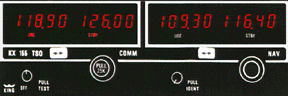 It’s quite simple really. Talk less. Sorry, I know it’s not what you were expecting. It doesn’t cost a billion bucks. It doesn’t involve putting some new gizmo in your airplane. It just involves a little common sense and will only cost you a few moments to brush up on (and follow) the rules. The areas that it encompasses, however, are diverse. From the filing of your flight plan to the way you check in on the frequency can (and does) have a significant impact on the system.
For instance, I must issue an arrival or a preferential route into Atlanta Hartsfield and its satellite airports a dozen times a day. Ditto for CLT, GSO, RDU, TEB, DCA ad nauseum. There’s not always an opportune time to do that with a frequency full of airplanes. Try to do it quickly and inevitably you’ll be asked to “Say again” while the pilot tries to find his pencil. The problem with doing it slowly is … well, it’s slow. I find it hard to believe that someone who’s smart enough to fly a multimillion-dollar airplane for a living can’t figure out how to file the AWSON.ONE arrival into PDK.
What? You thought I was going to pick on the guy that flies the Cessna 172? Sorry to disappoint you. I kind of like those guys. Not to mention that they’re learning from you – yes, you – the professional pilot. It’s the mortal fear of every student pilot that they are going to sound like a rookie on the frequency. So they listen to how the pros talk and try to emulate them. The pros must be doing it right. Right?
Open-book Exam…
Take a look at this text from the AIM:
Section 3. En Route Procedures 5-3-1. ARTCC Communications 2. The following phraseology should be utilized by pilots for establishing contact with the designated facility:
|
First off, did you even know there was a chapter entitled “ARTCC Communications”? Don’t be embarrassed. I didn’t, either, until I finally got so frustrated that I took the time to look it up. Secondly, look at what is included and notice what isn’t. In case none of this is sinking in, let’s see if these sound familiar.
…Huh?…
“Commuter fifty-eight sixty one six thousand.” Trust me, it’s as confusing to hear it as it is to read it. Is it Flight 5861 at 6,000 feet or Flight 5860 “level” at one-six thousand? Simple, huh? One word, the right word in the right place, can save five seconds of confusion. Don’t think it’s a big deal? Multiply five seconds times 1,000. (I’m being generous – ZTL works about 8,000 planes a day.) If that doesn’t work for you, keep in mind that just as today’s student is tomorrow’s commuter pilot, today’s commuter pilot is tomorrow’s airline captain. As an old controller once told me, “You can have good habits or you can have bad habits but one thing is for certain, you WILL have habits.”
 I know, it seems like a minor thing. But listen to the frequency the next time you’re flying. Notice how many times you don’t hear the phrase “Flight Level” when you should. Still think it seems like a minor problem? At Atlanta Center, we have about a half-dozen operational errors a year with the single phrase, “two five zero.” For example, “Airliner five eighty three reduce speed to two five zero knots.” “Two five zero Airliner five eighty three.” When I say, “talk less,” leaving out important words like “level,” “Flight Level,” “descending” or “climbing” isn’t what I have in mind. When an aircraft in the middle of the inbound push descends to Flight Level 250 instead of slowing to 250 KIAS, it doesn’t increase the efficiency of the operation.
When I say talk less, here’s an example that comes to mind: “Airliner five eighty three three three zero looking for lower and we’re on a heading of three four zero do you still need that?” Of course, that’s usually followed by, “Blocked.” More importantly, does it remotely resemble what is in the book? From my conversations with pilots here on AVweb, I’ve run into several professional pilots that believe telling a controller their assigned heading is required and/or a good practice when they check in. Again, refer to the book. Do you see it anywhere?
Of course, it could be our own fault. Controllers, that is. Does this sound familiar? “Contact Atlanta Center 132.97 and tell ’em your heading.”
 There are two reasons for that. Both of them are wrong. First, it’s been common practice for years on the midnight shifts to put the box haulers on a vector for several hundred miles direct to their destinations. Oh yeah, we can do that when we’re working a tenth of the airplanes that we work during the day. Anytime a controller puts an aircraft on a vector, the controller is required to coordinate that heading with the next controller (assuming the aircraft is to stay on that heading until entering the next sector). To avoid coordinating (lots of phone calls), controllers began telling the pilot to tell the next controller their heading when they check in on the next frequency.
What’s that old saying? What were once vices are now habits? After being “trained” to do this for years, there are pilots who do it that way on every frequency change. Now that the box haulers are flying during the daytime, even more pilots are copying it.
…Monkey See, Monkey Do
The second reason is related and is just as wrong. You see, the “monkey see, monkey do” principle works both ways. Controllers have seen other controllers do this for years, apparently without any ill effect. They get a little behind, don’t have time to coordinate and they take a little shortcut. “Contact Atlanta Center 124.37 and tell ’em your speed.” Hey, it works for headings, why not a speed assignment?
The problem is the controller working 124.37 is up to his eyeballs in airplanes. You try to check in: “Blocked.” You try to check in again: “Blocked.” You try again and get through but you forgot the speed. Five minutes later the controller notices something is wrong and says, “Airliner five seventy three say speed.” Whoops. As you sheepishly admit that the previous controller asked you to pass along that you were assigned 250 knots, the controller starts trying to pry the 727 (that he just vectored in behind you) off of your tail. Completely forgetting for the moment about the two coming together on the other side of the sector.
The second controller working the sector sees that the R-side controller (the radar/radio side controller) is now jammed up so he calls back to the previous sector and gets Airliner 237 slowed down to 250 knots and put on heading to give his R-side a little breathing room. Ten seconds later the Conflict Alert goes off on the two from the other side of the sector. The R-side looks over at it says, “Oh, &*^$,” and sees that he’s really going to have to rack the northbound guy around to avoid having a deal (Operational Error). As he reaches for the transmit button he hears:
 “Ah …Center this is Airliner two thirty seven with you at three one zero we’ve been assigned two hundred and fifty knots and a heading of two five zero we’re running a little late and we’ve got some international passengers that are running tight on their connections any chance we can pick the speed back up and maybe get direct MACEY or anything you could do to help us out would sure be appreciated.”
“Bizjet 123 turn left immediately heading two seven zero.”
“Blocked.”
“Uh … Center bizjet 123 is climbing we’re responding to a TCAS RA.”
Amazing what one little short cut can lead to isn’t it? The insidious part of it is that it’s done with the best of intentions (better service to more airplanes) and 99 times out of 100 we can get away with it. It’s that one time that you don’t get away with it that makes you understand why the rules were written the way they are. (As a side note, it’s usually about a day after an incident like this that a controller with a brand-new appreciation for the rules comes up to me and says “We’ve got to do something.”)
The Critical Link
The initial check-in is just that. It’s designed to get radio communications established so that we can communicate. Believe it or not, if you’re in a jet climbing to one zero thousand and you filed for FL350 we know that you are “looking for higher.” We already know that you want to turn on-course and we figured out long ago that you’d be glad to take direct to your destination or “direct to anything down the road.” We’re supposed to know if you’re assigned a heading or a speed. Yes, we’ll make a mistake every once in a while and fail to coordinate or we might just plain forget. If you think we’ve made a mistake or forgotten about you please feel free to bring it to our attention. After you check in.
“Radio communications are a critical link in the ATC system … it can be broken with surprising speed and disastrous results.” Trust me, we can learn to live within the rules. And I use the term “live” in the most literal sense.
Have a safe flight!
Don Brown
Facility Safety Representative
National Air Traffic Controllers Association
Atlanta ARTCC
