








 It’s Thursday, May 18, 2000. My wife Donna and I get up with the alarm at 5:30 a.m. Today we are going to fly from Clarksburg, W.V., home base of our airplane, to St. Louis. The AFSS briefer relates how there is a strong low over Kansas City with a frontal system extending from there to the East Coast. Strong winds and low ceilings with afternoon thunderstorms are in the forecast, with winds aloft forecasts of better than 30 knots at 3,000 feet. With the forecast weather and the West Virginia hills, I think to myself, “I’m glad we’re west of the higher mountains and that we’ll be flying an airplane with high wing loading.”
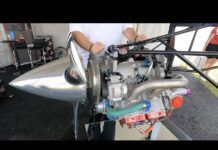
At the airport, the task of preflighting a round-motored antique airplane begins. Those who fly modern Cessnas, Pipers and Beeches can’t appreciate the task. For example, to properly preflight this airplane without getting at least some oil on your clothes is unheard of. By the time you position the ladder to check the oil, add a few gallons, clean the windows on one side, reposition to clean the other side, drain the fuel sumps, finish the walk around and push a 4,500-lb. airplane out of its hangar, about 45 minutes of hard work has passed. Is it all worth it? Ask me later; I might have an answer.
With all aboard, preflight completed and hangar closed and locked, we taxi to the FBO to complete the fueling process. Our Howard DGA-15 carries 122 gallons of fuel. I’ve added about 80 gallons of mo-gas and want to top it off with 100LL. Pratt & Whitneys like to have at least some lead in their diet to keep things running right.
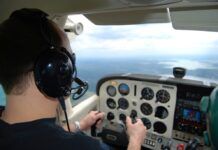
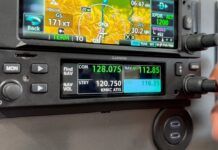
Wheels off at 9:00 a.m., we climb to 2,500 feet MSL but that’s all the ceiling will allow. That will give us about 1,000′ ground clearance over the western part of West Virginia. As I set cruise power of 1,850 RPM and 27 inches, the GPS shows the effects of that 30-knot headwind: a ground speed of only 115 mph with an en route time of 4:45. We settle in for a long flight and tighten our belts for the anticipated turbulence. Once established on course, I sit back and begin to ponder what brought us to this point in time and why are we flying a 57-year-old airplane halfway across the country in less than favorable conditions. My mind races back to find the start of it all.
 Did it start with the beginning of flight? Maybe, but that’s a little too general. Perhaps the more appropriate beginning is August 1, 1927, when Oliver L. Parks opened Parks Air College at Lambert Field in St. Louis, Mo., in a rented hangar with only one other instructor, a Standard J-1 and a Laird Swallow as trainers. From those humble beginnings, Parks Air College would grow to become the oldest operating aviation school in the country, with a reputation as one of the finest. In 1946, Oliver Parks sold the school to St. Louis University. Parks is not only the oldest aviation school, but part of the oldest university west of the Mississippi.
As the drone of the R-985 continues and the landscape of West Virginia hills changes to the flatter Ohio farms, my mind races on. Forward to the stories my dad used to tell of his childhood in the late ’20s and early ’30s. It seems that my grandfather’s friend, Alec Miller, was into this “new aviation thing.” He had a WWI-surplus deHavilland DH-4. Forget about licensing and such, the new Department of Air Commerce rules said a licensed pilot couldn’t fly an unlicensed airplane. Alec figured that an unlicensed pilot could fly an unlicensed airplane and still be legal. In any case, he gave my dad and uncles rides in the DH-4 and other aircraft he owned, including a Pitcairn Autogyro. The DH-4 that my dad got his first airplane ride in eventually ended up in the Air Force Museum after it was confiscated for, you guessed it, being flown unlicensed by an unlicensed pilot.
The turbulence is too much for Donna so she decides to lay down in the back. Thank God for that large bench seat for three. Flying the Howard is almost like sitting in your living room, with enough room to stretch out. Once she is safely settled in the back, I go back to my daydreams.
|

This time the setting is the Civilian Pilot Training program and the place is Cortland, N.Y., in the dead of winter, 1942. Dad’s initial flight training is in Porterfield CP-65s equipped with skis. After completion of the CPT program, it was off to Pensacola, Fla., for training in N3Ns. Dad’s flying career continued after the war – the setting is now the early 1960s, and we’re at Blairstown Airport in N.J.; only the memories are mine now. Dad just signed a lease for the airport and he’s going to run the FBO. The flight school started with a J-3; an Aeronca 7AC and Stinson 108 were added shortly. After a few years, the airport owner and other investors decided to start a parachute center. Dad convinced them that the airplane they needed as a jump ship was a Howard DGA-15. At this point I was about 10 years old, had been flying with Dad in the Champ, Cub and Stinson, but when the Howard showed up, I knew that this was an AIRPLANE. Those days at Blairstown are what infected me with my interest in aviation, old airplanes, and especially Howards.
The ceiling is dropping a little; we’re cruising at 2,000 feet MSL and the groundspeed is down to 105 MPH. In southern Indiana, if you tune a VOR to 108.0 MHz, you can pick up a country station. While listening to the tunes, they announce that the weather service has just issued thunderstorm and tornado warnings for the area for the rest of the morning and into the afternoon. I guess there is no need to call Flight Watch. The turbulence is still pretty strong even though we’re over flat land now. Visibility is still in the 12-to-15-mile range and I still have cloud definition so we press on. Donna is fast asleep in the back. Good thing the Howard is a stable platform; I guess that’s why the Navy used them for instrument trainers. If we were flying a newer GA airplane with lighter wing loading, we’d be on the ground. We pass through a few showers but no thunderstorms are apparent.
My mind drifts again, to the mid-to-late ’60s and my fascination with the writings of Richard Bach. It started with his magazine articles, many of which are reprinted in his book, A Gift of Wings. The central character of many of the articles and books was his Detroit Ryan Speedster Parks P2A, NC499H. The P2A was designed by Parks Air College, and the first several airplanes were actually built by students. As a teenager, I figured if a school could design and build an airplane with the lines of the P2A and the personality that Richard Bach could attribute to the airplane, that’s where I wanted to go to college.
The pounding of the turbulence has slowed some but ceilings also have gotten lower. We’re now over southern Illinois and down to less than 1,600 feet MSL. The 450 Shetland ponies are still beating away and the GPS shows we still have another half hour before touchdown at St. Louis Downtown Parks Airport. My mind continues to recap the past several years.
|

My second daughter, Jennifer, started at Parks (now known as Parks College of Engineering and Aviation of St. Louis University) about four years ago. She worked to get scholarships, grants, and loans to pay for her education herself. Two years ago she was awarded the prestigious Cobro Scholarship. While a student at Parks, Jen started the Parks Chapter of Women in Aviation, was active in the student chapter of SAE and participated in the annual SAE heavy-lift model competition at Daytona Beach, Fla. During her time at Parks, the University decided to move Parks College from the Cahokia, Ill., campus it had resided on since 1928 to the Frost campus in downtown St. Louis. In an effort to help the student population fit in the larger campus life, the Parks Administration organized the Association of Parks College Students (APCS) and Jennifer was active in that organization also. Since Jen was paying her own way, she needed a job. She found one at the St. Charles Airport as a line service person and after earning her A&P was promoted to working as a mechanic in the shop.
We’re on short final to Downtown, the wind is a little calmer near the surface but still blowing 190 at 12 gusting 20. I need my full attention now to get the Howard down with the crosswind and try to keep the inevitable bounces to a minimum. After touchdown and taxi to Mid Coast, we set about securing the Damn Good Airplane for the forecast thunderstorms. Five hours en route with turbulence, low visibility and no food leaves us tired, hungry and needing to use the rest rooms. Once in the terminal, we take care of the physiological needs, call Jen to say we’ve arrived, make arrangements to meet her later, and find the restaurant.
Friday morning dawns and we find out that Jen’s mother, Cindy, her husband Gary, and Jen’s younger sister, Kim were stranded at Newark Airport the night before. They eventually made it to Chicago and rented a car to drive from Chicago to St. Louis. Of course their bags were misplaced and they could get no answers over the phone. Donna and I made the best of the day searching out antiques in St. Louis’s Cherokee Street district. The Wings Ceremony, a pre-commencement ceremony for the Parks College students, was scheduled for that evening. Parks is still one of the smallest schools of St. Louis University. There were less than 100 students graduating from Parks but the seats of the Simon Recreation Center were filled with proud parents, relatives, and friends. After all the graduates were awarded their “Wings,” Arjun Ravindra, APCS President, awarded the Oliver L. Parks Award to my daughter Jennifer. Her hard work had paid off and now she is one of the only women in the history of Parks to receive that award. Her acceptance speech was short and sweet and gave recognition to her two sets of parents.
Saturday was the official St. Louis University graduation and Jen and her roommates had a reception at their apartment afterwards. A good time was had by all, but Donna and I had to turn in early so we could be on our way home the next morning.
Sunday’s weather called for the low to be over Maryland. I knew that we would be facing low ceilings and visibility on the way home. We waited at Downtown Airport for about half an hour after finishing the preflight for the field to go VFR. After departure we headed southeast to Pinkneyville for the RAH Newsgroup fly-in. We fueled up a Pinkneyville (97 gallons for 5-1/2 hours’ flying time; not bad for an R-985) and had a pancake breakfast along with the usual hangar tales. We departed PJY at about 11:30 am heading east, making it home in time to pick the dogs up from the kennel by 3:00 p.m. that afternoon.
 The flight home was uneventful but included some more reminiscing of days gone by and even deeper feelings of pride for my daughter’s accomplishments. I also contemplated how a 57-year-old airplane can fly VFR halfway across the country on a schedule while modern airliners with all their avionics get caught and leave their passengers to fend for themselves.
I guess it just goes to show the advantages of general aviation over commercial flights. We made our flights in the morning before the afternoon convection starts. While conditions weren’t the best, we were able to safely complete our trip as planned. Even though we flew low altitude, we had reasonably good visibility. If the thunderstorms had developed along our route, a diversion of less than 100 miles to the south would have taken us far enough away from the front to be well clear. We planned our flights so we would still have enough time to drive if we had to and the only pressure was to be there a day after our actual arrival.
We also had the chance to reminisce about the underpinnings of aviation in the U.S. and how we got where we are, about all of the men, women and aircraft that have gone before, and about our place in it all. A pretty good deal, all in all.