











 An airplane, especially an antique open-cockpit biplane built of wood and fabric and luck, is an idea with wings. The idea lives in each spar and brace, in every particle of imagination and know-how and tinkering that brought it all together and keeps it alive. And like any idea, it has the power to make things happen. This September, a handful of people inspired by an old airplane and the spirit of a lost aviator joined forces to bring an idea to life.
Early this year, a 1927 Avro Avian lured Greg Herrick, of Wyoming, halfway across the world to Australia, and planted an idea in his mind. Herrick collects vintage aircraft, and when this rare bird came on the market, he was eager to check it out. The seller had successfully flown the airplane along the route of a 1928 flight from London to Australia, covering 12,000 miles in 18 days, so Herrick knew the airplane must be in good condition.
 “[The seller] pointed out to me that this airplane, the Avro Avian, not this very one but one just like it, was the first airplane that Amelia Earhart had flown any distance at all in, by herself,” says Herrick. In 1928, Earhart, an avid weekend flyer, was a social worker in Boston when she was offered a chance to become the first woman to cross the Atlantic by air. “As she put it, as a sack of potatoes, not as a pilot, just as a passenger,” says Herrick, a history buff and Earhart fan. Her transatlantic trip, just a year after Lindbergh’s flight, made her world-famous overnight. She bought the Avro Avian in England, and two months after her return home, decided it was time to take a trip across the country – 5,500 miles, from New York to California and back – and help prove that women can fly as well as ride along.
The idea had taken root. Herrick flew the plane, he liked it, and decided he would use it to re-create Earhart’s cross-country jaunt, with a woman flyer to represent Amelia, and with a mission to revitalize her legacy. “I saw a chance to renew an interest in Amelia’s life beyond just that last flight,” said Herrick. He knew her as a pioneer, an adventurer, and an advocate for women’s rights … not only as the enigmatic woman who mysteriously vanished over the Pacific in 1937. The Avian was the oldest flying airplane in Australia when Herrick bought it, and it was with mixed emotions that he shipped it to the States, but he knew the idea had wings.
Herrick hoped that besides being a great adventure, the project would celebrate Earhart’s true legacy, plus promote vintage aviation. Maybe it would even sell a few books for his publishing company, HistoricAviation.com. But along the way, unforeseeable events lent a deeper significance to the meaning of Earhart’s spirit in today’s world.
A vintage airplane is like a time machine, re-creating the era in which it was born. In 1927, when the Avian was brand-new, Earhart and the other female pilots of her day defied the odds, forging their way in a man’s world in a time when most women had few opportunities in life. Flying in those early days was still a daring gamble against dangerous odds. Engines were often unreliable, most airfields were unimproved fields with few landing aids, the airplanes were unstable and primitive. The Avian has no radio, no lights, no electrical system. It’s the embodiment of aerial romance.
 Back in the 1960s, that romance captured the imagination of a child named Carlene Mendieta, as she wandered beneath the open skies near her family’s Nevada farm and watched Piper Cubs buzz by, low and slow. The people in those little airplanes could see far beyond the horizon, their wings took them above all obstacles, the sky was theirs to wander in … how could anyone not envy them? But while Mendieta held onto that feeling, she didn’t pursue it. Bright and practical, she chose a career as a periodontist, but in a roundabout way, it led her back to those childhood dreams.
Now, it’s a bright, chilly September morning, in Westchester County, N.Y. Mendieta preflights the Avro Avian, helps to pull it out of the hangar into the dawn, packs her charts, checks her GPS, all the while watching the winds, fielding reporters and cameras, and keeping her cool. She’s dressed in jodhpurs, a tailored shirt with a scarf, and custom-made leather boots, the kind of flying outfit Amelia Earhart would have felt at home in. With her close-cropped red hair and long lanky frame, she could be Earhart’s long-lost cousin.
Herrick found her shortly after he found the Avian. Having decided on the re-creation flight, he began asking around for a woman pilot who could fly the plane and might enjoy such an adventure. “Carlene’s name came up, across the board,” he says. Along the way from Nevada to California’s Sonoma Valley, Mendieta had rediscovered her love of flying, when a colleague took her for a ride in a Piper Cub. Soon she had a Cub of her own, four other vintage airplanes, and about 300 hours of flight time, all of it in taildraggers. When Herrick called her last March, out of the blue, he was pleased with her response. “I was ready to do all this convincing,” he says, “but after about two minutes, she said she’d do it.”
It turned out, serendipitously, that Mendieta had much in common with Earhart. The trip would be her first long solo cross-country, just as it had been for Amelia. Mendieta’s total time was about the same as Earhart’s when she embarked on the flight. Then there was the physical similarity, and the warm, friendly smile. “Perfect,” says Herrick. “Right out of Central Casting.” Now they’re ready to go, on a three-week flight planned down to the minute, with a break in California so Mendieta can see patients before heading back east. Their mission, not only to follow Earhart’s route, but to educate everyone along the way about her pioneering life and her contributions to aviation.
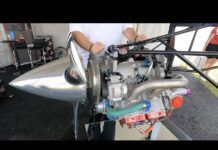
Mendieta climbs into the cockpit and settles in, and Herrick grabs an edge of the propeller, with the prudent stance of a pilot who knows props can bite. “Hot!” “Off!” “Contact!” they call to each other, as Herrick shoves the prop and jumps back, time after time after time. Finally, the propeller spins to life, and Mendieta taxis out to the runway, photographers in tow. “This airport is like my worst nightmare,” Mendieta had confessed, the day before. An antique flyer all the way, she had no experience using a radio. Westchester County is a busy corporate airport, with a tower, and it daunts her a bit. Her other nightmare, the media, is turning out not to be as scary as she feared. “I’m a very private non-media kind of person, but everyone has just been just genuinely interested and very kind to me,” she said. “It’s been like talking to friends. And I’m really dedicated to be open about the flight, letting people learn from it and maybe get some kind of inspiration from it.”
 The airplane has been painted to match Earhart’s plane. It looks brand-new, perfect and ready to go. “This is the only flying Avro Avian in North America,” says Herrick. “There are very few of them flying in the world. It is exactly like Amelia’s, the only difference is it has a slightly larger engine and reinforced landing gear. That gear was standard on later models. It was built at the same factory, just a few weeks before Amelia’s plane.” It may be small and simple, but that doesn’t mean it’s easy to handle. “You have to fly this airplane all the time,” Herrick says. “It’s very lightweight, like a kite in the air. It’s difficult to land in a crosswind, particularly a stiff crosswind.”
Now, alone in her “sauntering, go-for-a-nice-little-ride kind of airplane,” Mendieta gets to the runway, takes off and heads west, exactly as Earhart did so many years ago. “We flight-planned for 82 miles an hour,” says Herrick. “The issue really is headwinds. Unlike Amelia, we do have a schedule that we’re trying to keep, though that will probably go right out the window,” he laughs. Along the way, they’ve planned airshow appearances and meetings with flying clubs, school kids, and the media. They’ll stop at all the same places that Amelia did, eat the same meals, stay at the same hotels. They’ll give away thousands of little blue pamphlets that tell the story of “Amelia Earhart and her Avro Avian,” plus they need time for autographs, interviews, photo shoots. The Web site is up and running. They plan to return to Westchester County at 2:30 p.m. on October 2. Hmmm, maybe.
Besides headwinds and crosswinds, the list of things to worry about includes: rain – the wooden prop can delaminate if it gets wet, so showers mean get down and search for shelter; engine problems – Herrick will follow the route in a Cessna 182, with spare engine parts and a network of suppliers ready for quick shipments if needed; structural damage – the wood-and-fabric airplane may be delicate, but it’s fairly easy to repair if necessary, and in a pinch, says Herrick, “There’s always duct tape.” It seems he has considered and planned for every eventuality – except an unprecedented grounding of all VFR aircraft.
“It was going great, the plane was running beautifully, we’d had no real problems mechanically, we were on schedule,” Mendieta reports, from California, in mid-September. “We had a little bit of weather in Muskogee [Oklahoma] and had to land 20 miles early, but we were ahead of schedule, so we were able to go on to Hat Box Field the next morning. We couldn’t ask for it to go any better than it had been going. Plus we were all having a really good time.” The whole crew – Herrick and his co-pilot, plus a ground crew that followed the route in a motor home – had become like a family, fellow travelers on the road, sharing an adventure.
 Flying across New Mexico, with wide-open skies, Mendieta rarely climbed higher than 300 feet – low enough to wave back to the folks on the ground who looked up to watch her pass. When it got thermally, the 182 would climb to a comfortable altitude, but Mendieta preferred to take her bumps and stay low. “It was so clear and beautiful. It’s the best flying there is, there’s nothing better,” she said. “We were all enjoying it, I was loving the flying, feeling so lucky to live in such a beautiful country.”
They spent the night in Hobbs, N.M., and on the morning of September 11 Mendieta turned on the TV in her hotel to check the weather. “We all saw it in our rooms, we knew of the horrible tragedy,” she said. “You’re so far removed from it, somewhere like Hobbs, you can’t imagine it impacting you, specifically. But certainly, it’s impacted each and every one of us.” The impact on their plans was unexpected: They were grounded, and they were stuck. “We went to the hangar and were rolling the planes out, and the tower sent someone down to say, ‘Roll ’em back in.'” No airplanes would be allowed to fly that day, and nobody could say when the airspace would be free again.
 After waiting in Hobbs for a couple of days, anticipating at any moment a lift of the ground stop, Herrick and Mendieta decided they couldn’t stay in limbo, they’d better get home and take care of business, and come back to Hobbs when they could. Then they found it might not be that easy. “It’s wild, because we’ve always been so mobile, it was unbelievable to me that I couldn’t go home even though I wanted to,” Mendieta said. The trains and buses were all booked, the airlines were in chaos, forget about rental cars. Finally everyone patched together a travel plan and got where they needed to go.
But as the prohibition on VFR flight drags on, it gets tougher and tougher to wait. Flying IFR is not an option – the Avian has no electrical system, and no way can it be adapted to qualify as IFR-capable. As the fall season advances, winter would creep into the northern states – Mendieta’s eastbound route would take her through Utah, Wyoming, Nebraska – places where winter comes early. If they have to delay much longer, they might have to put the trip on hold, and take it up again in the spring. “I wish we could finish the trip,” Mendieta says, as she waits in California. “It would just be one small way for us to say, ‘Look, we’re not going to let them change our lives. We’re not going to be afraid of them, it’s okay to fly, look, we’re flying in a little old antique airplane.'”
 Finally, after nine days on the ground, VFR is okayed, everyone gets back to Hobbs, and they get underway. Schoolchildren who meet them at the airport now carry flags; everywhere they go, people thank them for continuing on with the flight. Along the way, Mendieta and Herrick meet a few people who saw Earhart on her trip in 1928, give a ride to the son of the original owner of their Avian, shake hands with Bill Piper Jr., and find themselves inspired by the hundreds of schoolchildren and aviators who come to each airport to see the airplane and show their support.
On October 2, a clear, cold day in Westchester County, Mendieta gently touches down in the Avian at 2:25 p.m., her best landing yet. Five minutes ahead of schedule. “Flawless,” says Herrick, of the entire venture. The crowds were great, people loved it. Mendieta says it was all so much more than she could ever have expected. “We couldn’t have had it better … it’s almost like it was a wonderful dream.”
“Pilots are always dreaming dreams,” Earhart once said, with a glint in her eye that left no doubt she had a few ideas of her own. Sometimes, even today, ideas turn into airplanes – or journeys that inspire flights of the imagination.
