





The weather forecast all week has been consistent if nothing else – wrong 100 percent of the time. A thick layer of fog smothers Oakland like a ridiculous amount of Styrofoam pellets protecting a small package. Forces greater than the defense of wishful thinking demanded cancellation of our trip last weekend. As lunchtime approaches, the fog stubbornly resists passage to even a glimmer of sunshine. We are coerced into canceling yet another flight.
The countdown is underway for the Reno Air Races. My friend Steve Andrues has extended an invitation to help transport a battery for the mighty Rare Bear. There is never a dull episode in the continuing saga of flying with Steve. A razor-sharp mind, wicked wit, and mile-wide streak of generosity compose this human phenomenon. Only months before, his stories and persuasive overtures regarding the exhilaration of racing impelled me to grovel before the Hayward Air Race committee, seeking late admission into their event. The committee granted my request, and the world of proficiency flying expanded both my skills and horizons. Owner of Ni-Cad Systems, Steve is determined to deliver a chemical powerhouse capable of feeding the electrical appetite of the Bear.
A Long Wait
For me, this trip is a sort of homecoming. Reno has been an annual Mecca for my two brothers, yet 15 years have passed since I last sat on the sidelines watching warbirds roar and rumble in a screaming dash around the pylons. Motherhood has a way of pre-empting any previously scheduled plans, and the years have gone by as quickly as the passing aircraft. The race season and summer’s end now converge into a precious few remaining days. Unpredictable weather has sidelined the delivery, and left me helplessly watching an entire week come and go. Dwindling opportunity has given me only one more chance to see the great plane. I swallow hard as I watch this opportunity evaporate to just one remaining day.
Let the Race Begin
Yet this morning we are mercifully granted brief glimpses of blue sky. The tenacious fog withdraws to the coastline by lunchtime. This is the moment we have been waiting for. I have scraped to have the funds available for flying the Tiger to Reno, while Steve successfully procures a Cessna 182 on short notice. The offer of a free ride in the Cessna is an economical bargain compared to the funds I will siphon to feed my plane, but I find the necessity to fly far more pressing than a fun-loving jaunt. My mountain flying skills need sharpening, and I have far too many good reasons to fly.
The race flag has been dropped, and we are off. Fog can move into the low-lying Bay-Area airports with shocking rapidity. I have watched Hayward go from visual conditions to IFR in the time between pre-flighting the plane to holding short of the runway. Because we have two aircraft at separate airports, we move quickly to get ourselves into the sky.
Time to Dance
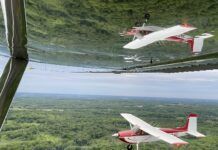
The flight of aerial choreography commences, beginning with a touch and go in Hayward, and becoming a formation flight as we depart toward the East-Bay hills. The dance progresses smoothly, and we are tickled to have this last crapshoot succeed. But the sky is an interesting place, which both the visible and unseen claim as territory. I have several clues that there is an impending event forming.
Visible and Unseen
A large aircraft is swiftly approaching – very large, in fact. It appears to be a C-5 inbound on one of the instrument approach paths that intersect this vicinity. Big planes equate to enormous, unseen waves of crashing atmosphere. Beating this behemoth to an invisible intersection will rescue the Tiger from turbulent consequences. I push the throttle to the firewall.
I succeed in beating the C-5 … and losing Steve. Perplexed, I circle the area while announcing my intentions to find a speck of a plane. The ‘bug’ on my windscreen metamorphoses into a Cessna, the transformation concealed by the hazy murk masquerading as a sunny day in the Bay Area. Talking, circling, and maneuvering allow us to pair up once again over Rio Vista. I surrender aspirations of formation flight to the desire of arriving in Reno earlier rather than later, and Steve leads the way to Auburn.
Pure Mountain Air
The Sierras are enjoying a crystal-clear bout of Indian summer. The milky haze of the Central Valley is left behind as we travel over the Donner Pass toward Lake Tahoe. Pure mountain air sharply defines rugged granite peaks and broken mesas. Strewn throughout the mountain range are shimmering topaz and turquoise lakes, filling mountain cavities with jeweled splendor. Even from our vantage point above them, their purity allows us to see clear to the bottom. Transmissions are kept to a minimum as we fly on in our own worlds of quiet thought. Skirting left of Truckee, we fly directly to Reno-Stead.
Reno Arrival
 | |
High-desert visibility is deceptively clear, with the sprawling city of Reno, Nev. appearing to be only a stone’s throw away. The airport is quiet and virtually deserted, but this picture will change dramatically in the coming week as people arrive in preparation for the Air Race. We taxi past a handful of planes and an enormous grandstand, which consumes the space a terminal would ordinarily occupy. I have never seen the actual stands before – only enthusiastic crowds of cheering, sweating race fans. Mentally, I fill in the blanks to match the Air Race scene buried in my mind 15 years ago.
Marc Weir greets Steve on the ramp with the usual good-natured ribbing. I have only come along as a wide-eyed tag-a-long, but Marc’s manner is easy and gracious. His kindness is every bit as noble as a red carpet or an open door. Steve hoists the battery onto his shoulder, and we happily walk over to the open hangar.
Inside “The Bear Cave” …
| (click photos for larger versions) | |
 | |
And there she is – more beautiful than the autographed poster I have hanging in a place of honor on our office wall. The Wright 3350 engine sits across the hangar. The Bear looks strangely decapitated without its engine and prop in place, but still dignified by reputation alone. It appears that there is a mandatory, unspoken rule in operation. Visitors to “The Bear Cave” will unhinge their jaw and allow their mouths to drop to the floor. Gaping is both allowed and encouraged. Each person who enters has the same look of awe.
 | |
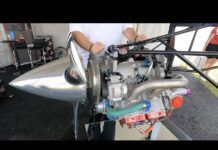
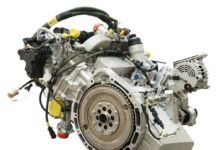
The Rare Bear is a highly modified Grumman F8F Bearcat. The heart and soul of this plane is impatiently awaiting its transplant, but for today, both curiosity seekers and aficionados alike have a remarkable view of the Wright 3350. Over 4,000 horsepower are generated in the nitrous-oxide-injected engine – 60 percent more than the Bearcat’s stock Pratt & Whitney R-2800. There are only a few fine pilots with the skill and strength to fight the yaw created from the tremendous torque of this massive engine and the modified Orion three-blade prop. Flights are literal triathlons for these pilot/racer/athletes.
Other modifications include a wingspan shortened by four-and-a-half feet, and compact ailerons, effective in the 450+ mph range that the Bear frequents. The shortened wing has also altered flying characteristics for touchdown and landing, effectively doubling standard speeds for the Grumman.
… and Inside “The Bear”
 | |
I feel dwarfed as I crawl into the Spartan cockpit of the former warbird. The few gauges on the panel clearly show the topic of supreme importance to all involved. Engine instrumentation has become the “visual voice” of a monstrous powerplant. I notice both the “pounds per hour” of fuel, as well as the oil-inlet and oil-outlet temperature gauges.
Marc explains that the pilot only looks at selected instruments. A ground crew is in charge of monitoring the engine, with the cockpit gauges used as a cross-reference. The less time divided between the cockpit and the racecourse, the better.
The appetite of the Bear is enormous. Flat out, the Wright 3350 consumes 600 gallons of fuel per hour. The tanks hold 180 gallons. You do the math. The racer is a complex beast of simple appetites – “If you treat me ‘just so,’ I will give you the ride of your life.”
Rare Bear has been the course record-holder and a crowd favorite for generations of race fans. “The fastest prop-driven aircraft in the world” has been clocked over the New Mexico high-desert during a record-breaking run at a blistering average speed of 528.33 mph!
Countdown
 | |
The mechanic volunteers have their work cut out for them. The race is only 12 days away. Lack of funds and assorted gremlins of the time-consuming sort have plagued the team, and the Bear hasn’t flown for three years. Yet even in its absence from competition, it reigns from an untouchable throne, remaining the course record-holder and retaining the world speed record for piston aircraft.
Reluctant Departure
Our labor of love is finished, and it is time to head back to the Bay Area. The usual desert winds are picking up as the afternoon lengthens, and we can expect headwinds for our return trip. After fueling the planes, we taxi back to 26 for departure. A virtual museum of aircraft from a different era – MIGs, Sabrejets, and an F-105 – stare blankly at me from the tarmac. I dearly wish I could get out and explore them, but I have promised an arrival time back into Oakland that will keep me clear of the usual fog.
Running the Course
Steve announces his departure, and I quickly scoot in behind him. Performance numbers on the 182 and the Tiger are quite similar, and I calculate that I can depart without overtaking and devouring him. Still, I am off the ground several hundred feet before Steve, climbing both faster and higher. Inquiring of his climb speed, I make corrections to the Tiger’s behavior.
“Want to do a trip around the patch?” Steve asks.
“I’m right behind you!” I respond.
“I’ll make a slow turn to the right.” Strangely, this looks like a definite left to me, and I ask if he meant “the other right.”
“Yes, that’d be the one.”
The 182 swoops into a sharp left bank, and Steve takes the plane back over the runway at about 100 feet at a scorching pace. I look down at the GPS; already it is indicating 148 knots. I am higher than Steve by a few hundred feet, and put the plane into a steep bank. I am going too fast to follow his ground track, but the dive down the runway has me quickly overtaking him. My hand stays on the throttle to keep the engine below redline.
Steve banks to the left and I follow, again pulling the throttle back and gaining some altitude in order to give myself more options. Thoughts pelt my mind like rain on a windscreen. I hear my instructors. I see news flashes and NTSB reports. “Where is your out?” is the crystallized version of every caution ever taught to me.
But the thrill of the chase is mercilessly addicting, and the Tiger could catch this bird ahead of me if I so choose. The sagebrush is both a stationary form and a passing blur in the same moment. The rolling high desert hills undulate beneath us as we round the next pylon. I remember Marc’s words and an interview of Lyle Shelton. You’re visual – purely visual. You have to be.
A quick glance at engine temps looks good. Steve starts to gain ground and I do a slow dive to try and catch him. The pleasure is pure and exhilarating, coursing through my body and consuming my senses. I feel as if I have grown wings. Flying an aerial bobsled run, I savor the view of a lead plane carving a visual course beautiful to behold.
We approach the last pylon and I recognize the spot. This is where I’ve watched the Air Racers do exactly what I’m doing now – banking around the last pylon, and heading for the finish.
 | |
The past and the present converge in the pinpoint of now. I have passed through a barrier, coming out on the other side into a new world. In the past I’d only watched the race from the sidelines. Now I find myself in the cockpit – flying the course. In a million years I could not have imagined that this is where I’d find myself 15 years down the road. The flight will forever be burned into my mind as one of the best of my life.
Returning Home
We break off from the chase and head over the hills to Truckee. The Tiger is pulling away in powerful strides, and even throttling back isn’t sufficient for the Cessna to catch up. A standard rate turn allows Steve to overtake me, and I follow him through the Sierras. Haze on the western slope of the Sierras consumes the phenomenal view through the Donner Pass, and only a few miles of distance will permit positive identification of an aircraft.
The planes arrange themselves into a respectable duo as we fly to Sacramento. Thanks and best wishes are exchanged before breaking off just east of Mount Diablo to our respective destinations.
A Fervent Love …
Returning to Reno has allowed me to reclaim a lost love, renew a lost passion, and rekindle a smoldering spark. And in only a few days, the best and the finest will wring out their hearts and souls to claim their prize and pursue their passion.
 | |
… And a Reverent Memorial
But the warbirds are even more – a reverent memorial to a time of selfless bravery and sacrifice. These are glory runs for heroic planes. To see their beautiful forms scream across the sky allows us to hold onto the finest specimens remaining of a rugged past. Each flight heralds mighty men and women – facing an uncertain future, but choosing only to look forward, pull together, and sacrifice for the generations to come.
And we are those generations.
This handful of piston-powered aircraft are treasures, like our dear friends who used to fly them. Time has taken its toll, and these friends are slowly stepping aside, vanishing so that we may now take our turn.
No Holds Barred
It is worth whatever shot you can take to be a part of the Air Race. A fan, a crewmember, a relative, or a friend can share a flat-out, heartfelt fervor for this sport of high-desert gladiators. The best in the field are there to throw the dice and give it their all – come what may.
And whether on desert backroads sitting in truck beds, on car roofs, or sitting in the stands – go look, watch, wait, and cheer. Be a part of this no-holds-barred world. For here, being a spectator can be more far-reaching than it appears.
See you at the races.