











In a perfect world, the opening morning of a major spectator event would bring crisp, clear, cool skies conducive to the focus of the celebration. No traffic snarls would plague the arriving throngs, the entertainment would start on time, and the scheduled attractions would rise to the expectations of the audience.
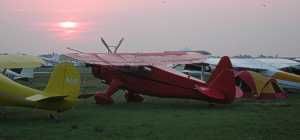 Somewhere, somebody must have deemed the 27th EAA Sun ‘n Fun Fly-In worthy of such wonders, because from opening day to today, the weather cooperated with nothing more offensive than a little ground fog that evaporated in time for the launch of the show with the annual sunrise balloon race on Sunday morning.
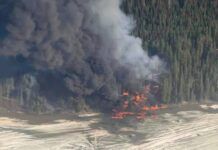
From the opening-day wake-up call of a big round engine crisscrossing the field before dawn to the liftoff of the two dozen aeronauts to the glitter of the Tuesday night aerobatics show, Sun ‘n Fun 2001 has so far lived up to its name. The only downer of the fly-in to date was the Monday evening crash of a two-place Pelican light experimental trying to take off from the grass strip at Paradise City that killed the pilot and injured a 15-year-old passenger.
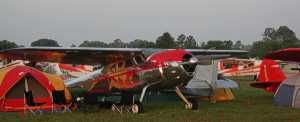 On-the-field chatter focused as usual on talk of new aircraft designs, new kit airplanes, new avionics and other goodies available across the field. Perhaps the highest point of interest surfaced at a series of briefings on the new Sport Pilot and Sport Aircraft rules currently in draft form at the FAA – along with the accompanying frustration with how long the process is taking (nearly a decade, to date) and the length of the process still to go, which includes stops the proposal must make at DOT, the Office of Management and Budget (OMB), and back to FAA before a final proposal is published for public comment.
Odds-makers on the field were putting the chances of seeing a proposal before year’s end at less than one in a hundred and the chances of the final rule becoming effective within 18 months at less than one in a thousand.
But most of the throngs dwelt more on the immediate attraction of thousands of airplanes to ogle in the Custom-Built, Vintage, Warbird and Ultralights parking areas, the scores of new and new-and-improved products to shop among, socializing with hundreds of old friends and making new friends under the warm Florida sun.
Happiness Is A Hangar Built For Two
 Your mother-in-law might not see a major fly-in as the ideal locale for her daughter’s nuptials, but there was no better place than Sun ‘n Fun for newlywed bride Gloria Nicholson and her groom, Robert Casey, to wed. So with a little fanfare, the right trimmings and a bunch of friends from EAA Chapter 611 – where Robert is a member – the couple did the deed Wednesday afternoon.
AVweb managed to catch the happy couple during their post-I-do cruise as friends paraded them around the grounds in a golf cart, complete with the obligatory tail of dangling, clanging soft-drink cans. The status of the pair was clear by their formal dress and matching Bride and Groom baseball caps. The bride wore white, the groom a black tux, and the driver, well, she was all smiles at the warm reception the couple received from passersby.
So, a toast to the happy couple from all the folks at Sun ‘n Fun and here at AVweb. When a couple starts life together at an airshow, you can pretty much expect that the happy duo will be flying high together for a long time. We’ll be looking for you for at first-anniversary celebration.
A Higher Plane: Bohannon Tackles Altitude Record
Bruce Blasts Hot-climbing Exxon Flyin’ Tiger Into The Blue Beyond…
One hour, 19 minutes, 43 seconds. That’s the time needed for Bruce Bohannon’s scorching Exxon Flyin’ Tiger to claw its way to an apparent world record for altitude in horizontal flight Tuesday afternoon, ending a process years in the making. The project netted the former pilot of Pushy Galore his fourth climb record since he changed mounts and set his sights on the up, up and away, instead of flat-out speed.
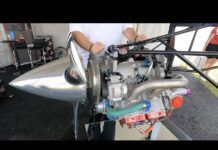
The high-altitude drama began on the ground, with seemingly endless preparations leading up to the moment of truth. Breaking records requires a lot more effort than just hopping up a Lycoming IO-540 to 400 smoking ponies, strapping in to the modified RV-4 airframe, and blasting off toward the stratosphere with a tank of O2 at your side.
There are propellers to test and instruments to certify, equipment to build and try out, and flight test after flight test to hone the machine to its highest state of performance and strop the pilot to the keenest edge of mental sharpness. After that, it’s a matter of convenient climb clearances, balancing the fuel load for the mission, and trusting that the minions of weathermaking will cooperate.
 …Mission: To Go Where Pistons And Props Fear To Fly…
“We tried this out just a week or so ago, and we didn’t quite make it …” Bruce Bohannon said on the morning of his record attempt. Smiling, relaxed and ready, Bruce Bohannon lacked the demeanor of a man about to go where only the pressurized generally go. “It’s quite a trip up there, and it’s always good to get back down,” he conceded. “But I think we’re ready.
Bruce’s recent test flight was flown to more than 33,000 feet behind a Hartzell three-bladed prop that helped him smoke through three time-to-climb records in the past year: 3,000, 6,000 and 9,000 meters. After seeing the times and residual performance left at 30,000 feet during the last record, Bruce had plenty of confidence in his bird. But between 30,000 and the 34,800 needed to lock the absolute record, there are lots of places where things can go wrong.
“We simply ran out of climb up there, so we did some tests on a two-blade that indicated to us that it would do about 80 feet per minute better above 30,000 feet,” Bruce said. Swapping props also saved some weight, meaning he could carry a bit more fuel. Dropping out his flat-pack parachute also shaved some pounds, which he hoped would help to make the final effort. “With just enough fuel to fly this and the lower weight, we should be right in the ball park.”
…Just Getting There Is Not Enough – 90 Seconds Straight And Level…
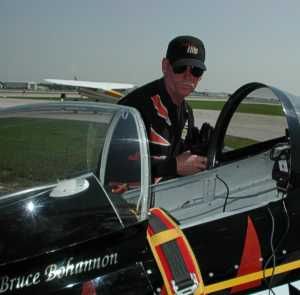 Unlike his time-to-climb records – your basic race-against-the-clock task – this challenge involved much more in the way of technical requirements, as explained by Larry Steenstry, a retired United Airlines captain who served as the official observer for the National Aeronautics Association. “Essentially, he has to hold the airplane in level flight for 90 seconds with no loss of airspeed,” Steenstry explained. “The pitot-static system has to be tested and certified, the altimeter has to be certified, the scales we weighed the airplane on had to be certified. But the real work is Bruce’s.”
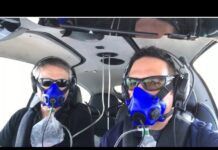
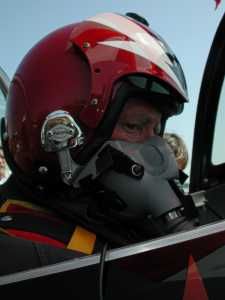
And what work, indeed. After indulging a group of aviation journalists in a breakfast briefing a few hours before his noon launch slot, Bruce returned to the Exxon/Mobile tent to make final preparations, check out the airplane a final time, test the pressure-oxygen system, oversee fueling, and push out to the flight line by 11 a.m. Parked at his spot near Runway 9, Bruce had to suit up in totally atypical attire for Florida in the Spring: long pants over ultra-thin insulated underwear; a jacket, gloves, and then his helmet and O2 mask. He spent a sweltering 45 minutes in the Tiger, suited, strapped in, helmeted and breathing oxygen through a pressurized mask in order to super-saturate his blood with the gas. The reason: to purge his bloodstream of nitrogen.
“Otherwise, up that high you can suffer the ‘bends’ just like a deep-water scuba diver coming up too fast,” he explained. The bends can afflict divers who surface too quickly, when nitrogen bubbles out of the blood and collects in their joints. In mild cases, the bends is extremely painful; in severe cases, death can result. For a pilot tackling the rarefied atmosphere above FL300, even a mild case presents potentially fatal problems: vision problems, mental acuity -“Always a problem for me, anyway,” Bruce joked – and physical control. Definitely something to be avoided, right?
Now imagine sitting in a hot, confining cockpit wearing winter clothing on a 90-degree, humid Florida afternoon. “You’re clothes soak with sweat that won’t evaporate and that sweat will freeze in your clothing at minus-30 (C),” Bruce explained in his typical dead-pan delivery. “But it doesn’t feel cold against your skin – it burns, like a hot iron, and you can’t get away from it.”
Heating the cabin might seem like an solution to some. But the added weight of a heater system in an airplane tackling this record is nothing more than another potential failure point. Bruce preferred to do without.
…As The Crowd Watches, Bruce Melts…
The folks at our Favorite Aviation Agency promised to do all they could to help Bruce meet his goal, which basically meant one thing to Bruce: Cleared to climb direct, no vectors around those pesky jetliners.
 Just before 11 a.m., Bruce and his crew slipped the Flyin’ Tiger out of its display slot and headed out to the staging area, a parade of photographers in trail. He suited up, got a good-luck hug from his partner and girlfriend Donah Neville, and then Bruce slipped into the cockpit. While Donah shaded him with an umbrella, he strapped in, donned his helmet, took a couple of swigs of spring water and strapped on the pressure mask. He then started the process of purging his circulatory system of nitrogen.
The clock started to count down: 45 minutes to go. Next, he entered his initial flight plan into the Honeywell KMD-150 he uses as his primary navigator. Among the waypoints entered was an intersection about 200 miles to the west over the Gulf of Mexico. That would be his destination as far as ATC was concerned. By 11:25, the preliminary work was done.
Nothing left to do but sit and swelter. As the minutes ticked by, Bohannon would periodically ask a question, his voice muffled by the specially-fitted pressure mask, only the slit of his unshaded eyes peering out from between the mask and the helmet. The sweat soaked through his insulating underwear, through his jeans, through his jacket. Donah wiped sweat from eyes and tilted the umbrella to block the moving sun. Ten minutes to go, just enough to time for a trio of controllers to stop by, let Bruce in on the latest information, and tell him they were ready to wave him off Runway 9.
Five minutes remaining, and it was time to add to his blazing heat load. With a special auxiliary battery plugged in to the Exxon Flyin’ Tiger’s electrical system, the big-bore Lycoming spun to life, despite its 12:1 pistons, and the resounding rumble of 400 horsepower roared across the show grounds as the watchful cheered. With his crew, Donah, the well-wishers and controllers waving their good-luck wishes, Bruce released the brakes and the Exxon Tiger rolled north toward Runway 9. A red-shirted controller waved Bruce through the taxiway intersection and in 300 feet, Bruce was off.
It was a minute after high noon and the showdown was on – pitting pilot and plane against gravity.
…The Long, Lonely Climb…
 With only a single com radio on board and the need to communicate constantly with ATC, Bruce’s departure from LAL pretty much left his supporters with nothing but silence. Save for hearing Bruce’s response to ATC, the ground crew had little to go on to gauge his progress. And off he climbed, aggressively, he would say later, far more aggressively than he had before. In his favor, ATC was true to its word, giving Bruce a direct climb clearance to his chosen intersection way, way out over the Gulf. Far from the view of the folks back at Lakeland, the Flyin’ Tiger charged ever upward toward its target altitude, 35,000 feet MSL, up where the ISA standard temperature should have been below minus 40 degrees Celsius. “Once in a while, the controller would give me a traffic vector, but at least they didn’t make me hold,” Bruce later related.
Upward and onward, for the ensuing 45 minutes, until the Exxon Tiger clawed through 30,000 feet, then 31,000, to 32,000, 33,000, achingly slowly to 34,000, then 34,100 and, finally, 34,150. Behind him, a video camera recorded Bruce’s altimeter, airspeed indicator and thermometer, to provide the critical documentation Steenstry and the National Aeronautic Association (NAA) would need to make their call.
After peaking at 34,150, the Tiger settled back to 34,100, and Bruce worked to hold the plane level at a constant 85 knots indicated. By Bruce’s calculations, the big Lycoming that churned out 400 ponies back down on the ground gasped for enough air to eke out the 75 horsepower the Tiger could make with only 7.5 inches of manifold pressure. He needed every ounce of thrust to hold level flight. A scant 90 seconds later, his fuel dwindling, skin burning from the ice crystallized in his clothing, Bruce turned the Tiger for home and the most critical part of the remaining mission: making it back to Lakeland on the scant few gallons of fuel left. He’d been gone nearly 50 minutes.
“I got a little worrisome up there toward the end, when ATC kept giving me vectors for traffic,” he related later. “I kept telling them, ‘Guys, I’ve got to get back to Lakeland.'” At one point, he considered landing elsewhere as a precaution against going dry. “They finally turned me loose, but I was beginning to get a little worried,” he said. By the time he turned final for Runway 9, Bruce had little fuel left. “Heck, I may only have a gallon or two. The harder climb got me up there faster, but at the expense of more fuel than I expected to use.”
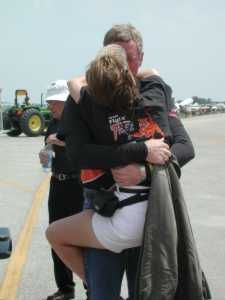
One hour, 19 minutes, 43 seconds after he left Runway 9, Bruce touched back down on the pavement and stopped the timer and the camera. His crew swarmed to meet him and direct him back to his parking spot. Donah jumped into his arms for a congratulatory hug once Bruce extricated his chilled frame out of the cramped cockpit, grabbed a sip of water, and started shaking hands. “I think we got it,” he said quietly. “Now it’s up to what we’ve got on tape, and Larry.”
…The Waiting Game: Short, Sweet And Still Uncertain…
 Larry Steenstry took the videocamera from Bruce’s hands even before he got out of the airplane, heading toward the Exxon/Mobile tent to review the record. Peering through the tiny viewfinder, Larry strained to read the dials on the miniature screen, a stopwatch in his hand, timing the level portion of the flight. “We can’t know exactly how high Bruce climbed until we get the afternoon readings from the NOAA (the National Oceanic and Atmospheric Administration),” Steenstry explained. “And that won’t get plotted until all the data are back in Washington at NAA headquarters.” The chairman of NAA’s contest and records board, Steenstry is in the exact position to understand the drill.
Twice a day, NOAA probes the atmosphere with helium-filled weather balloons to record temperatures and winds aloft. Armed solely with the 7:00 a.m. reading from Tampa, Steenstry went to work on his pocket calculator to convert the Tiger’s indicated altimeter readings into true altitude. With the 7 p.m. soundings, NAA officials can plot a temperature line for the day, providing the judges with an hour-by-hour reading for the temperatures at 34,000 and 35,000 feet.
About 15 minutes after starting the tape, Steenstry had completed his preliminary calculations. The Exxon Flyin’ Tiger reached 34,671 feet -73 feet short of the 34,744 Bruce needed to exceed the old record of 33,700 feet by the 3-percent margin required in record attempts of this type. But knowing that six hours after the morning reading that the temperatures should be warmer, Steenstry ventured an expert opinion, the simple sentence Bruce, Donah and the crew waited anxiously to hear: “If it’s one degree warmer up there than at 7 a.m., he made it,” Steenstry said. “I think he’s got it.”
That’s an unofficial opinion, but the unofficial opinion of a man who helped set 26 world records himself and has overseen a dozen other attempts. Larry, if you’re comfortable saying it, so are we … until the official word comes out a few months from now.
…So, How Do You Feel, Now That You’ve Won?
“It feels great to have it over,” Bruce quipped later. “It’ll feel even better to get the official word later.” With no nitrous oxide, no turbocharging, and only 75 horsepower, Bruce managed to squeak past a record that stood for 17 years. “Sure, it feels good,” he deadpanned, his smile spreading and his eyes glimmering with joy. “This one has taken some extraordinary effort by some extraordinary people. … I want to thank everybody involved in this effort,” Bruce said. Those thanks extended to his mother, who graciously drove a new two-blade Hartzell out from Bruce’s home in South Texas; Donah, and all his sponsors and supporters.
So, what’s next for the reigning champ of piston-airplane altitude records? He wasn’t saying, wanting to simply enjoy the fruits of all that labor, both his and his supporters. But if past actions are any indication, don’t be surprised to see another Bohannon-ian effort in the future.
And lest we forget: Congrats, Bruce.
