











 It sounds like a flat-out emergency.
 It’s the deafening din of helium gas, squeezing and squirming and squealing through hoses and valves and connectors, finding its way from a tank truck, across the launch field, and into the inflation port of a balloon. The noise is very alarming, and it’s nonstop. It whines and whooshes and roars and whistles, like a giant vacuum cleaner scrambled with a handful of dentist drills and a hundred chainsaws. But the pilots calmly go about their procedures, checking their supplies, loading their sandbags, some of them wearing headphones or earplugs, and watch as their balloons, captive within a web of cables and straps, flap in the breeze and tug at their restraints. The gas ripples the fabric as it flows inside — the comparison to a school of sperm squiggling up into a fat, growing belly is inescapable. Slowly, each of the 15 balloons fills out into its proper full, round shape, and finally, after about an hour and a half, the noise subsides. The balloons now stand straight and silent, as the sun sets and the pilots make their final preparations.
Thus begins a gas-balloon race on a Saturday night in Albuquerque, an odd sort of frantic sendoff for a sport known for its tranquillity and grace.
Going The Distance
Gas balloons are relatively rare in the United States, and they are radically different from the common, everyday, hot-air balloon. The system consists of a fabric envelope filled with helium, a valve controlled by the pilot that lets helium escape, and the sandbags, which allow for maneuvering. While a hot-air balloon typically flies for only an hour or two, gas balloons go the distance, staying aloft for two or three days at a time, never touching the ground.
(click photos for | |
 | |
Gov. Gary Johnson and Richard Abruzzo | |
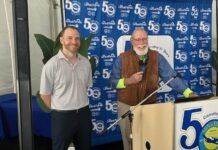
"Every flight is an incredible adventure," says Richard Abruzzo, one of the sport’s premier competitors. The son of Ben Abruzzo, who flew aboard the first balloons to cross the Atlantic and Pacific Oceans, Richard has inherited his father’s zest for long-distance flight. In 1992, Richard crossed the Atlantic in a balloon, landing in Morocco and setting a record for hours aloft. He’s flown in many gas-balloon races, including the annual Gordon Bennett Race, the sport’s top competition. In this race from Albuquerque, Abruzzo’s co-pilot is Gary Johnson, New Mexico’s governor, who typically flies a Bonanza. To win, they must land the farthest from the takeoff point, measured in great-circle distance.
As the sky grows dark and the stars come out over the wide-open Fiesta field, the gas balloons are carried one by one to a brightly lit launching stage, floating along as a crew holds them within reach of the ground. An announcer tells the crowd about the balloon and its two pilots, and the national anthem of the pilots’ home country is played over loudspeakers (Germany, Canada, the U.S. and the UK are represented this year). The balloon is released into the sky with its strobe light flashing below the basket, the pilots wave to the cheering mob, and a gentle stream of sand falls to the ground, barely visible in the darkness. For a while the vague shadow of the round envelope can be discerned, but soon each one merges with the moonless night, and just the flashing strobe remains to show its direction.
Racing In Real Time
 | |
As the balloons vanish from view, those following the race turn to their computer screens to watch its progress. Each of the competitors carries a tracking device, and their flight paths appear on the Fiesta’s gas-balloon web page as multicolored lines superimposed on a map of the U.S. In a trailer at the edge of the field, a round-the-clock team staffs a Command Center, to monitor the race progress and answer phone calls from the pilots, chase crew, air traffic controllers, and the media. An FAA Flight Service Station worker staffs a weather post, offering immediate reports and forecasts. The first night of this year’s race, a somewhat scary-looking cold front is hanging around just to the south of several of the teams, who are zipping off toward the east … zipping at about 25 kt, which is fairly quick for a balloon. A couple of the pilots have called in to report lightning that seems not too far away. A gas balloon has no defense against lightning, other than to get on the ground and escape it. One team lands before the night is over, and a few more set down early the next morning. The leaders in the race have already set themselves far ahead to the east, and a couple of teams start to find winds up to 50 and 60 kt.
"We have a real horse race going here," says Tom Goettsche, a veteran Command Center staffer. Balloonists wander in and out of the trailer, offering their analyses of the racers’ strategies … is it better to fly low and conserve ballast, or get up high and catch the faster winds? How much of a threat is that cold front? Is there enough of a southerly wind to work up the coast toward Maine? But one by one the teams land, either running low on sand, daunted by the weather, or getting down before sunset to avoid another night aloft. At the 48-hour mark, only four of the teams are still flying, with Abruzzo and Johnson leading the pack and approaching Washington, D.C. Somehow they manage to just skirt the southern edge of the TFR, and keep tracking due east across the Chesapeake Bay and toward the Atlantic coast.
 | |
The watchers in the Command Center now begin taking bets on where Abruzzo will set down. At his speed of 60 kt, he has about 20 minutes before he hits the beach. And it’s getting late in the day … nighttime landings in gas balloons are generally dicey and pilots avoid them. But if Abruzzo can find a wind that tracks to the north, will he try to stretch his flight? Will he go for the distance and duration, even if it means flying out over the ocean before finding landfall somewhere in New England — or even New Brunswick? The speculation goes fast and furious ’till the ground track shows a hook to the south, the speed readout drops down to 8 kt, and it’s clear that he’s about to set down and call it a day. Just before sunset in Delaware, about 10 miles from the Atlantic Ocean, some 1,700 miles from their liftoff point, Abruzzo and Johnson make a safe landing, and sew up the Number One slot.
What prize do the pilots win for all that time and effort and risk and expense? The right to compete in next year’s Gordon Bennett Race, in France, and do it all again.
The Matter Of Hydrogen
 | |
One recent development in the small world of gas ballooning is the advent of hydrogen use in the U.S. For years, hydrogen has been commonly used as a lifting gas in Europe, but here, its adoption still suffers from the stigma of the Hindenburg disaster. Yet this year, five of the 15 gas balloons launching at Albuquerque flew with hydrogen. Its appeal? It’s much cheaper, costing about one-third the price of a helium fill-up, making it easier to fly more often.
Many helium balloons fly only once or twice a year, costing about $3,000 and up for each inflation. By switching to hydrogen, pilots can accrue more time aloft, offer more training flights, and get out once in a while to fly just for fun. Although Abruzzo piloted a helium balloon in this year’s race, he also flies with hydrogen. He and other pilots in the Albuquerque area worked with local officials and insurance companies to advocate for its acceptance. There were no laws on the books restricting hydrogen use, he says; it was just a matter of overcoming prejudice against it and a lack of familiarity with its safe use. Eventually, says Abruzzo, "Everybody signed off and we just did it." This year’s third-place finishers, Mark Sullivan and Cheri White, flew a hydrogen balloon.
A Long Walk On A Cool Night
 | |
Here in Albuquerque, even in October, the cool mornings surrender to a midday sun whose rays sear like fire. So when the afternoon wears away, and the desert air grows calm and cool and tinged with a yellow glow, it’s a fine time to head outdoors, as the world feels fit for humans again. Four of the evenings at Fiesta are devoted to the popular Balloon Glow events, which are all about light and color, as the hot-air balloons never leave the ground.
At 6 o’clock on Sunday evening, the enormous expanse of soft, green grass at the Fiesta field is spread with swaths and bundles of balloon fabric, reds and blues and greens and yellows. Soon the noisy inflator fans roar to life, and the balloons swell and billow as they fill with the rush of air. The burners blast and the balloons stand upright, their baskets weighted down with pilots and their friends. The sun leaves an orange stripe along the horizon, as the city lights sparkle in the west and the lights from the Fiesta fairway — where vendors sell balloon calendars, roast corn, grilled bratwurst, and fried Twinkies on a stick — are bright to the east.
The 72 acres of brand-new grass is like a carpet underfoot, the cool air is gentle and sweet, and the faint scent of propane swirls with the mesquite smoke from barbecues. Mothers and fathers push babies in strollers or carry them on shoulders, and steer the elbows of grandfathers and grandmothers. Children rush and wander, waving glow sticks and wearing butterfly wings. Teenagers walk hand in hand, in silent romantic absorption. The crowd swells to 80,000, yet the field never feels congested. The balloons, all inflated now, tower like redwoods overhead. Walking along, row after row, gazing upon each unique design, as the day fades and the night deepens, makes for a fine evening stroll. In every direction, balloons stretch one after another, and they go on and on and on, more than 350 of them. Each one blasts its burner every few minutes to stay inflated, creating a fine display, as the colors are lit from within by the flame. And every five minutes or so a distant announcer counts down to a universal burn: "Get your cameras ready!" he calls. And the crowd joins in: "Five, four, three, two, ONE!" and all the burners blast simultaneously for a loud, bright show, and thousands of camera shutters click, click, click.
 | |
The balloons at night create something magical in their presence. They are so densely packed, so diverse, so benign and charming. Each one of them represents the dream of some wistful individual who longed for a life less ordinary, and found some expression of that desire in bringing a hot-air balloon into their world. Each one is a machine for generating experiences that cannot be had any other way. And each balloon creates a confluence with other lives, as friends and relatives and strangers are enlisted to help with the setting up and the tether lines and the taking down and packing up. Each one of those collaborators becomes entangled in the spell of this aircraft, which tonight may be just a big bright bauble, but holds within itself the thrilling potential to fly with the wind.
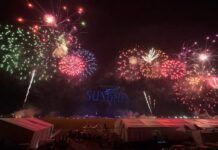
The leisurely half-mile walk, which began in the sunset glow, reaches the far end of the Fiesta field under a dark starry sky, the Big Dipper low in the west, the wide "W" of Cassiopeia overhead. The balloons now are starting to deflate; they fall gracefully and silently to the ground as the hot air is released from a vent at the top. Soon the field is quiet, the balloons are flattened, the burner blasts stop. Pilots and helpers then begin the hard work of packing and stowing all of that gear in the dark, under the glow of flashlights and to the booming accompaniment of a fireworks show.
A gray-haired couple, sitting side by side in camp chairs in the dark, shares a kiss as the first flash of the fireworks fades away. There must be worse ways than this to while away an hour or two on a Sunday night. A sudden stiff wind chills the air, stirs the dust, sets flags and tent tops flapping. The grilled bratwurst beckons, but the fried-Twinkies-on-a-stick (with topping!) are left to braver souls than mine.
A Morning Mass Ascension
 | |
Three things make it worthwhile to get up before dawn to catch the morning show at Albuquerque’s International Balloon Fiesta: phenomenal box winds, perfect weather, and hundreds and hundreds and hundreds of bright, brilliant, hot-air balloons scattered across the wide-open clear-blue morning sky. On five of the Fiesta’s nine days, all of the attending balloons are invited to fill the launch-field grid and fly away, an event billed as a Mass Ascension, which makes it sound vaguely like a religious experience.
One mystical element unique to this event is that box wind. "For Albuquerque, the box is normal, but anywhere else, it would be very unusual," says Dennis Anderson, a pilot from Ames, Iowa, here at Fiesta for his 10th year. The box — light, low-level winds flowing in various directions — allows a pilot to take off from the green Fiesta turf, fly downwind for a while, then climb a thousand feet or so and drift back over the field, setting up a sort of aerial ballet. Sometimes pilots play the winds just right and, after an hour or so of flying, come back and land close to the same spot where they took off. The mountain-and-valley terrain interacts with local climate systems to create the Albuquerque box.
 | |
Locals say the weather here is good for flying just about every single morning, all year round. The air sinks down into the valley overnight, and becomes very stable. Light winds in the morning make for safe, easy inflation and takeoff. The box makes for a steerable and enjoyable flight. This year, the weather has been especially fine, day after day. Friday’s box winds enabled pilots to cross the field as many as five times in the popular Key Grab competition, in which prizes from cars to cash to watches can be won by flying past and snatching an envelope from atop a pole.
On Wednesday morning, the Mass Ascension is billed as The Flight of the Nations. Five hundred balloons from 24 countries fly together in peace. About 70,000 people watch as they gently drift off to the south. The entire launch operation takes close to two hours, and by then the surface winds have picked up a bit, and the last balloons to lift off race across the field at a fairly fast clip. Then up they climb, slowing to an elegant and leisurely pace, and join in the dance of the spheres.
Note: The Fiesta’s web site has mucho information about the event.