






















The Rocky Mountains of central Colorado have been greatlyaffected by the fast-growing popularity of skiing. It wasn’t long ago that the smallColorado mountain community of Aspen came to realize this in a big way. Every year,thousands of enthusiasts flocked to their town to ski their "hills," many ofthem arriving by air. The amenities of Aspen were enjoyed by the general aviationcommunity as well as some very successful mountain commuter airlines (Rocky Mountain andAspen Airways).
Some history
At the time, the Aspen Airport was served only by a VFR tower, and had neither radarnor a navaid serving the airport for an IFR approach (except for some special airline-onlyapproaches developed by the commuters). ATC services were provided by Denver Center, whoseradar coverage was virtually non-existent below 13,000′ MSL. Because of the lack of decentradar coverage, ATC had to handle IFR operations to and from Aspen using non-radarprocedures-one in and one out. VFRs received vectors "down the valley." If youcouldn’t cancel or execute a visual approach, you went somewhere else. Not much else couldbe done with what we had.
Soon, traffic volume and complexity far exceeded the Center’s capability to provide forthe safe, efficient and orderly movement of aircraft under these difficult conditions. TheFAA established a slot reservation program during ski season. Delays were routinelymeasured in hours, and flights were often turned away if they didn’t have the appropriatereservation "slot time" or arrive within the appropriate "window" forthat slot time. Extra controllers were assigned to plug in to those "skicountry" sectors as a "third set of eyes," and other sectors wereinstructed to "miss" the Aspen sector with enroute traffic and hold Aspenarrivals at outlying intermediary fixes. Things were, very simply, getting out of hand.
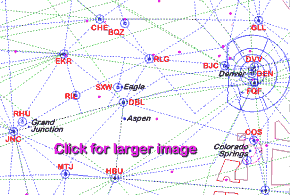 Then cameAspen Approach. Through pressure exerted on Washington by the flying community, acongressional mandate ordered a radar approach control facility be established at Aspen.This added to the ATC system a transponder-only terminal radar site for Aspen, plus anavaid (the Red Table VOR/DME, identifier DBL) to serve the airport with an IFR approach,and a gap-filler radar site for the Center located near DBL. The terminal radar gave ATCthe ability to sequence IFR traffic with 3 mile separation, and to radar separate arrivalsfrom departures. The result was that most of the traffic problems at Aspen went away.
Deja vu all over again?
But does history repeat itself? It does, and it has. Welcome to Eagle, Colorado.
The very same problems faced at Aspen in previous years are now manifesting themselves25 miles north at the Eagle County Regional Airport, the airport that serves the Vail andBeaver Creek ski resorts. Once small county airport with hardly any IFR operations, EGE isnow the third fastest-growing commercial airport in the nation — second only to ColoradoSprings and North Las Vegas, according to DOT figures — and is fast becoming the numberone Colorado ski country destination and busiest mountain terminal area in the country.
In 1989, barely 300 air carrier passenger enplanements were recorded at Eagle. By 1995,there were nearly 90,000 reported. At the end of the 1996-1997 ski season, that number haddoubled to nearly 180,000. The air carriers say the will begin year-round service to Eagleas early as 1998, and expect traffic volume to double again within the next two years towell over 300,000 passenger enplanements. Keep in mind that the great majority of thistraffic takes place within the six-month period from November to April. While thesefigures deal strictly with air carrier operations, general aviation traffic at Eagle isexperiencing similar growth.
You can now fly non-stop to Eagle from such places as ORD, DTW, ATL, DFW, MSP, IAH,LAX, EWR, LGA, IAD, MIA, SLC and of course DEN. Where once you might have spotted a singleDHC-7 commuter or two on the ramp at Eagle, you can now see a vast assortment of B757’s,B727’s, B737’s, BA46’s and others. The airlines are spending big money to developfacilities at Eagle. American Airlines for example, is pumping millions of dollars intothe airport to handle their B757 operations. They have built their own terminal anddeveloped their own FMS approach and departure procedures. Both Northwest (B757’s) andDelta (B727’s) have followed suit. Even Air Wisconsin (BA46’s), United (B737’s) andContinental (B757’s) are getting into the act. They have recognized a business opportunityand are capitalizing on it.
ATC at EGE
And how is ATC handling it? Well, basically, we’re not! We’re reliving yesteryear atAspen. It’s basically a non-radar airport, because even with the DBL gap-filler radarsite, we can’t see below 9,000′ to 9,500′ MSL within a 5 to 10 mile radius of the airport.It has a VFR tower operated by a contractor (Midwest ATC Services, Inc.), and that toweris only there because the air carriers forced the issue. In fact, scheduled closing timeat Eagle tower is 7:00 pm local, but the controllers often stay on duty until 10:00 or11:00 pm until the last air carrier flight has arrived, with their overtime pay picked upby the airlines.
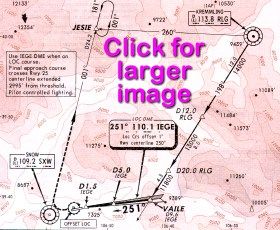 Eagledoes have navaids and IFR approach procedures. But because of the non-radar environment,IFR at EGE is basically a one-in, one-out affair. To make matters worse, take a look atthe LOC DME-C approach: it’s 33 NM from the initial approach fix (Kremmling VOR,identifier RLG) to the airport, and it usually takes an aircraft 10 to 12 minutes toexecute the published approach. If (heaven forbid) the aircraft misses the approach, it’sanother 23 NM to the missed approach fix (JESIE intersection) and 20 NM more back to RLG.Adding it all up, if you fly the approach, go missed, and want to try it again, you willhave flown 76 NM and literally "tied up" the airspace for nearly a half hour!Talk about being handcuffed! Expeditious handling under these conditions is a whopping 4aircraft an hour, and that’s if we’re lucky.
Fortunately, the weather at Eagle is VFR much of the time. Although the air carriersnever cancel IFR and seldom accept a visual approach, many general aviation operators do,and that helps boost the acceptance rate. But when weather conditions drop to MVFR or IFRor when pilots who are unfamiliar with the area prefer (understandably) not to cancel, thesystem gets easily backlogged and severely overloaded. At Denver Center, the controllersfeel like they’re trying to pour a gallon of water into a quart jar without being able tosee the jar and trying not to spill a drop.
Flow control
The FAA has a plan to deal with this problem. Unfortunately, it comes as the expense ofour "customers" and adversely affects general aviation most of all.
Every year between about Thanksgiving and mid-April, Denver Center’s Traffic ManagementUnit (a.k.a "flow control") implements a "ski country" program. Whatthis basically does is schedule a certain number of arrivals into a particular airportduring each one-hour period, based on a specific acceptance rate determined ahead of timebased on factors such as forecast weather, equipment outages, etc. The idea, of course, isto hold ski-country-bound IFR departures on the ground as necessary so that they don’toverwhelm our capacity to handle arrivals. Sounds reasonable, but it’s got severalproblems.
For one thing, all that this program does is to control departure times. Any delaysthat occur enroute (vectors for traffic, deviations around weather, equipment problems,etc.) renders the ETA useless. Apply Murphy’s Law and you’ll see that instead of thesteady stream of arrivals that we’re supposed to get, the aircraft tend to arrive inbunches.
For another, the TMU’s method of "slot" scheduling discriminates severelyagainst general aviation. This occurs because the TMU automatically pencils in scheduledair carrier operations into its hourly slots first, then makes any remaining slotsavailable to general aviation. So, for example, it’s IFR at Eagle and TMU sets theacceptance rate at six aircraft per hour (about normal), and if there are six air carrierarrivals scheduled to arrive during a particular hour, there would be no slots leftfor G.A. operators. During some hours, only 1 or 2 air carriers are scheduled to arrive atEGE; during other hours, as many as 5 are scheduled. Furthermore, if EGE weather goes downlow enough that the TMU thinks there’s a reasonable chance of missed approaches, it lowersthe acceptance rate to just two aircraft per hour (remember, it takes a half-hourto shoot the approach and miss). Under such circumstances, the chance of a G.A. operatorgetting into EGE are between slim and none. Feel like a second-class citizen yet?
When the weather is forecast to be VFR, no slot program is implemented. While thismight seem to be good news, that’s not necessarily so. Even in VFR weather, the IFRacceptance rate doesn’t increase to much over six aircraft an hour because of thenon-radar one-in/one-out environment. So with an unlimited flow of IFR aircraft headed forRLG, you can expect delay vectors and/or holding at outlying fixes while we juggle thearrivals to establish the necessary miles-in-trail. If that doesn’t sound good, you canalways cancel IFR…but you better have your head on a swivel. Last year, an air carrierdid take evasive action in response to a TCAS alert to avoid traffic during the occurrenceof a very complex ATC operational error that resulted in loss of standard separationbetween aircraft in the sector. I highly recommend never departing for Eagle with anythingless than your maximum available fuel load and, if it’s IFR, a precisely blueprintedalternate plan. We’re still dealing with a quart jar here.
To make matters worse…
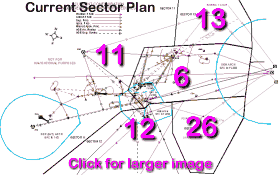 When thenew Denver International Airport opened, Denver Center realigned the vertical and lateralboundaries of the sectors surrounding the Denver terminal area. The western boundary ofthe sector handling westbound departures off DEN (Sector 6) was extended approximately 35NM west to reach out nearly 100 NM west of DEN, and now encompasses Eagle Airport and oneeach of the major Aspen arrival and departure gate streams. The once easily-controlledsector with a single basic mission, overnight became an unmanageable nightmare with a trioof terminal difficulties.
It was all these factors—ineffective flow controls, inferior equipment and anominously supersaturated sector—that prompted me to file an Unsatisfactory ConditionReport in January of 1997. The FAA has still not responded to this filing, having giventhemselves (to date) six extensions to the required time period for providing such aresponse. They have now given themselves until January 1, 1998—nearly a full year fromthe original filing date and two months into ski season—to think about it.
But this is not to say that the solution is simply to move the boundary back. Thesector that gave up the Eagle airport to sector 6 was similarly overburdened. That sector(Sector 11), prior to the resectorization, provided approach control services to not onlyEagle, but Hayden, Steamboat Springs, Grand Junction and other mountain airports, all ofthem experiencing fast-paced growth. The sector was also responsible for the other threearrival and two departure gate streams serving Aspen.
Geographically, sector 11 covered nearly the entire state of Colorado west of theContinental Divide. An effective sector "scan" was a near-impossible task forone controller. To make matters worse, the need for multiple communications sites to coverthe huge mountainous area meant that aircraft frequently "stepped on" clearancesand readbacks. It was simply too much airspace for one person to handle. Something clearlyhad to be done.
The resectorization did help sector 11 (by shrinking it), but it hurt sector 6 (byexpanding it). Moving the sector boundary back is not the answer. The problem is the hugeincrease in traffic at these airports (especially Eagle), and it’s not going to be solvedby robbing Peter to pay Paul.
Is there a solution?
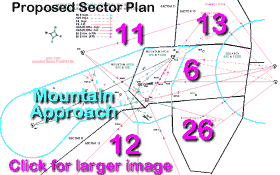 We thinkso. We are a group of controllers and members of the National Air Traffic ControllersAssociation that are petitioning the FAA and Congress for the development of a new"Mountain Approach Control Facility" to be located in Grand Junction, Colo. Thisfacility would take on the responsibility of providing approach control services to theAspen, Eagle, Rifle and Grand Junction airports collectively. It would combine the currentAspen and Grand Junction approach control facilities and take all the airspace in between,including Eagle to the north. It would be staffed by the personnel currently assigned toAspen Approach and Grand Junction Tower, and relieve Denver TRACON of the burden entirely.
[The present ATC situation at Grand Junction is also quite controversial, and acontroller at Denver Approach has filed another Unsatisfactory Condition Report with theFAA over the fact that approach control service at GJT is provided using non-ARTS (i.e.,non-approach certified) radar via a 300-mile-long chain of sixteen microwave links andother communications relays over the Continental Divide to Denver TRACON. But that’sanother story.]
Many of the logistics involved in the creation of Mountain Approach Control havealready been addressed by NATCA. The Walker Field Airport Authority (Grand Junction) hasoffered to make the portion of the air traffic control tower building not currently beingleased by the FAA available to house the new facility. Hardware and software vendors havebeen contacted, and we have received estimates of "off the shelf" productsavailable today for system integration and modernization. Personnel issues have beenoutlined (moves, staffing, training, etc.). And all the while, our cost projections haveremained in check. In fact, what we have proposed would be considerably less expensivethat what the GAO estimates will be the cost of the modernization projects currentlybudgeted by the FAA (such as STARS). We believe that our proposal would return the levelof ATC service in the Rocky Mountain area to what the users expect from it, while theFAA’s current plans do not address the issues in our judgment.
How you can help
In order for this to happen, we could use a little help. We realize that if we simplywait for the FAA bureaucracy to adopt our proposal for Mountain Approach Control, we’llprobably reach retirement age before anything happens. It took a tremendous lobbyingeffort by users and a congressional mandate to get the facility built at Aspen, and wethink it will take another to get a Mountain Approach Control facility built in GrandJunction. In the short term, we need the FAA to commit the resources to install one moreradar site at Eagle, and we need to prevent the FAA from carrying out it’s current plan tocontract out the operation of Grand Junction tower in early to mid-1998.
So in September, a group of NATCA representatives traveled to Washington D.C. to meetwith representatives of Colorado’s congressional and senatorial delegations to present theMountain Approach Control proposal. That got the ball rolling. Through the months ofOctober and November, several meetings have been called with legislators and users aliketo discuss the proposal. We are currently embarking on a letter-writing campaign to conveysupport of the proposal to Colorado’s Legislators. We have an open invitation to them, oranyone, to come to Denver Center and see the operation, and fully expect some visits thiswinter.
Our Mountain Approach Control proposal (a 74-page document) goes into considerabledetail on how the proposed facility would work and what resources it would need. To makeit more accessible to interested parties, we have posted the proposal on the World WideWeb at http://www.sni.net/~spad. We invite you tolook it over. If you’d like more information, feel free to drop me a line at [email protected], or visit our "Contact" page on theweb for a detailed list of government, legislative and local contacts. If you like whatyou see and would like to let Colorado’s Legislators know, visit our "Write Colo.’sSenate" and "Write Colo.’s Congress" page for sample letters we’re using inour letter writing campaign. Copy and mail them to our representatives if you’re soinclined. We surely would appreciate your support.
We think our proposal resolves many of the issues of safety and service in Colorado’sski country that exist today and will get worse tomorrow. We also realize how difficult itis to justify projects such as this, and ultimately pry the funds from very tightcongressional budgetary hands. Facilities all across the nation need help. But our basisis sound and our direction clear. We are committed to preserving over the skies of WesternColorado the quality of safety and service of the caliber that is expected of the finestair traffic system in the world. You should demand nothing less.
