

















Cessna Three Four Uniform, cleared direct to the Lost at or above3000 feet, cleared for the VOR 24 approach at Podunk Muni, report the procedureturn inbound.
The above is a routine clearance that’s probably issued a hundred timesa day by various ATC facilities. You’re instrument rated, so we’ll assumeif you hear a clearance like this, you know it’s required. But what’s thebest way to actually fly the turn? There’s no simple answer. It falls intothe category of elective technique.
Although there may be many "right" ways to do a PT, thereare certainly some wrong ways, too. No matter how you fly the turn, thecritical thing to remember is to do it in a way that keeps you well withinthe obstacle protected area while still giving you enough time and distanceto line up on the course outside the final approach fix.
Think Speed
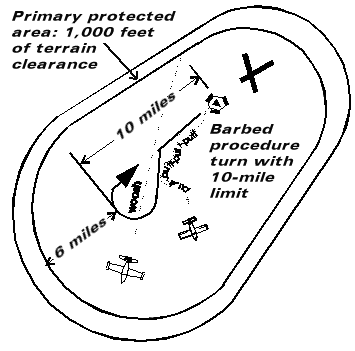 The drawings at right depict the typical protected areas for both a standard,barbed-procedure turn and for a holding-pattern-in-lieu of a procedureturn. As you can see, there’s plenty of safe maneuvering room around bothtypes…unless you happen to be flying a very fast airplane, fast beingup to the 250-knot-below-10,000 feet-MSL limit. That’s not to say there’snot enough room for a fast mover — say a biz jet — to make the coursereversal, it’s just that there’s less margin if you get careless.
On Jepp charts, the procedure turn barb is to scale in the plan view.That means if the profile view says "10 NM from NDB," the outeredge of the barb is at the 10-mile limit. If the PT limit is only fivemiles — as it is if the approach is limited to Cat A airplanes — thebarb is obviously much shorter. On NOS charts, the plan view has a 10-miledistance circle and virtually all of the barbed PTs extend to the insideedge of this circle. On both charting systems, the holding-pattern-in-lieuof PT reflects no particular scale; it’s just a graphic representation.The obstacle clearance area we’ve drawn here represents a typical applicationfor a holding-pattern-in-lieu of: the number 4 holding pattern template.
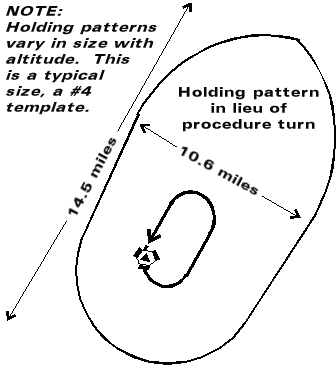 The thing to worry about here is approaching the PT fix at a relativelyhigh airspeed and perhaps with a stiff tailwind. In a 100-knot Cherokee,unless you’re asleep at the yoke, you’ll probably have plenty of time toget yourself turned around without busting even the relatively small protectedarea of a holding pattern-in-lieu of PT. But if you’re driving a Lear intothe very same airport, the protected area is the same size as it is forthe Cherokee.
You could be doing 300 knots over the ground; five miles a minute. At100-knots, the turn radius of the Cherokee is about 1/4-mile. For the Lear,it could be more than a mile-and-a-half, even without taking into accountthe tailwind, which could push the turn toward the edge of the protectedarea.
Most of the time, these speed factors probably won’t matter much. Butin extreme conditions — such as the 80-knot low-level winds describedin the accident analysis on page 6 of this issue — they could be a factor.If you’re watching your groundspeed on loran or GPS, you should have agood idea of windspeed at altitude; plan accordingly.
For flyability, the turn should be planned so that you’re establishedon the inbound course, with a centered needle, or nearly so, at least twomiles outside the FAF. As a matter of personal preference, you may wantto stretch that to three miles and that’s fine. Just be mindful of thewind and make sure you stay within the published PT limit.
Which Way?
In your instrument training, your instructor may have insisted thatyou fly a standard barbed PT just as it’s depicted. Nothing wrong withthat. But you don’t have to do it that way. Both the FAA’s Instrument FlyingHandbook and the AIM say that "the point at which the turn may becommenced and the type and rate of turn is left to the discretion of thepilot." Besides the standard 45-180, you can also fly a 90-270 orwhat some pilots call the 40-second turn, which consists of an abbreviated45-degree outbound turn to compensate for the effects of a tailwind.
You can even execute a 45-degree turn from the outbound leg, followedby a 180-degree turn toward the airport to intercept the inbound. Justmake sure all of this maneuvering is done on the protected side of thecourse, that is, where the barb is depicted.
If you’re flying a holding-pattern-in-lieu of a PT, the AIM recommendationis to use a standard holding pattern entry. Remember, the protected airspaceis smaller, so keep it as tight as practical. The one-minute posted onmost of these refers to a one-minute inbound leg, with timing startingas soon as you’re wings level on the inbound course, same as a standardhold. However you choose to enter — standard method or something else— to maximize your obstacle protection, do as much of your maneuveringin or as close to the depicted holding pattern as possible. Minimize excursionsinto the non-holding side of the course.
There are a few teardrop-type procedure turns here and there in theU.S. These must be flown exactly as depicted; no improvisation allowed.Most have positive course guidance — say a VOR radial — for the outboundleg, then a DR inbound turn to pick up the inbound course, again, definedby positive course guidance.
There are lots of tricks to fly a PT that will put you on the inboundtwo miles outside the FAF. One simple method is to think back to your highschool geometry days. Remember the formula for calculating the hypotenuse(longest leg) of a right-angle triangle? It’s a2 + b2= c2. In this case, c is the length of our outbound PT leg,while a is that two-mile distance we want when we roll out on the inboundcourse.
Doing the math using two-mile legs, the hypotenuse — outbound leg —is 2.8 miles. Round it off to three miles to make things easy. Now, insteadof guessing at timing, for the outbound procedure turn, turn to a groundtrackthat’s 45 degrees off outbound course, then use your actual groundspeedto determine how long to fly outbound. Rule of thumb: At 120 knots groundspeed,you’re going two miles per minute so use 90 seconds; at 180 knots, a minutewill do; at 90 knots, two minutes.
When you turn inbound, your actual intercept will actually be a littleinside of two miles from the FAF, depending on the wind, but it’ll be closeenough. If you want three miles from the FAF, fly the outbound PT leg foran additional mile or use 30-degrees off the outbound, rather than 45 degrees.
VOR, Loran and GPS
On a VOR approach with procedure turn, you can use the CDI scale toestimate your distance from the course. As a rough rule of thumb, yourdistance offset from a VOR course is equal to 200 feet per dot per mile.So, let’s say you’re on the outbound leg, the 360-degree radial. You eyeballthe 45-degree outbound procedure turn and watch the CDI needle, checkingyour DME distance from the VOR, which happens to be, say, 10 miles. Atfour dots deflection, you’d be 8000 feet or 1.3 miles off the course. Stillwell within the protected area. (On a VOR, four-dot deflection at 12.5miles would still be well within the two-mile offset we offered as a goodgouge.)
If you have loran or GPS — and these days, who doesn’t? — how canit help on the PT? One quick-and-dirty method is to just pass over thefix where the PT starts and then use the GPS or loran to fly a groundtrack45-degrees (or whatever) off the outbound leg. Thus, if the outbound is180-degrees, turn to a groundtrack of 135 degrees for your outbound andtime the leg for a three mile segment. It’s hard to get much more accuratethan this.
Some pilots plug in the entire approach as a route and although thatmay be too involved to do in the air, it can be done ahead of time. Inthis case, use the receiver’s offset waypoint capability to place a pointin space where you want to terminate the outbound PT leg. If you want toget really elaborate, you can also put a waypoint on the inbound course,where the PT intercepts it, two miles outside the FAF. To keep things legaland safe, make sure the GPS or loran guidance squares up reasonably withyour dead reckoning.
Keeping in mind the purpose of the course reversal, I run a mental checkliston these items: (1) Set up approach configuration and airspeed before reachingthe fix where the PT begins, including flaps as appropriate. (2) Aftercrossing the fix, turn outbound on the protected side to yield a 45-degreegroundtrack and (3) apply the speed factor to yield a three-mile outboundleg or whatever will have you intercept the inbound course two miles outsidethe FAF.
Finally — and this is critical — what is the wind direction and speedand what’s it doing to your groundspeed? In a fast airplane, this couldmake all the difference in the world. Don’t lose track of it.