
































If you’ve looked at the instrument written booklet lately, you’llnotice that although there are some new questions here and there,not much has changed. The written is heavy on regs, theory andweather but light on the real meat-and-potatoes grit of IFR flying.This is especially true of how the feds treat SIDs and STARs.
Consider, for example, the elaborate time en route problems involvingstandard instrument departures. Instrument-pilots-to-be spendhours sweating over these things, only to learn that (a) the multipleguess answers are too close to be resolved by an E-6B and (b)no one ever does these calculations in the real world anyway.In fact, apart from the test writers in Oklahoma City, maybe noone ever has done such calculations.
Even though it’s misdirected, the emphasis on SIDs and STARs isnot misplaced. These procedures are a part of everyday IFR flyingand if you routinely pencil in “NO SIDs/NO STARs” onyour flight plan, you’re denying yourself the occasional shortcutor, at the least, missing an opportunity to learn how ATC works.So, how do you use SIDs and STARs? Should you use them at all?What are the pitfalls?
Where They Come From
SIDs (standard instrument departures) and STARs (standard terminalarrival routes) appear in both Jeppesen and NOS publications.Jeppesen bundles them together with the approaches. NOS groupsthe arrivals at the front of the booklets while the SIDs are pairedwith the approaches.
Personally I like the way the STARs appear, since it saves duplication.But why didn’t they do the SIDs the same way? I didn’t check carefully,but I saw the Regional Six departure printed on 10 different pagesin the same NOS booklet. Jeppesen does the same, of course, meaningyou might get to file one SID 10 times.
Even though we consider them instrument procedures for pilotsto use, SIDs and STARs aren’t there primarily to make the pilot’slife easier. SIDs and STARs exist chiefly to make it easy on ATC.The idea is this: It’s a lot easier for a controller to say “clearedto Kansas City via the San Jose Seven Departure, J12,” thanit is “cleared to Kansas City via runway heading to the SanJose VORDME 1.8, then right to heading 110, to cross the San Jose47-degree radial at or below 5000 feet, intercept the Oakland121degree radial to MOONY, J12…”
The point is, SIDs and STARs allow ATC to codify commonly usedclearances and procedures. Essentially, they buy frequency timeand, for that reason, SIDs and STARs make it easy on both controllersand pilots. Also, SIDs and STARs give ATC a means to communicateto the pilot what his or her routing is likely to be when departingor arriving. By reviewing that ahead of time-or by filing theprocedure in the first place-the pilot can plan accordingly.
SIDs for Flibs
Light aircraft IFR pilots routinely encounter SIDs. They’re usedalmost everywhere, at towered fields served by some kind of approachcontrol. Some are complex-such as the previously described SanJose Seven- while others consist of nothing more than “runwayheading” to a specific altitude. Why such a simple clearancerequires a SID is beyond us. We don’t make the rules, we justtry to avoid breaking too many of them.
As fully described in section 5-26 of the AIM, SIDs come in twotypes: pilot nav and vector SIDs. In practice, some SIDs seemto be a little of both. Pilot nav SIDs imply that the pilot isequipped to navigate the SID and that he or she will do so withoutany intervention from federal authorities. If the clearance reads”via the San Jose Seven departure,” the pilot is authorizedand expected to follow every little twist and niggle in the route,unless ATC comes up with another plan.
Pilot nav SIDs are clearly labeled as such, in the title on bothNOS and Jeppesen plates. Not that you could get confused. Pilotnav SIDs usually have a fat slug of type describing the variouscourses and altitudes the pilot is supposed to fly. Vector SIDs,on the other hand, usually give a heading and maybe a fix or twobefore the word “thence, ” which is ATC’s rather biblicalway of saying expect vectors or resume own navigation.
SIDs are really pretty simple. So simple, in fact, that we wonderwhy so many pilots duck them by adding “NO SIDs” tothe remarks. There are a few traps to worry about, however. Oneobvious point is to make sure you have and follow the correctand current SID. Many airports have several SIDs for the samerunway and pilots have been known to fly the wrong one. Watchout for expired-plate syndrome, too. Altitudes, courses and frequencieson SIDs change more often than you might think. Expired platesjust won’t hack it.
Watch That Altitude!
Some SIDs are performance based, meaning that you’re expectedto be able to maintain a minimum climb gradient in order to acceptthe SID. The gradient may be necessary for terrain clearance orto meet an ATC crossing restriction. If you fall short of thegradient, you could become part of the local topography or, atthe very least, get spanked by ATC for messing up the departuresequence. Either way, check the chart carefully and use the gradient-to-ratetable to convert the required climb to a feet-per-minute value.If no special climb gradient is specified, the assumed climb gradientis 200 feet per mile, or about 333 feet per minute at 100 knots.The same assumed gradient, by the way, applies to ordinary unnamedinstrument departure procedures found at towered and non toweredairports.
Pilot nav SIDs always (well, almost) specify the initial altitude.Vector SIDs sometimes do, too. But often that altitude comes withthe clearance. Some pilots have been thoroughly confused by aclearance with an altitude other than that given in the SID. Whichaltitude takes precedence, that on the SID or the one given inthe clearance? Frankly, we don’t know. We’ve been told that localcustom applies to this one. When an altitude other than that onthe SID is given, most controllers are careful to emphasize it.But you can’t count on that. The best way to sort it out is toask the controller to clarify the clearance.
STARs
Standard terminal arrival routes are largely the province of heavyjets or al least relatively fast traffic descending from the flightlevels. Some even say as much. Notes such as “applicableto turbojets only” or “all aircraft operating 11,000feet and above” tell the story. If you’re a piston driveroperating at low altitude, you can forget flying those STARs.Even if you’re a high falutin’ Mooney 252 pilot used to cruisingat FL240, you might be too slow to keep up with the jets populatingthe SIDs. You’ll either get turned off the route or, more likely,descended and brought in under the jet traffic.
But that doesn’t mean you should forget STARs entirely. Theseprocedures do offer important clues about the traffic flow intomajor terminals, information that’s useful for flight planning,whether you’re VFR or IFR. In some parts of the country, suchas Dallas-Fort Worth, where I operate, STARs are used commonlyfor low altitude traffic. It really depends on the whim of theof local ATC facility, since that’s where the procedures originate.
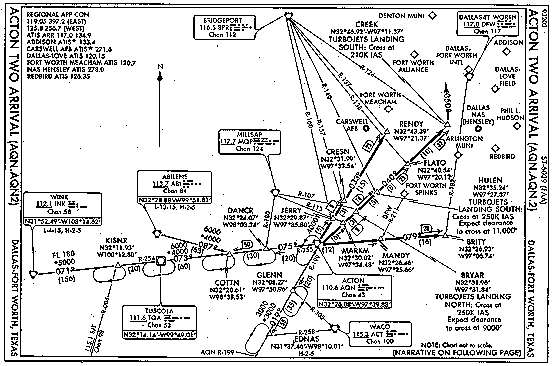
Let’s examine the Acton Two Arrival (AQN.AQN.2) for DF/W to seehow it can work. Let’s assume we’re flying a piston single ona short 50-mile trip coming into the D/FW area from Waco. Let’ssay we file 5000 feet, direct to our destination, Arlington, Texas.In case you’re wondering, there’s no chance we’ll get that routing.IFR traffic into DF/W is routed over one of four “gatepost”VORs that form a square around the metro area.
With that in mind, clearance delivery will come back with somethinglike this: “Cleared to the Arlington Airport, via Victor17 Acton, the Acton Two arrival, maintain 5000 feet, departurefrequency 135.2…” Pilots not accustomed to flying low-altitudeSTARs may be surprised by that clearance, since the STAR goesto small muni field with no tower.
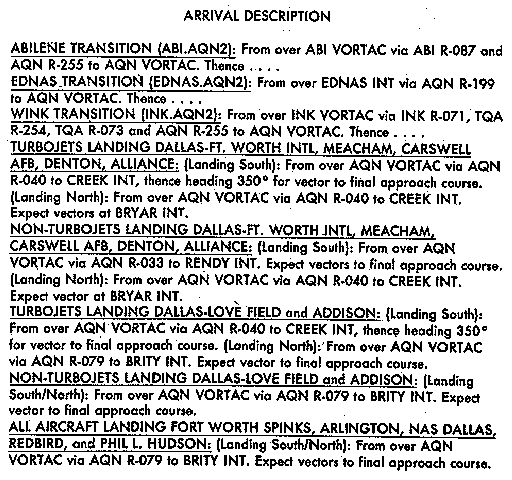
Step one is to make sure the STAR goes to your destination. Ifit doesn’t, you can’t get there from here, period. Step two isto forget about the picture and go to the text on the back ofthe page. For this particular STAR (and many others around Dallas)the map is a nightmare. The arrival description cuts through theclag, though. It lists various categories of aircraft: Turbojetslanding at Dallas. ..that’s not us. . .Non-turbojets landing atDallas…closer, but no cigar. Finally, under “All aircraftlanding at Arlington,” we see these instructions: “Fromover AQN VORTAC, R-079 to BRITY, expect vectors final approachcourse.”
Real Life
So, remembering that STARs are meant to simplify clearance deliveryprocedures, all we really needed to know is that Victor 17 takesus to Acton VOR and from there, we’re going to track the R-079outbound and get vectors. If you had used NO SIDs/STARs in yourflight plan, that’s exactly what you would have gotten anyway.
Does the clearance actually pan out in real life? Nope, probablynot. Often, an amendment is tacked on by Center: “CherokeeThree Four Charlie, join the arrival east of Acton.” Then,as soon as Regional approach gets hold of you, you get vectorsto the final approach course, never having gotten near the publishedSTAR route. Why? Local traffic, probably. Could be there was fastertraffic closing up behind and it just worked better not to usethe STAR.
So why do they bother specifying it? ATC procedural inertia, mainly.The Letters of Agreement have been written and the controllersgenerally follow them, even though they know the routing won’tstand. What they don’t know (at least when you depart) is whatthe traffic picture will be when you prepare to enter the STAR,which is why they don’t cobble up a new route to begin with.
Lost communications is another reason. Say you lost comm beforethe shortcut. You could turn east on the R-079 at the VOR, stayout of everybody’s way and safely continue to Arlington. If youlost radios after the shortcut, same story.
Planning It
Is it possible to figure out in advance if STARs are in use andif so, is it worth doing? Yes, it is possible and it ‘s also worthdoing, to the extent that it always makes sense to know as muchas you can about ATC ‘s plans. I can’t think of any circumstancewhere it’s better to be in the dark.
The easiest way to plan is to look at the index of the approachplates in NOS booklets. Look up the airport you’re going to andsee what applies. The key is to read the arrival description tosee if low-altitude traffic is included. As I said earlier, makesure your destination airport is served by the arrival. If itisn’t, don’t bother filing it. ATC will hand you the preferredrouting anyway.
Most STARs (and SIDs) have transitions that are best thought ofas branch routes feeding the main procedure. The Acton Two, forexample, has the Wink, Abilene and EDNAS transitions, flown, respectively,from the two VORs and an intersection. These transitions jointhe STAR, then lead right to the Acton VOR. If you’re expectedto fly the transition, the clearance will say that: “Clearedto…via the Wink transition, Acton Two arrival…etc.”
If you want to file a transition, the filing code is given righton the chart. Let’s say you were filing for Arlington from ElPaso, with the Wink transition. The route would read: ELP V16INK.AQN2 F54. The computer would probably accept the routing,but whether ATC would stick to it is anybody’s guess. DUAT, bythe way, is supposed to accept SIDs and STARs, but will do soonly if the procedures appear in its database.
One last point about both SIDs and STARs: They provide the approachand departure frequencies you will need. It’s funny to listento the tower at Houston Hobby, where every clearance gives theHobby Eight, and no departure frequency is given. After takeoff,the tower ships pilots to departure and some have to ask for thefreq, forgetting that it appears right on the SID. (The same appliesto STARs) Just remember to look it up before you take off.
