




















The NDB approach is generally considered one of the tougher itemson the flight test for the instrument rating. If you asked abunch of instrument-rated pilots to list their favorite approachequipment, you’d probably get a list something like this:
# 1 — ILS
# 2 — LOC only (no glideslope)
# 3 — VOR
# 4 — NDB
The ILS (Instrument Landing System) is every IFR pilot’s favorite.It consists essentially of two indicators, one for "go right/goleft" and another for "go up/go down". The LOC(localizer) only and VOR approaches look pretty much the sameas an ILS except that they don’t have the "go up/go down"glideslope needle, just a "go right/go left" needle.
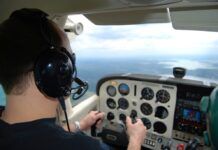
Everybody’s last choice is the old NDB (Non-Directional Beacon)approach. The important difference between the NDB and the othersis that there isn’t a single dial in your cockpit that you canrefer to, to see your tracking error (go right/go left). Youmust use both the Heading Indicator and the ADF (Automatic DirectionFinder) indicator and combine the information presented by thetwo, if you wish to accurately track to or from an NDB.
Looking at two dials probably sounds pretty simple, reading thisarticle on your couch eating crackers, but gosh, when you’re bumpingalong in the soup, seemingly with a million other things to do,it somehow gets lots harder!
Being the lazy but crafty person that I am, I’ve wondered if itwas possible to consistently fly an acceptable NDB approach withoutever having to track using an NDB.
Don’t get me wrong, I have nothing against learning to track usingthe NDB. Cross-country, there’s not much else to do, so why notfiddle with your crab angle? Good visualization practice.
But during the approach, you’re busy with other things and you’reawfully close to sharp, hard things that stick up into the clag. I worry that people under load may try to get fancy, misinterpretthe dials and go the wrong way. That’s probably never happenedto you, but it sure has to me.
Your basic no-brainer NDB approach
So, let’s look at flying the NDB approach to our favorite airport,Sumspot, which has an NDB located 4 miles west of the thresholdof runway 09.
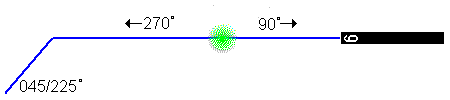
You’re cleared for the Sumspot NDB 09 approach, so you could simply"home" to the NDB, which is your IAF (Initial ApproachFix).
"Homing" with an ADF simply consists of keeping theneedle on the _nose_ of the aircraft, or on the zero at the topof the ADF indicator.
With a crosswind, our path to the NDB may not be pretty, but we’llget there. Spend any excess brainpower (and in a single pilotIFR cockpit without an autopilot, there may not be much!) studyingthe approach plate. Lots of stuff on the plate, but make surethat you get the important items. I use the acronym "AMORTS":
Approach – have you got the right plate out? (don’t laugh!)
Minimums – MSA, PT, FAF, MDA
Overshoot – quickly review the missed approach so you’reprepared
Radios – ADF tuned and identified, comm and nav as reqired
Times – get a time to the Missed Approach Point (MAP)
Speeds – based on the groundspeed you expect with the wind
Passing the NDB outbound, fly some kind of procedure turn.
Visualize what the wind is doing to you on each straight leg ofthe procedure turn, and make a correction for it. A crosswind,crab into it. A headwind, increase your time significantly. A tailwind, decrease your time slightly.
Do your cockpit checks now. Check your Heading Indicator againstthe compass. You cannot fly an accurate NDB approach withoutan accurate heading reference.
OK, the procedure turn is complete, we’re now intercepting theFinal Approach Track.
Turn initially to a heading of 090 and get a descent started ifyour altitude over the NDB inbound—the FAF (Final Approach Fix)—islower than your procedure turn altitude. Be sure to keep a solid500 fpm descent rate going, use 600 or 700 fpm if you have a tailwind.
Now, if there’s no wind, a heading of 090 will take us right backto the NDB. You should be so lucky! Rather than using some complicatedtracking and correction technique after you’re established onthe final approach track, an idea is to simply home to the NDB. Needle on the nose again, back to the NDB.
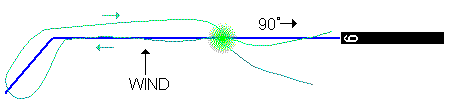
If we home to the NDB, we are assured of a good station passage.
Passing the NDB (the FAF) inbound, turn back to 090 and get adescent going again if necessary, down to your MDA (Minimum DescentAltitude).
If you want to keep it really simple, after station passage justfly a heading of 090 until you see the runway, or your timer runsout at the MAP.
Without much wind, this generally works out pretty well. At aa groundspeed of 90 knots, it will take 2 minutes to travel 3nautical miles to a 1 mile final for runway 09, at which timeyou should be visual with the runway, and start your descent fromthe MDA.
What about crosswind correction?
But let’s say we’ve got a 30 knot direct crosswind out of thesouth (which is a lot at 500 feet AGL). If we get a good stationpassage, and just ignore the wind by flying a heading of 090,after 2 minutes the crosswind will have pushed us 1 nm north ofcourse. If you figure out the trigonometry (pythagorean is easier),instead of being 1 mile from the runway threshold, we will be1.4 miles, which is a pretty good return for such a simple procedure.
If you think about it carefully, it’s actually going to be betterthan that. With a strong wind from the south, while homing tothe NDB after the procedure turn for the FAF, let’s say we eventuallyweathervaned to a heading of 110 at station passage.
After we pass the station inbound, during our turn from 110 backto 090 we will travel somewhat south (upwind) of the desired track,so we probably won’t drift a whole 1 nm downwind as we calculated.
Also, if you have a higher groundspeed than 90K, you will be affectedless by the crosswind. There’s less time for the crosswind blowyou off course after passing the FAF.
The neat thing about the above no-brainer NDB approach is thatat no time did you ever have to track using the ADF.
Your slightly-enhanced half-brainer NDB approach
Okay, so you’re a perfectionist. The "no-brainer" approachjust isn’t good enough for you. You want to be right over therunway threshold, so that when you pop the hood, you can’t evensee the runway underneath the nose of the aircraft, right?
Well, we can do that, too, if you insist.
Slightly modify the above procedure. With a groundspeed of 90K,we know that two minutes after passing the FAF we should be visualwith the runway, and in position to start descending on final.
So, passing the NDB inbound, turn to a heading of 090 and holdit as accurately as you can for one minute. After one minute,observe the ADF indication. Let’s say that it’s now 170 relative.This means that if all of our toys are working as advertised (hehheh) we have drifted south (to the right) 10 degrees during theone minute after we passed the FAF.
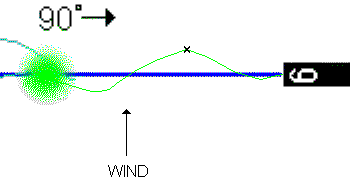
To correct for it, we turn right 20 degrees to a new heading of110 for the remaining one minute. This 20 degree correction fora 10 degree drift is exactly the same track correction methodyou used as a student pilot on your private pilot flight test.
How to fly an NDB approach with the NDB on the field is left asan exercise for the reader. (I’ve always wanted to say that!)