















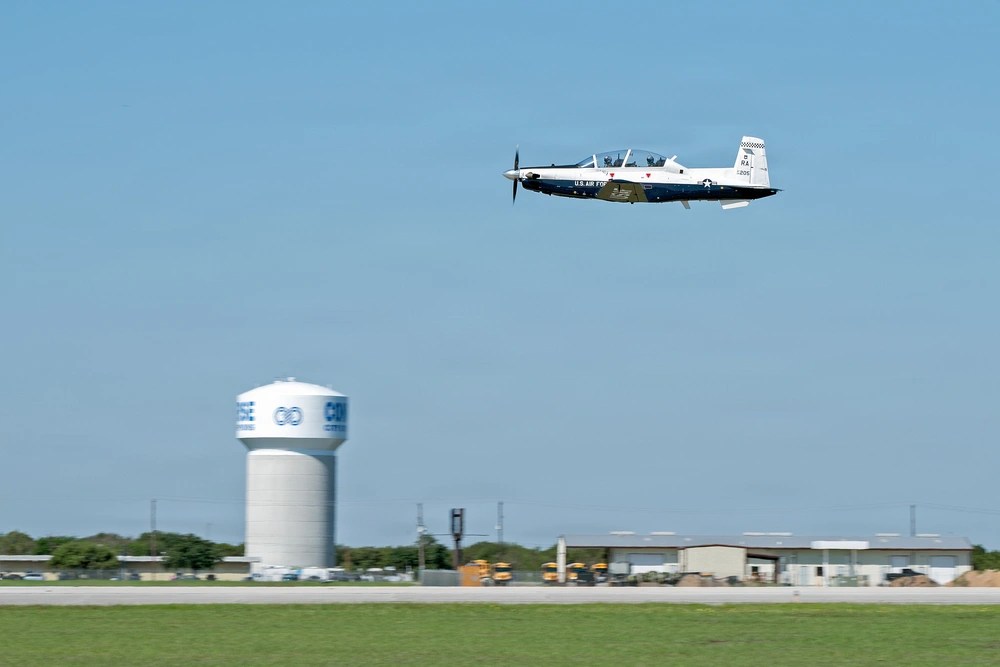

Two U.S. Air Force pilots safely ejected from a T-6A Texan II near Seguin, Texas, Thursday evening after experiencing a landing gear issue. The incident took place at approximately 5:51 p.m. local time and reportedly followed a hard landing at an uncontrolled airfield, according to a statement from Joint Base San Antonio.
Crew Advised to Eject
The pilots who were flying the T-6A mission were assigned to the 12th Flying Training Wing at Joint Base San Antonio-Randolph. They contacted personnel on the ground for guidance, following a landing gear warning, and ultimately decided to abandon the aircraft.
“After receiving unsafe landing gear indications, the pilots consulted with experts, who recommended the crew conduct a controlled bailout,” Joint Base San Antonio told local KSAT.
Both pilots were subsequently evaluated by local medical personnel. Officials did not immediately disclose their conditions or explain the circumstances of the reported hard landing.
Aircraft Background
The T-6A Texan II is a single-engine, two-seat turboprop used for primary flight training by the Air Force and Navy. Powered by a 1,100-horsepower Pratt & Whitney Canada PT6A-68 engine, the aircraft features tandem seating, digital avionics and ejection seats. A similar landing gear problem prompted the ejection of two pilots from a Canadian CT-156 Harvard II, a variant of the Texan II, in 2014.
The Air Force has not released additional information about the condition of the aircraft or the cause of the landing gear indication. Officials have also not specified whether the warning resulted from a mechanical problem or an indication system fault.


Not sure if this is government waste or government cost‑cutting. Apparently the Air Force has figured out the cheapest maintenance program: just eject and let gravity handle the write‑off.
Really? When would an ejection be safer than a belly landing on a runway or grass? Plus the needless destruction of the aircraft.
I agree, as a pilot for 34 years civilian pilots do not have the option to eject and most low wing aircraft can be safely landed on the belly. This was a foolish decision.
Another example of the lack of concern when blowing our hard earned tax dollars. Just look at the lavish lifestyles of our politicians, funded by us. They should at least try!
I‘be been a pilot for 55 years and have never had a hard landing that would require an ejection. It’s just another example of the waste of today’s military.
How is there time to consult with experts after a hard landing? At 1000 agl, did they get a warning, consult with experts who said land it on the belly and then eject? This is either poor reporting with lack of followup questions, or is poor “experting”. Sometimes, two things can be true at the same time.
Wow. Lots of strong opinions here by people who have clearly never flown a military turbine aircraft.
Following a hard landing, the gear may have been stuck down in an “unlandable” configuration, eg. the nose and one main down and locked and the other main damaged/in transit. In that case, the -1 (flight manual) would likely direct an ejection. I’ve never flown the T-6 but have time in the T-37 and T-38, and a controlled ejection was preferred vs. landing in a partial gear situation.
This decision was not made “willy nilly” or in a vacuum. The crew likely consulted with the supervisor of flying (SOF), a highly experienced instructor pilot, who sits in the tower during flying operations to assist in just such situations. There was probably a chase ship involved as well to get eyes on the problem in flight. After exhausting all other options, an informed decision based on the available information was made to abandon the aircraft.
The decision to eject was not made to somehow get one over on the taxpayers, or in the name of corporate greed, but to give the best chance to preserve the lives of our most valuable assets - the men and women who strap these aircraft on each day in the service of our country.
So who reported the hard landing, the pilots? If so, did they eject after the landing, or what? The whole incident sounds quite confusing!
As a retired AF pilot with over 3,000 hours in ejection seat trainers (T-37 & T-6), and as one who has lost friends in both combat and training missions (military and civilian), I wish those of you who don’t know would keep your uninformed opinions to yourself. You have just told us what monetary value you assign to the life of the two human beings that stepped up to serve you in the military and preserve your right to say stupid things. You have never been in their situation and you don’t know the details of it. Sometimes it’s safer to eject than burn to death in the wreckage. So, unless you have something useful to say, please don’t.
An abject and total waste of an expensive aircraft and needless risk to the crew to unnecessarily eject. Stan-Eval Board may have the final say in this.
100% agree with @goldsteinjd The article states ejected after hard landing and the annunciation of a gear fault. I assume that was as simple as not getting 3 greens. The article did not do a good job articulating that but if you have any practical experience you have to assume they did not eject because the gear simply did not deploy and lock. Nor did they belly land and eject while sliding down the runway, come on. At this level of training in the T6 they most likely had worked touch and goes into the exercise or they had the hard landing on return from exercise that required a go around and once back up the gear annunciator, the tower, another aircraft, most likely all the above said you guys are going to need to bail. The PIC on of that aircraft likely earned his call sign that day. Something the “Greaser” or “Breaker”
Folks: The article is pretty high level. In many aircraft, landing without fully extended main landing gear can be an ejection situation. A belly landing with all gear up is usually not an ejection situation. So, I’d guess that the aircraft had one or both of the mains partially down and at least one of them would not retract. Since the pilots ejected after consulting with folks on the ground, it seems pretty certain that one or both main gear were not down or fully down and would not retract. So, I suspect the actions were reasonable and according to the checklist. (Note: A stuck nose gear with the mains down and locked is normally not an issue. Just land on the centerline (or take an arrested landing.)
So where did the airplane end up? By all accounts it was still flyable so where did it fly to after the pilots ejected?
Next time you wait for a year to comment, you should consider sticking to the topic or waiting another year. Politicians blowing taxpayer dollars has diddlysquat to do with this topic. Plenty of other places to squawk about it to people who want to hear it. This isn’t.
I am shocked at this decision… unless long-ago prior experiences in the T-6… incured serious injuries or deaths.
At very least I hope the crew depleted fuel to minimums, lowered flaps for slow flight, shut-down the engine/feathered the prop, re-trimmed for a flat descent etc before the crew ‘jettisoned’ the aircraft. In this way there would be a not-so-tangled mess of aircraft debris…without melted aluminum fom a roaring fire.
So all of the experts here that have never faced this problem here is my take.
First I HAVE faced a gear unsafe warning in a aircraft with a split gear system ( Mains in system 1 and nose on system two. ) and the wisdom of their decision depends on many factors.
First, what was the actual configuration they had after the failure ) Nose up and both mains down, or one main and a nose, or only the nose gear.
In MOST cases a belly landing is still a better bet than the ejection seat. The Martin Baker US16LA seat is a good seat but it is still a last resort. I worked for McDonnell Douglas on the ACES 2 program and have engineering knowledge of these types of seat. The difference between the baker and the ACES is that the baker is a two gun seat and the ACES is a vernier rocket seat, and a gun seat has a very high initial specific impulse so using it even in the low velocity version here is riskier than a controlled belly landing.
EXCEPT when you have an asymmetrical gear deployment that could make a straight ahead belly landing impossible so a fly by and assessment from the ground would be step one and it seems they did that because they got advice from the ground.
If that was the case finding uninhabited land and punching out is a good choice, if this was just someone blindly following procedure or being timid then it was the wrong move, but the article doesnt have enough specifics to really determine the truth.
I faced two landing gear emergencies in my 30 years of flying one resolved using emergency procedures and the other was a nose gear compromised landing where I was able to keep the nose wheel from collapsing by soft field landing technique and a piss ton of luck.
Aside from needing a new seat cushion and laundry services both resulted in an intact airframe being useable again and a story, but nobody weeping over the outcome, or needing a chiropractor for the rest of their life.
Chuck Kubin…
Inappropriate and bizarre reply