














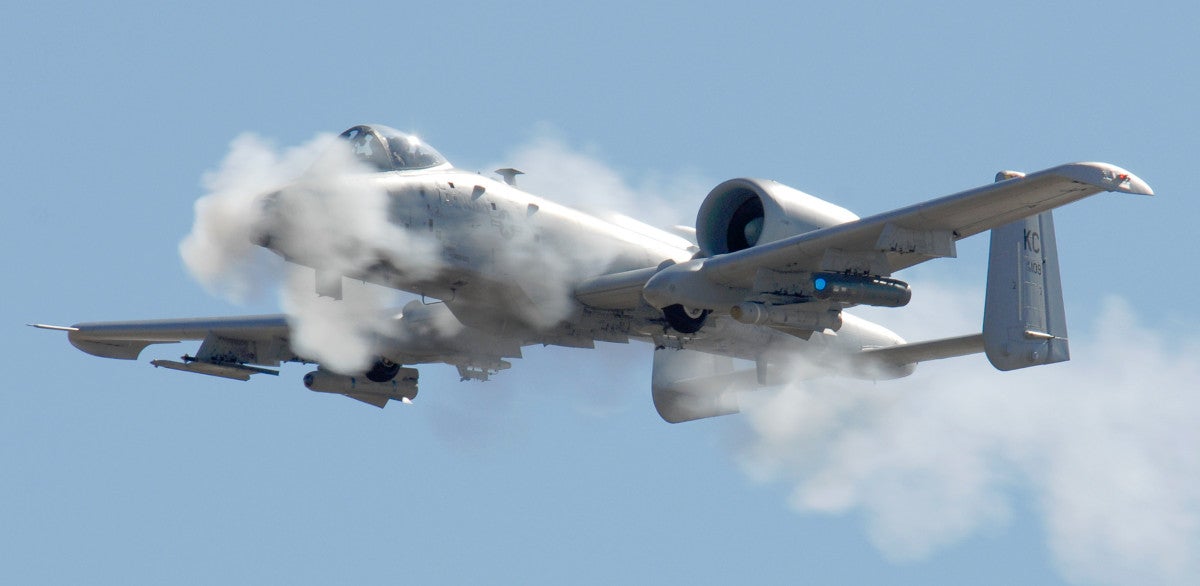

The Air Force has gone strategic on its seemingly hopeless quest to retire the elderly A-10. Instead of year after year giving well-reasoned arguments to Congress on how the slow and boxy airplane is like a big metal billboard to enemy attack radars and of no use in a contested environment, it’s taking a piecemeal approach and trying cull Warthogs in jurisdictions where politicians can be distracted by a potentially better offer, like a new squadron of F-16s. The House Armed Services Committee is now poised to allow the Air Force to retire 21 A-10s at the Air National Guard base in Fort Wayne, Indiana, in its latest defense bill.
The move has the support of Indiana federal and state politicians because the Air Force has offered to replace them with Vipers. The Air Force has a surplus of F-16s because they are being replaced in active duty units with F-35s. There is still a long legislative road ahead of the proposal. If the House accepts it, it will have to be endorsed by the Senate and President Joe Biden. Congress has historically had a soft spot for the sexy A-10 with its big rotary cannon, arguing that nothing else in the inventory can provide close air support for ground troops. The Air Force has long argued that the Warthogs would be shredded by enemy antiaircraft fire in a contested environment. The second half of the fleet of 281 aircraft is about to get new wings as part of a congressionally mandated life extension program worth $1 billion.
