















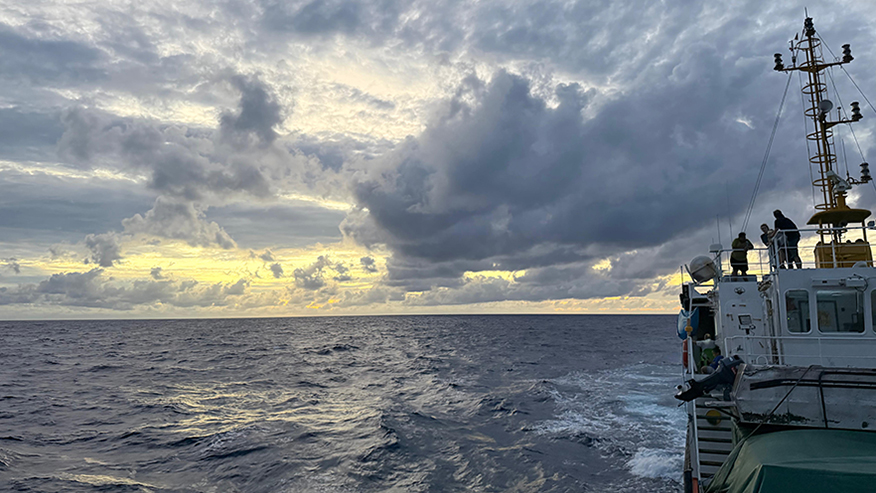

A 17-member expedition backed by Purdue University is expected to arrive at Nikumaroro Island in the South Pacific on Tuesday to investigate a submerged object that researchers believe could be Amelia Earhart’s missing Lockheed Electra 10-E. The team departed Tarawa, Kiribati, last week aboard a research vessel and plans to spend five days examining the site.
The search centers on the so-called Taraia Object, an unusual shape identified in satellite imagery in 2020 that researchers say is also visible in aerial photographs dating back to 1938. The expedition follows a previous postponement due to permitting delays and weather concerns.
Earhart and navigator Fred Noonan disappeared in July 1937 while attempting to fly around the world. Their intended destination, Howland Island, lies approximately 400 miles northwest of Nikumaroro.
Search Targets Submerged Object
“Finding Amelia Earhart’s Electra aircraft would be the discovery of a lifetime,” expedition leader Richard Pettigrew said in remarks published by The Guardian. “Confirming the plane wreckage there would be the smoking-gun proof.”
According to a Purdue update, researchers plan to survey the island using drones before deploying sonar and magnetometers to examine the submerged object. The team will then use a hydraulic dredge to expose the object for identification. Any eventual recovery of aircraft wreckage would require additional authorization from the Kiribati government.
Researchers Disagree Over Evidence
“You can see the root ball,” Ric Gillespie, co-founder of The International Group for Historic Aircraft Recovery (TIGHAR), told Reuters. “You can see the branches. It’s a tree. People see what they want to see.”
Gillespie, who has conducted numerous searches at Nikumaroro, believes Earhart may have landed on the island but that her aircraft was subsequently washed into deeper water. No definitive wreckage from Earhart’s aircraft has been identified.


Gardner Island was the island’s name when Earhart landed on its coral reef July 2nd, 1937. It was uninhabited. Native islanders who would later inhabit the island renamed it Nikumaroro. The 400 miles distance from Gardner to Howland Island given in the post may be off by an order of magnitude. The distance may be only 40 miles.
I agree that the object seen from aerial and satellite photos is unlikely to be the Lockheed Electra. Purdue University bought the airplane for Earhart in 1937 as a result of the conniving of her husband, George Putnam with Purdue officials. Her death on the island from starvation was an indictment of the incompetence of our Navy and Coast Guard at the time who despite her many distress calls over a two-week period using the HF radio on her Lockheed Electra with its right engine running, could not locate her and eventually abandoned the search leaving Earhart to die only to have her skeleton found years later and forensically matched to Earhart. Fred Noonan, Earhart’s navigator: His bones were never found. It’s believed he died from a laceration he received from falling on the coral reef that became infected leading to blood poisoning and death. He may have died in the airplane and went down with it when it was washed off the coral reef at high tide.
Some of Earhart’s radio distress calls were heard clearly in the continental US despite being several thousand miles away, a common characteristic of the HF radio frequency band and its carrying distance.
The distance between Howland Island and Nikumaroro is 350 nautical miles. US naval aircraft flew over what was then called Gardner Island 5 days after Earhart’s disappearance in 1937. If it was me, I would have dragged myself onto the beach and waved. When Kiribati became an independent republic (July 12, 1979), the new government adopted Indigenous Gilbertese names for many islands in the Phoenix Group.
While Purdue University did play a central role in securing the Lockheed Electra 10E, the acquisition was not a matter of “conniving.” In 1935, Purdue President Edward Elliott recruited Earhart as a career counselor and aeronautical advisor. Recognizing her desire to advance scientific aviation research and attempt a world flight, the Purdue Research Foundation established the Amelia Earhart Fund for Aeronautical Research. Backed by substantial donations from Trustees like David Ross and industrialists like J.K. Lilly, the foundation successfully funded the plane, which was legally titled in Earhart’s name with the mutual understanding that it would eventually return to Purdue’s campus.
Amelia Earhart’s actual bones have never been recovered definitively:
British officials found 13 bones and a partial skull on the remote Pacific island of Nikumaroro in 1940. They initially examined them and concluded they belonged to a stocky, middle-aged male.
A 2018 study by University of Tennessee professor Richard Jantz re-analyzed the historic measurements. He argued the bones could have been a 99% match to Earhart.
The physical bones from 1940 were lost decades ago, making DNA testing impossible.
The Purdue target is the lagoon in the middle of the atoll.
Earhart transmitted over IIRC days, which indicates the airplane was above water part of the time so its electrics and antennas could function.
Could that happen if the airplane landed in a lagoon?
Why would Earhart land in a lagoon when exposed reef is available?
(Beware there is speculation - I haven’t heard the notion that Noonan died from cutting himself on coral of the beach, but I have not read TIGHAR’s latest book of details yet.)
TIGHAR wanted to do a DNA test on what could be a finger though pigs lived on the island at some time, but DNA tests would have taken too much of the flesh so they did not. A great nephew or such relative was identified as someone who could donate a bit of DNA for comparison. Followup needed as DNA analysis has progressed tremendously.
DNA testing does not necessarily narrow identification to an individual, but does at least to a family line. In the case of killer of a young couple from Saanich BC when they were visiting Seattle WA, DNA testing a few years ago narrowed down to family lines of both his sires, then Snohomish County sheriffs followed the suspect’s work van until a coffee cup fell out - that gave them his DNA, another sample was found in the victim’s van.
Interviewing of persons in family lines is part of the search.
Mr. Gillespie has said he would be pleased if Earhart’s airplane was found, but he is extremely skeptical of Purdue’s theory.
TIGHAR spent much on sonar surveys of ocean bottom which slopes steeply off of the reef, in doing so learned about interpreting sonar which is not easy to get right.
But it’s publicity for Purdue I guess. Perhaps that will motivate donations to TIGHAR to do more research including sonar in ocean and digging around land.
Violent winds, tides, animals/fishes and corrosion… of the barely protected alumimun, copper and steel alloys will have ‘long-ago’ sheredded and/or disolved in the merciless environment.
/NOTE/ My dad’s experience of oceanic flying [Thorp T18]… and his ‘electrical system problems’ due to corrosion and moisture intrusion, prompt me to suggest that Earhart… and her less than stellar navigator Newnan… would have been unable to navigate effectively if their single ADF system suffered degraded [quiet ‘failed’] electrical system damage.
Purdue is not at the island yet!
People should realize that the journey to the island is not easy, takes time and weather can interrupt or worse. Then have to use small boats to go ashore, and bushwhack inland.
TIGHAR did much looking and digging, found artifacts matching Earhart’s characteristics and medical needs. And some aluminum sheet.
TIGHAR’s book of a few years ago sums their [evidence] to conclude her fate, recent book gives details of the evidence. People should buy and read the books.
BTW, TIGHAR’s thesis is that Earhart and Noonan turned toward islands toward the south of Howland rather than spending time and fuel square-searching around their destination Howland island. Not many islands in the region.
A couple with navigation experience posited that the airplane went down after exhausting fuel doing a ‘square search’, and sank. (They explained square searching, more of rectangular adjusting for visibility given sun angle and I recall estimation of magnitude of error which is likely different along-track versus direction.)