















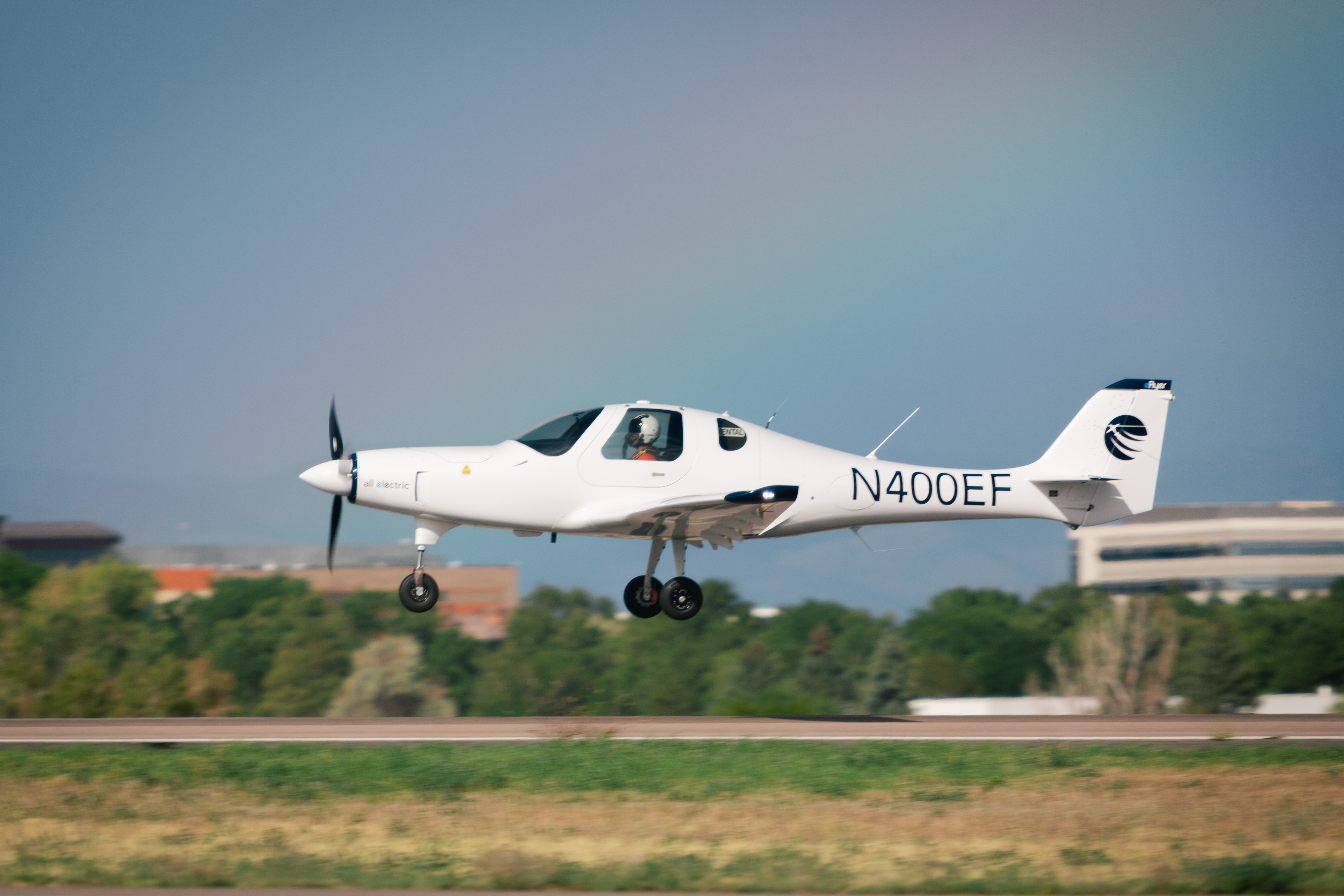

Bye Aerospace has completed the first flight of its full-scale eFlyer 2 prototype, beginning flight testing of the two-seat electric aircraft the company is developing for the flight training market.
The aircraft flew from Centennial Airport near Denver on Sept. 17 with Chief Test Pilot Elliot Seguin at the controls. The flight came about a week after the FAA issued a special airworthiness certificate for the prototype and included an initial evaluation of handling qualities, aerodynamic characteristics and aircraft systems.
Electric Trainer Moves Into Flight Test
“First flights are always significant moments for any new aircraft program. This team has worked hard and they will remember this achievement for a long time,” Seguin said in the company’s announcement. “The eFlyer 2 handled well during the flight and validated the work the engineering team has put into designing and testing the aircraft over the past several years. It’s exciting to help advance a platform designed specifically for the future of pilot training.”
The eFlyer 2 uses a 125-kW electric motor and a magniX Samson battery system. MagniX said the flight marked the first use of its Samson300 battery product in an aircraft. The battery provides up to 800 volts and has an energy density of 300 watt-hours per kilogram, according to magniX. Bye selected the Samson system for the prototype in 2025.
Certification Work Continues
Bye says the aircraft has more than two hours of mission endurance and a recharge time of less than 30 minutes. The company is pursuing certification under Part 23, Amendment 64, and plans to market the aircraft primarily for flight training. Skyborne Airline Academy previously expanded its commitment to the eFlyer line by signing for 30 additional aircraft.
The company says the flight-test program will now gradually expand the aircraft’s flight envelope while collecting handling and performance data for certification. Bye has not announced a firm certification or customer delivery date.


Oh, I see, this makes sense to me, since I went to MIT and majored in Electrical Engineer—wait, I forgot, no I didn’t, so it’s gibberish.
“The battery provides up to 800 volts and has an energy density of 300 watt-hours per kilogram, according to magniX.”
Well if you use their numbers and do the math then the batteries weigh 625kg or 1378 lbs.
Matt: These performance claims (819v max and 300kwh/kg) can be found on the company’s website. You may be skeptical of the claim, but this is accurate reporting.
Well, I did get 4 degrees from MIT but majored in Physics and Mechanical Engineering. However, I took the basic EE classes from a professor that many in aviation would know of, Amar Bose. Anyway, the higher the voltage, the small and lighter the wiring can be and the higher the Whr/kg, the lighter the batteries will be or the longer the range will be for a given weight. The total kWhr was not given, so unless you know the power profile for a flight along with the time, you can not compute how much power is used or what battery weight is required.
I did work on an electric car project in 1967 while I was an ME graduate student. We added about 3000 lbs of NiCad Batteries to a 1967 Corvair donated by GM and with the help of the local power companies, it was driven from MA to CA. It was not very practical but you have to start somewhere or nothing gets done. I have been driving a practical electric car (Chevy Bolt and now an AWD Chevy Equinox) since 2019 and wish I was flying an electric plane. It is a harder problem but is going to happen. Anyway, I drove the Bolt for 105,000 miles and other than tires, the only maintenance was to replace the rear wiper blade twice and the cost of the electric energy was negligible.
All the naysayers 5 years ago saying batteries in airplanes will never work… here you go. Two hours duration is more than sufficient for a typical primary lesson. 10 years ago we were lucky to get one hour. Progress takes time and effort - we should applaud it, not undermine it.
I look forward to flying an electric airplane. That said, the naysayers had - and have - a point.
As a rule of thumb, the range of a well-designed fixed-wing electric aircraft, in nautical miles, is roughly the energy density of its battery packs, in Wh/kg. Unlike cars, airplanes can’t just use a bigger battery to go farther, because as you scale the battery, you have to scale the airframe and motor. Everything just scales together, and the range doesn’t change.
This airplane’s battery packs are 300 Wh/kg. So 300 nmi, likely at around 70 kt, giving range with VFR reserves of 265 nmi, comparable to a 1948 Piper Cub, at about the same speed. Yes, this airplane could sprint much faster than the Cub - but it won’t sprint far.
On the other hand, if you want to go 900 nmi at 150 kt, you’re going to need a battery with a pack energy density well north of 1,000 Wh/kg.
Progress on energy density has been really slow. Randall Fishman demonstrated a fully operational electric airplane at Oshkosh 18 years ago. His battery packs had an energy density around 160 Wh/kg. So, improvement of about 8 Wh/kg per year (and slowing). At that rate, an electric SR20 would be close to a century away.
In 1942, you could build a touring airplane and even a fighter, but piston engines were not going to bring us modern airliners - ever. It took a radical invention, the jet engine, to do it. The batteries we have can support training airplanes but they’re never going to give us practical traveling machines. We need something radical.