
















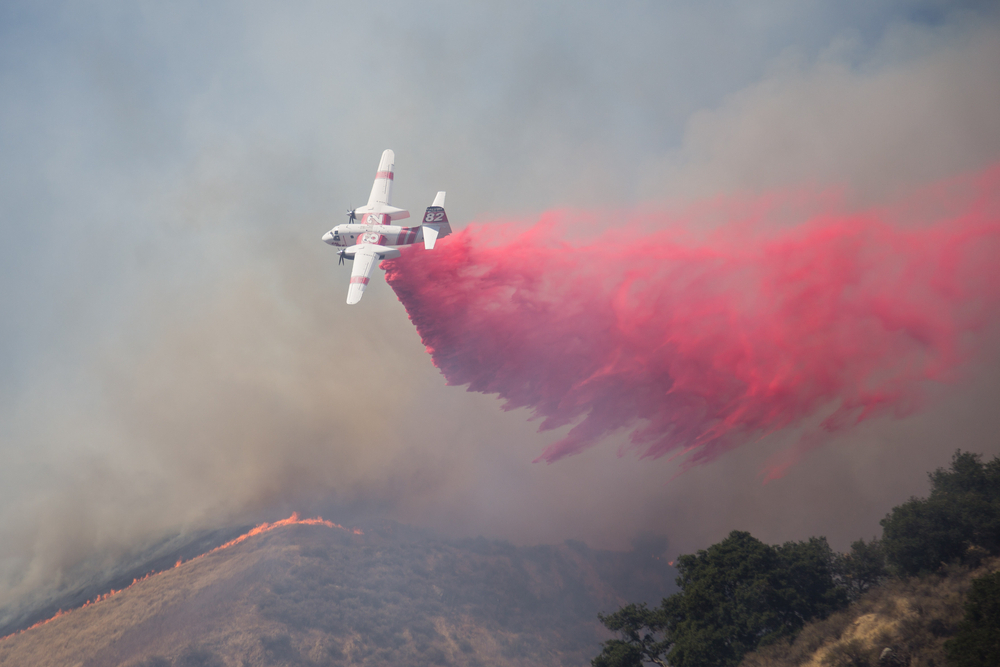

The Federal Aviation Administration (FAA) is considering changes that could make it easier to use certain restricted-category aircraft to transport firefighters to and from wildfires.
The agency published an advance notice of proposed rulemaking (ANPRM) Sept. 14 seeking information from firefighting organizations, aircraft operators and other stakeholders. The effort would eventually allow firefighters performing ground suppression work to ride aboard certain restricted-category aircraft.
Under current rules, restricted-category civil aircraft generally cannot carry people unless they are performing an essential function associated with the aircraft’s certificated special purpose operation. Firefighters traveling to a wildfire to perform ground suppression don’t meet that standard. The FAA also has determined that transporting firefighters for ground operations does not qualify as an aerial-work operation under Part 119.
The proposed changes would address those restrictions by potentially adding transportation of firefighters to a wildfire as a special-purpose operation under §91.313 and making corresponding changes to the Part 119 exceptions.
The FAA’s action stems from Section 360 of the FAA Reauthorization Act of 2024, which directed the agency to establish a regulatory path for transporting firefighters aboard certain restricted-category aircraft. The legislation specifically excludes former military aircraft from the provision.
The FAA is not proposing a final rule yet. It is collecting information that will help determine what a future rule could look like.
Comments on the proposal are due Nov. 13, 2026.


If the aircraft is operated by a government entity on a wildfire, then it is a public aircraft operation not subject to the FARs. Wildland firefighters could be transported in that situation. Civilian contractors of government entities are where the current restriction kicks in. Then any occupants of the aircraft can be transported only if they perform an essential function.
This feels like common sense. The public-interest benefit is obvious, and firefighters are well aware of the risks involved. Treating them the same as the general travelling public doesn’t seem necessary in this context.
May need special requirements for ex-military aircraft like Coulson’s C-130s.
(Military usually have meagre troop seating AFAIK.)
Whereas Coulson’s B737’s might be easy to certify for full transportation use as they are former airline airplanes (Coulson has been trying to provide ability to transport cargo and people).
Apparently some Coulson-modified airplanes may be owned by a government agency though may be operated by Coulson - so a complex situation. an Australia state and CalFire/LAFire for example.
Beware Canada is probably tighter to begin with.
Though few if any Coulson heavies are contracted for in Canada, never mind some of its C-130s are former Canadian military C-130H airplanes.