














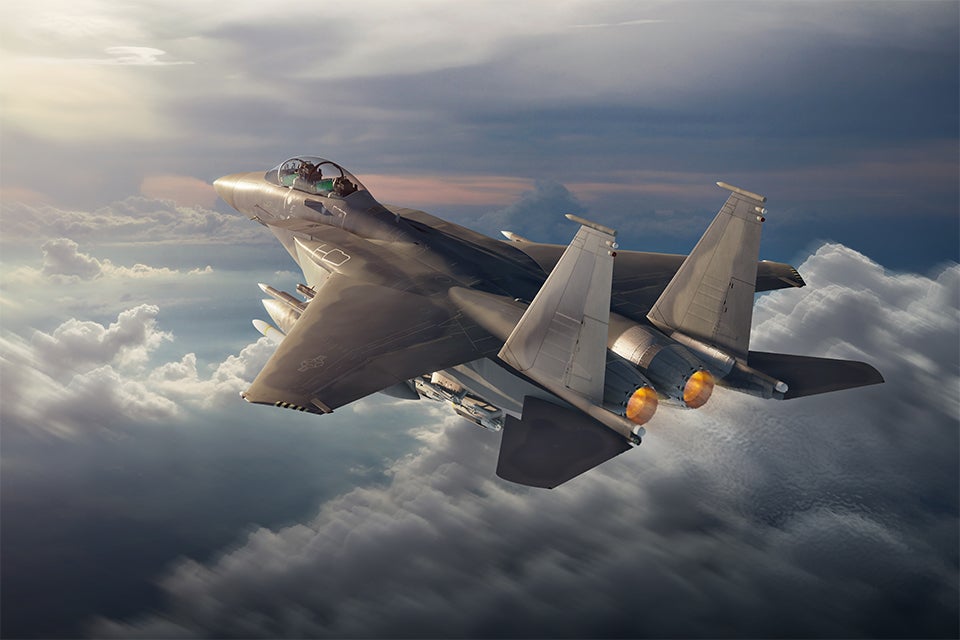

The latest generation of the venerable F-15 fighter took flight today in St. Louis, with Boeing chief test pilot Matt Giese at the controls. The flight lasted 90 minutes, and began and ended at Lambert field. The F-15EX is a technologically advanced version of the fighter that entered service in 1974, with fly-by-wire controls, a stronger airframe and much more modern computers and sensors.
“Today’s successful flight proves the jet’s safety and readiness to join our nation’s fighter fleet,” said Prat Kumar, Boeing vice president and F-15 program manager. “Our customer can feel confident in its decision to invest in this platform that is capable of incorporating the latest advanced battle management systems, sensors and weapons due to the jet’s digital airframe design and open mission systems architecture.” According to Boeing, the F-15EX’s “digital backbone” means it can be used as a “testbed for future technology insertion, a key capability for the Air Force.”
“On behalf of the GE team, congratulations to Boeing and the United States Air Force on the first flight of the F-15EX,” said Shawn Warren, general manager, GE Large Combat & Mobility Engines. “This milestone reflects the teamwork and dedication focused on the capabilities of this outstanding fighter. We are proud to power the Air Force’s most advanced F-15 fighter.”
The first eight aircraft will cost $1.1 billion as part of a planned 144-aircraft program.
