















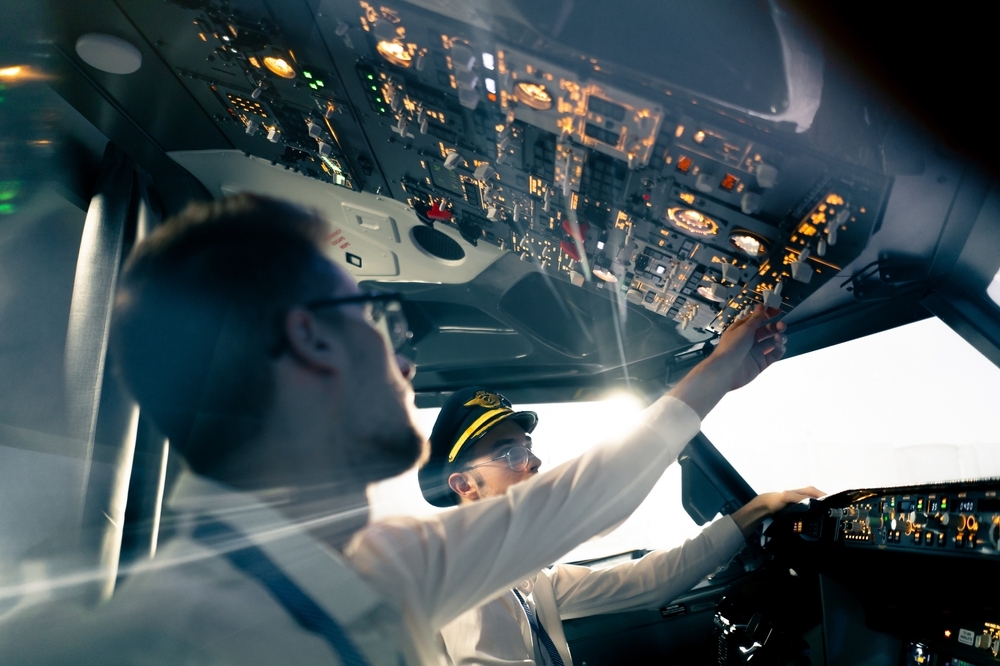

Members of the House Aviation Subcommittee introduced bipartisan legislation aimed at improving coordination between pilots and air traffic controllers by giving controllers an opportunity to observe airline operations from the cockpit.
The FLIGHT DECK Act, introduced Sept. 4 by Reps. Nellie Pou (D-N.J.), Rob Bresnahan (R-Pa.) and Hillary Scholten (D-Mich.), would direct the FAA to establish a training program allowing air traffic controllers to ride along on actual flights. The bill, H.R. 10303, has been referred to the House Transportation and Infrastructure Committee.
The lawmakers say the program would give controllers a better understanding of the workload, operating environment, and challenges pilots face while communicating with ATC.
The FAA would develop the program in consultation with controllers, pilots and participating airline crews. After the first year, the agency would be required to report to Congress on participation and identify any obstacles that prevented controllers or operators from taking part.
Bresnahan, a pilot, said his own experience visiting a control tower gave him a different perspective on the work controllers perform.
“Pilots and air traffic controllers work together every day,” he said, arguing that allowing controllers to see the cockpit environment could provide a similar perspective from the other side of the radio.
The legislation comes as the FAA continues efforts to address a nationwide shortage of air traffic controllers. The lawmakers also pointed to recent efforts to improve the resilience of the nation’s air traffic control infrastructure and communications systems.
Pou, who serves as vice ranking member of the Aviation Subcommittee, has made ATC staffing, communications and implementation of the FAA reauthorization law priorities during her first term.
The bill’s sponsors said the additional flight experience could help strengthen communication between pilots and controllers and ultimately improve aviation safety.

This isn’t a new idea. Controllers in the jump seat for ride-alongs was de rigeur for decades before 9/11 changed the cockpit access rules.
Wasn’t this already a “thing” at some point, with Air Traffic Controllers and Dispatcher’s doing mandatory flight deck familiarization flights?
Great idea, especially for new controllers.
‘future to the back’ I like to say.
Might also be worthwhile for experienced controllers or FAA specialists to get better appreciation for convoluted procedures like one at SFO.
FAM program, take Five…
Hardly a new idea. The Flight Deck Familiarization program has come and gone in several iterations over the past few decades.
At its core, it’s a good idea. However, perceived misuse and abuse by the public in past years has always put a damper on the program. It’s also not the easiest or most forgiving program to use. It’s pretty easy for a controller to get stranded when on a Fam flight, leaving the controller to book travel home at his own expense.
I used to FAM back in the day, when I was young and full of adventure. In my later years, I would much rather just buy a ticket, sit in the back, and not worry about what the pilots have to deal with. If the FAA really wanted me to see what goes on inside the flight deck, the FAA wouldn’t make it so difficult for me to do that.
I was of the same line of thinking, crsunblast. By the time I left ATC, I was buying tickets even though I enjoyed talking to the flight crew. I know I learned some things that I would not have known had I not used the fam program, and it made me a better controller and ultimately served me well as my career progressed outside the control room.
Truth is, it is not only controllers that would benefit. I deal with people every day who come up with otherwise seemingly good ideas based on faulty assumptions about what pilots, dispatchers, and operators in general do, want, can use, or help them in any way.
Even the idle conversation in the cockpit was more enjoyable than what I may have had in the cabin because we generally had more in common in many ways.
Interesting concept BUT this could lead to pilot distraction possible errors . I would propose that this training first be performed in flight simulators and a first stage of implementation with a strong analysis and lessons learned . Each controller would first witness flight operation within the safe confines of the simulator w training pilot oversight to understand and ingrain safe procedures for what I would call witness flight.
Only then should a controller be allowed into the flight deck.
Each part of the program
Pre simulation
Simulation recap and witness flights
Need to be designed to emphasize what are the topics to be learned and how the information exposed is retained and what really was learned.
The same should be done for pilots via a vis the ATC system.
Otherwise this becomes a series of poorly structured joy rides
I emphasize a well structured program because the negative consequence or a serious flight desk issue if far more life threatening than the same in a controller environment.
In other word be careful what you ask for make sure you get out of this what you want. What should be the objective is an improvement in operational safety!
As many have said, this is already a program and yes post 9-11 program exists… so good job Congress wasting time! Here’s the catch! YOU NEED STAFFING TO ALLOW THE CONTROLLER OFF THE SCHEDULE, as it counts as a duty day! Get staffing and Pay in order first! The administrator is completely unqualified!
We don’t need any “new” legislation. Title 14 Part 121.547 already admits controllers to the flight deck to observe.
Knock off the crap and get down to doing the job like it says in Title 49 Part 44713.
Also – facilitate controller rides with general aviation pilots in piston singles.
Why? All the same rules apply, but things happen slower, so the controller would have more time to observe the interactions.
Title 14 § 121.547 Admission to flight deck. Is seriously in need of revising; it is a disorganized jumble of “permissions” that overlap and duplicate, with an unclear subsection that can’t be tied to its parent header that reads:
“(2) An air traffic controller who is authorized by the Administrator to observe ATC procedures.”
Back in my day, controllers were issued a “700 card” that identified them as air traffic controllers, and could be used to request from the aircraft’s PIC on any flight, at any time, as well as being used with “approved controller duty time” trip requests.
Great idea for controllers.
How about revising the training requirements for instrument rating students to visit/observe an IFR ATC facility?
I remember it well back when FAA FSDO, ACO, and ATC could request a jumpseat observation. It would bump an employee from a jumpseat authority and the FAA staff would get the usual Captain’s consent and then settle into first or business with a glass of bubbly.
In other words, they don’t go for education, but to vacation, see family. Never did I ever see a real purpose behind this. It’s b/s … I’m sorry to see it.
Agree with all the other posts. At ARB, a training environment for both students, and local controllers out of DTW and YIP, whenever I had a little extra time after a flight, I’d ring up the tower before heading back to the hangar and ask if they had any controllers who wanted a familiarization flight. This is permitted, and I was frequently taken up on the offer. I especially worked with the tower chief when we all knew a fresh controller was struggling a bit. My C182 is pretty capable of flying a pattern fast or slow, and being able to demonstrate that to a controller sitting in the cab is sometimes life changing for them. And us. It also gave me a chance to help the controllers understand that not all skill levels are available in all pilots, just like controllers, but by listening carefully to the radio calls they could be distinguished from each other, too. I was pleased more than once on a busy football Saturday to hear a controller that I’d given a fam/flight say, Cessna N999UM can you indicate 80, traffic is a Goodyear Blimp bound for the southeast Ts. Of course I acknowledged, but will I know an airship when I see it? Or the more usual keep your speed up, inbound is a Citation.
I retired from a major airline 19 years ago and having an ATC guy/gal never once was a distraction, in fact I briefed them to help with eyes out the cockpit for traffice if I or the F/O haven’t had a visual on traffic bring called out. Once levelled at cruise we always had interesting exchanges describing our roles in aviation. I admired the New York sector in their rapid fire directives, in fact advised one controller to slow down a bit so we could clearly understand what he said. Your idea reeks of bureaucratic multi-level make work!