















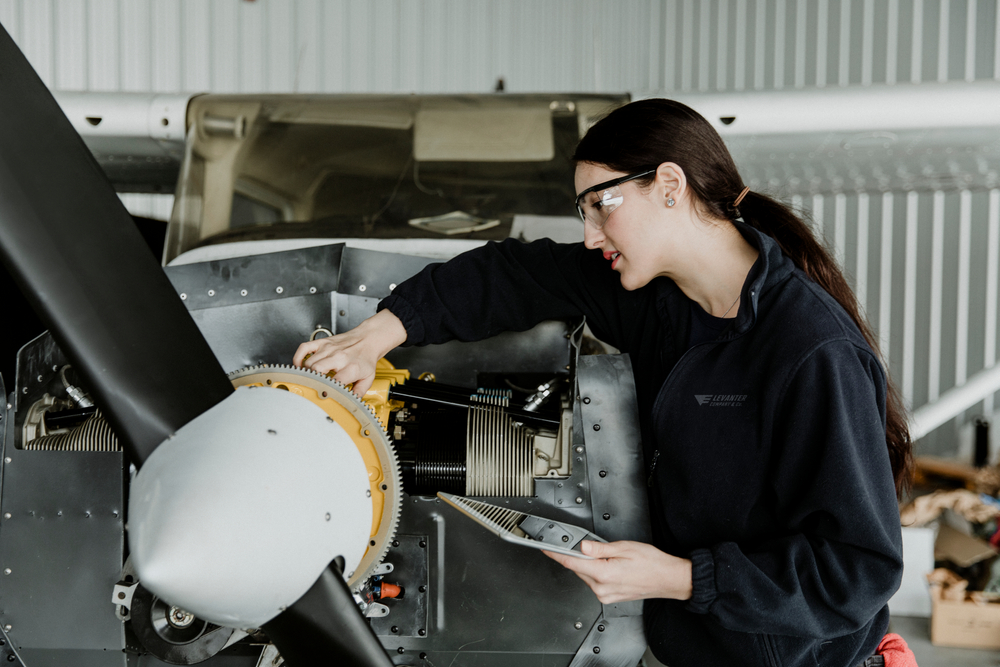

The Government Accountability Office (GAO) has recommended that the FAA review whether students who complete aviation maintenance curricula at non-FAA-certificated high schools should be allowed to take the agency’s general written knowledge test. The GAO identified at least 43 such high school programs, in addition to FAA-certificated schools and other institutions that provide maintenance training to high school students.
Testing Access
The general exam is the first of three FAA knowledge tests required for applicants seeking airframe and powerplant ratings. Graduates of an FAA-certificated Aviation Maintenance Technician School can establish eligibility through their schooling. Other applicants can qualify through practical experience, which generally requires 18 months for one rating or 30 months for both under FAA mechanic testing requirements. Students from uncertificated high school programs who lack the required work experience or additional education generally cannot immediately take the general test.
“This can be a time consuming and costly process that may discourage students from pursuing careers in aviation maintenance,” GAO wrote in an overview accompanying the report.
The agency said many such students must pursue additional coursework at an FAA-certificated school after already completing maintenance classes in high school.
FAA Review Still Pending
The FAA Reauthorization Act of 2024 directed the agency to have an Airman Knowledge Testing Working Group assess whether students who successfully complete an aviation maintenance curriculum should be allowed to take the general test. The group was supposed to be established by May 2025, but GAO found that the FAA had neither established it nor obtained the required assessment.
FAA officials told GAO that the work was interrupted after the Department of Transportation terminated all members of the Aviation Rulemaking Advisory Committee pursuant to an executive order affecting advisory committees.
GAO recommended that the FAA assemble industry stakeholders and aviation experts through the committee or another mechanism to study the potential advantages and disadvantages of expanding test eligibility. DOT agreed with the recommendation, which remains open.
The report comes as the industry continues to seek new aircraft mechanics. GAO cited Bureau of Labor Statistics projections estimating about 11,300 aircraft mechanic openings annually through 2034 and said expanded testing access is one issue the FAA should consider as it examines future workforce demand.


Asking for a friend, must an applicant be “English Proficient” to apply for a A&P?
Most of the practical test involves being able to read manuals and follow those procedures spelled out in those manuals. I don’t know of any examiner in the US who has manuals for the practical test in any other language except English. I haven’t seen any written test administered by the FAA done in any other language than English. I know as a pilot being “English proficient” is a legal requirement, not sure about A+P certificates.
Having taken all three exams in the distant past: General, Airframe, and Powerplant; the General exam was the easiest. Airframe was intermediate because knowing airframe terms is a general for everyone; and how and what works in sequence in an aircraft control system is critical; and the powerplant exam I found to be the toughest because knowing all, I repeat of the nuances of aircraft engines takes a lot of study: magnetos, constant speed propellers, dual ignition systems; and others; takes a lot of time to have down pat! To say nothing of turbine engines and how they work and what works in what sequence. An A&P course is probably essential. Because to pick up this knowledge working is certainly possible; but all of this knowledge required for the exams appears to require taking the classes,