
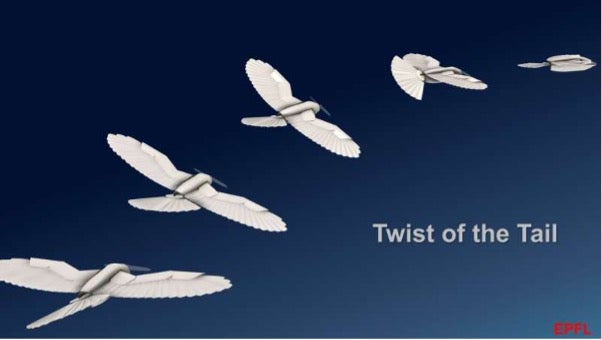

A pair of aerodynamic researchers at the École Polytechnique Fédérale de Lausanne (EPFL) in Switzerland have created a raptor-inspired drone that uses its tail feathers to control bank, rather than wingtip feathers mimicked by ailerons on airplanes. Hoang-Vu Phan and Dario Floriano built a feathered drone with morphable wings and a twistable tail that they have shown can induce bank angle.
The pair published a paper in the Science Robotics technical journal describing how they built their model and how well the model performed in wind tunnel tests. In preparation, they studied video of hawks in flight and how they could initiate banks without actuating their wing feathers. The turns could be executed at low and high speeds as the raptors maneuvered. Just a slight twisting of the tail feathers could initiate asymmetric wind flow over the wings, as well, resulting in bank angles and turning motion.
According to the paper, the research suggests that Phan and Florio’s raptor-inspired drone could not only help explain how birds maneuver but also help design new drones to turn more efficiently.

They found it worked due to the proximity of the tail to the wings—a slight twisting allowed for asymmetric wind flow over the wings and tail, resulting in asymmetric lift—which made the bird bank to either side, even as the tail feathers simultaneously initiated a pitch-up motion to counter the induced drag, just as the elevator does on a fixed-wing airplane.
The research pair suggest their robot not only helps explain certain aspects of raptor flight but might be useful in designing new kinds of drones that are able to turn more smoothly, and thus, more efficiently.