















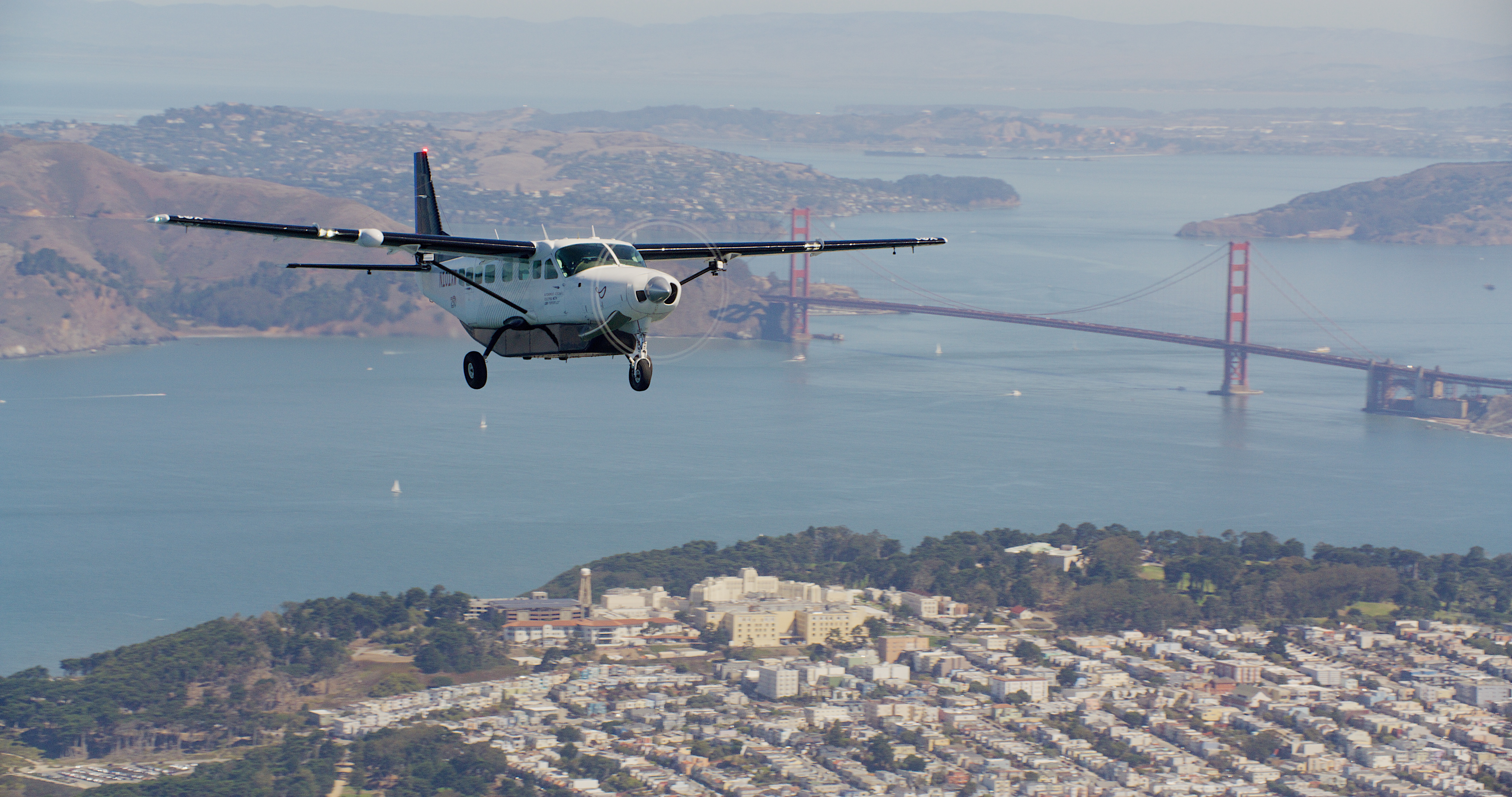

Joby Aviation says a converted Cessna Caravan equipped with its autonomous flight system has completed a 3,199-mile trip across the U.S. without any control inputs from a safety pilot onboard the aircraft. According to a company release, the eastbound flight began at Buchanan Field Airport in Concord, California, and ended at Dare County Regional Airport in North Carolina’s Outer Banks.
Autonomous Operations
During the trip, the Caravan autonomously handled taxiing, takeoffs, route navigation and landings. Although a safety pilot was onboard the aircraft, Joby said the aircraft was remotely supervised from its autonomy headquarters in California and from Shaw Air Force Base in South Carolina. Remote supervision occurred from distances of up to 2,323 miles.
The route included stops in Phoenix, Fort Worth, Texas, and Shaw Air Force Base before reaching North Carolina. Joby said the aircraft operated at Phoenix Deer Valley Airport and changed its routing around severe weather and thunderstorms during the trip.
“This journey across America offers a glimpse into a new era of aviation,” Joby founder and CEO JoeBen Bevirt said in the company release. “Autonomy has an important role to play in the future of flight, allowing us to connect remote communities, deliver critical supplies, respond faster to disasters, support military operations, and keep pilots out of harm’s way.”
More Flights Planned
Joby acquired the autonomy technology through its 2024 purchase of Xwing. The company says the system has accumulated more than 400 flights and 800 automated flight hours in controlled and uncontrolled airspace. The Caravan will now make a westbound return trip that is scheduled to include stops in Raleigh, North Carolina; Fredericksburg, Virginia; Louisville, Kentucky; Wichita, Kansas; Oklahoma City; Salt Lake City; and Portland, Oregon.


I for one will never be a passenger on an aircraft where the pilot is not “in harms way.” If the pilot does not have skin in the game, then I have a healthy fear for my own safety.
I felt the same way when Elevator Operators were eliminated in favor of Autonomous Elevators.
But seriously, Waymo has been proven statistically to be a safer taxi cab driver than any human and we know that the vast majority of plane incidents are due to pilot error. Even with two ATP pilots aboard, most accidents are due to pilot error. I’d rather have a computer fly me, than any Air Malaysia or Air India pilot - to name but a few sketchy airlines.
This technology will be invaluable for dangerous missions: fire fighting, transmission line inspection; agriculture spraying, war. Also for small plane commuter flights, where replacing the pilot with a passenger will improve economics.
Just one more way to put pilots out of a career. I was at a briefing during a GAMA meeting years ago and was bluntly told by an engineer that pilots were going the way of the Stagecoach driver. He said that although many of the people in the room would not fly on autonomous aircraft, their kids and grandkids would. It is inevitable. I’m 69 and have over 12,000 hours flying time. I may live long enough to see this technology become common place, but I’ll never give up my right to fly until they bury me.
Eventually, just like driving cars, manually flying a plane will become an activity for enthusiasts that will be restricted to certain times and/or locations.
While every time an autonomous surface vehicle has an accident it is big news (especially if there is an injury), the actual accident rate is much lower than for human driven vehicles. It will be the same for aircraft. The flying environment is much easier for autonomous vehicles to handle.
While Waymo is statistically safer than human drivers, do the stats compare the same routes between human drivers and Waymo? And Waymo has yet to accrue the millions of miles humans have over the course of driving history, including crash stats. There may be an uneven comparison unless Waymo stats are presented in discussions in comparison to human stats. Moreover, Waymo and other driverless vehicles are still restricted in specified areas. That and the mounting crash stats of driverless vehicles is cause for concern. Tesla has fought against revealing its crash stats, whether from drivers using FSD or its cyber taxi presently roaming around a restricted area in Texas.
I studied NTSB stats while earning pilot privileges. Stats from 30 years ago listed around 85% of aircraft accidents were pilot errors. To read about one autonomous aircraft making a long distance flight with stopovers without human intervention is astounding but I wonder if this is 100% accurate or was assistance needed. I think there’s a great deal more of computer processing in a flying environment relative to vehicle driving.
Sadly, we all know what automation, AI, and tech can do. However there’s a lot more to this philosophy. As with any job, it probably can be done remotely, but should it? Are we getting rid of millions of jobs that humans do? How are people going to earn a living? We see the results of all these tech advances on a daily basis. Why are there so many homeless? They can’t all be losers. Another discussion I know.
When flying as a professional flight engineer on B727, I only had about 3 serious events happen. However, none of these events were covered in training, checklists, or other forms of guidance. I had to think my way out of the box, and with the captain’s permission, do some things that were not standard. As good as AI, autonomy or whatever programming alphabet items are, they cannot, and will not, in my humble opinion, ever completely cover all events.
We’ve reached the point in this world that we need to think about the human side of labor and cost cutting endeavours.
Skill wise, I will take a human decision any day, over a computer driven one.