















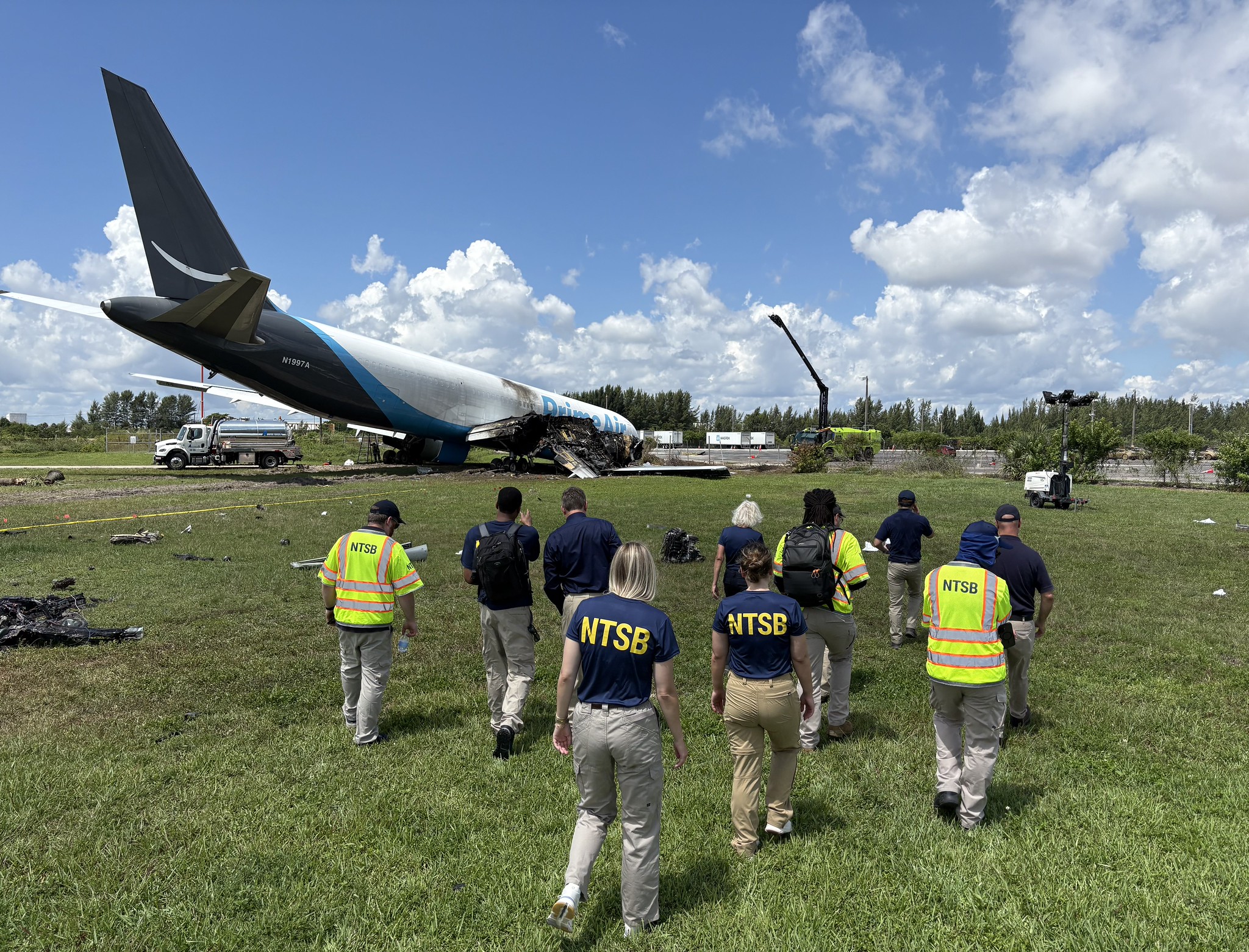

New flight recorder data from the Boeing 767 that overran Runway 30 at Miami International Airport Sunday shows the aircraft’s throttles advanced to values consistent with go-around thrust after touchdown. During a Tuesday evening briefing, NTSB investigators said the brakes were released before the increase in thrust, then reapplied four seconds later after the throttles returned to idle. The 21 Air freighter was operating an Amazon Prime Air flight from San Juan, Puerto Rico, when it overran the runway and struck two vehicles, killing five people on the ground.
Go-Around Thrust Recorded
The nose gear and right main landing gear touched down at a ground speed of 158 knots, according to flight recorder data. The crew began braking seven seconds later at 146 knots, and the left main gear touched down at 134 knots. Once at 120 knots, the brakes were released and throttles increased to values consistent with go-around thrust. Four seconds later, throttles were returned to idle and brakes were reapplied at 117 knots.
Investigator-in-charge Chihoon Shin said the recorded data showed no indication that the speed brakes or thrust reversers deployed. NTSB Chair Jennifer Homendy declined to characterize those findings before investigators complete an aircraft performance study.
“My career is over.” An unidentified pilot made the remark after escaping the aircraft, according to witness Abraham Altamar in an interview with CBS News. Altamar said the pilot was shaking and had injuries to his forehead and hand before borrowing a phone to call his wife.
CBS identified the pilots as Capt. Joseph Carroll, 55, and First Officer Jaime Felipe Silva Molina, 37, but said it could not determine which pilot spoke with Altamar. Both pilots were treated for injuries and later released.
Crew Interviews Underway
The captain received his Boeing 767 type rating in May and reported 7,145 flight hours on his March 2026 first-class medical application. The first officer received his 767 type rating in April 2025 and reported 2,655 hours on his August medical.
Homendy said investigators would compare updated information from crew interviews against company records. The cockpit voice recorder contains more than two hours of what the NTSB described as good-quality audio, while the flight data recorder contains about 55 hours of information covering more than 400 parameters.
Investigators said they wanted to interview the pilots before releasing a cockpit voice recorder readout.
Weather at the time of the accident included winds from 190 degrees at 17 knots, gusting to 26 knots. A thunderstorm was reported at the airport, along with 10 miles visibility and scattered cumulonimbus clouds at 2,000 feet.
The NTSB has not determined a cause of the accident and said a preliminary report is expected within several weeks of completing its on-scene work.


Indecision is a killer. If you’re long, go around.
Not in an airliner with turbine engines! Thrust reversers, full reverse, once on or touching the runway.
I did a ‘on-the-ground-go-around’ once! C-172, kinda short runway (from what I learned on). It’s a really scary thing; especially with 3 other souls on board!! All my fault and I certainly learned from it….and never want to do that again!
This final report will be interesting. Any simulation will be interesting too! You think someone will make a movie of it (think Sully)?
As a retired B-767 pilot that has landed on that runway more times in my life than I can count.
A thunder storm in the area, gusty winds, WAY to fast, he should have gone around before he crossed the landing threshold. There is no way about it, poor head work is what gets you in this situation.
without the left main on the ground no chance to have ground spoilers or reversers available, plus a multitude of other factors, this accident was a foregone conclusion…
The Sully experience was a positive outcome, a result of superior airmanship, with a bit of luck thrown in, this is exactly the opposite, seriously doubt anyone would consider using this accident for any purpose other than a shining example of how not to do it.
I beg to differ, it was more luck than airmanship. True, Sully had the presence of mind to flip on the APU, which kept the computers alive to provide flight envelope protection, but during the glide to the water Sully pitched up gradually until the speed dropped and Alpha Max protection kicked in. That is, the computers lowered the nose to keep the AOA at max without stalling. But that left no reserve airspeed/AOA to trade for lift at the end, i.e. no flare was possible. The aft fuselage slammed into the Hudson at 3x the descent rate engineers had designed for a ditching, rupturing Section 46 open (which began flooding) and caused the cargo sidewall stanchions to thrust upwards into the aft cabin, causing the flight attendant’s leg gash. Both Sully and Skyles insisted they maintained Green dot speed all the way in, but the FDR and the damage told a different story. Can’t say I blame them. The NTSB didn’t say anything to explain the lapse, but I believe it would be a natural human response to subconsciously gradually pitch up to avoid the alien watery landing surface as it loomed closer and closer. Thank goodness the computers were functioning and provided Alpha max protection. The real miracle on the Hudson was that the plane remained afloat long enough for all to be evacuated. NTSB should have recommended ditching sim time so the water doesn’t cause shell shock when it happens for real.