















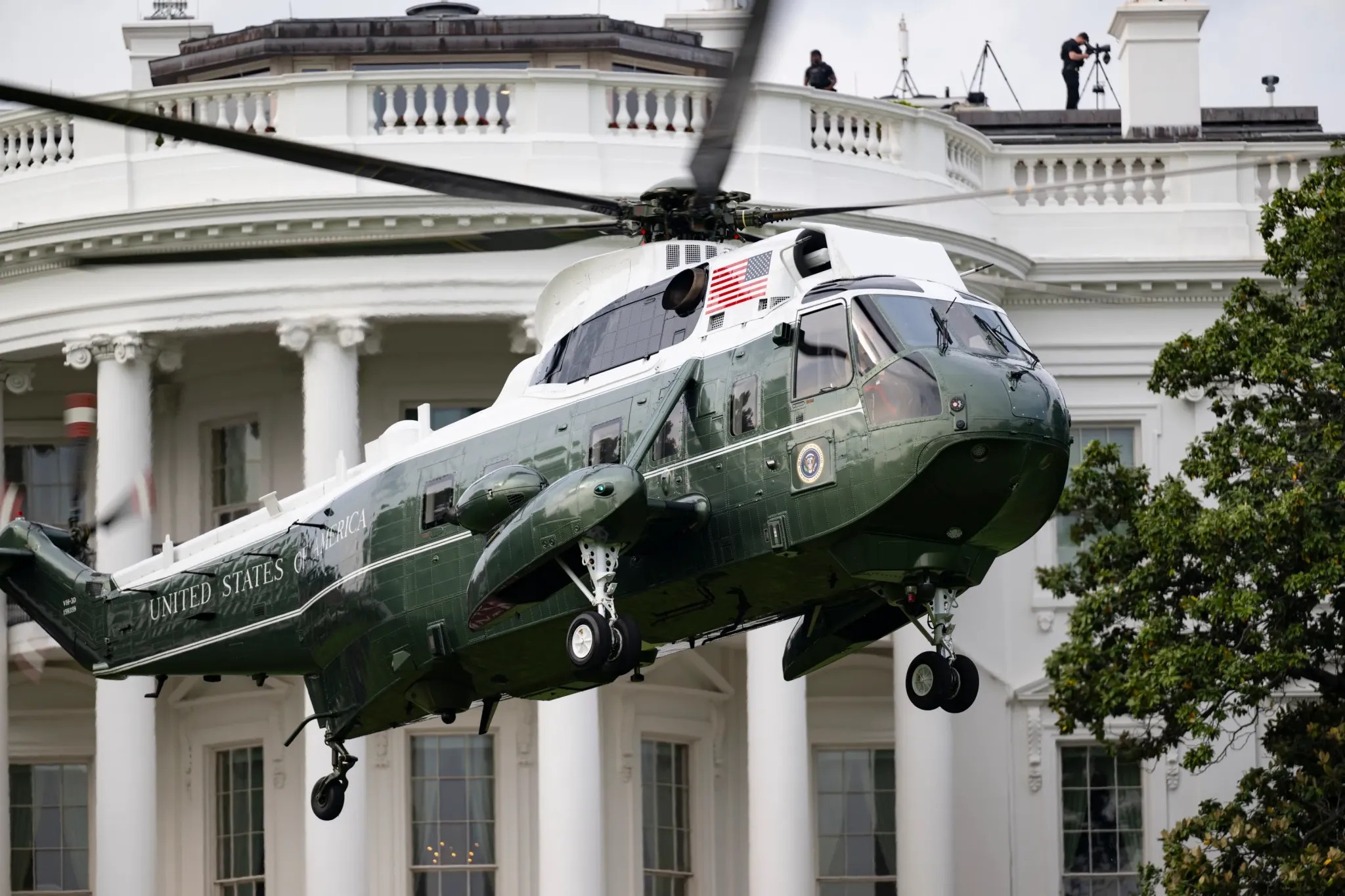

Communication problems between Marine One and air traffic control preceded an Aug. 4 incident involving the presidential helicopter and a departing Envoy Air Embraer E170 near Ronald Reagan Washington National Airport, according to an NTSB preliminary report released Thursday. The FAA estimated the aircraft came within 0.82 nautical miles laterally and 700 feet vertically, although the NTSB said that distance met the applicable Class B radar-separation standard.
DCA tower officials and Marine Helicopter Squadron One personnel had met five days earlier after reports that controllers were not receiving the required notification three minutes before presidential helicopter departures.
“HMX-1 advised that communications ‘had been spotty,’” the NTSB said.
An alternate procedure was established, but an attempt to use it Aug. 4 was unsuccessful.
FAA recordings showed Marine One’s first attempt to contact the tower was not received and a second transmission was unreadable. A subsequent FAA analysis found inadequate line-of-sight radio coverage between the Ellipse and the radio site. The agency later relocated the helicopter-control radios to the top of the DCA tower, and follow-up checks using two HMX-1 helicopters found no communication deficiencies.


Did no one assess the Situation? Did no one check all the boxes? Why would the PIC depart without the necessary communications with the tower? Sloppy
Can you imagine the outcry if general aviation was involved in this incident? Time to shut down DCA for good!
I’d hate to be that helicopter pilot. You give the tower 3 mins notice when you see the POTUS boarding, but then he stops, one foot in one foot out, to have a 10 minute chinwag with reporters. ATC is pissed off, so is everyone else that’s been held up for Marine One.
Or, you wait until the POTUS is buckling in to give the 3 mins notice. Now 3 mins wait is an eternity to the POTUS who is used to being whisked off the moment his belt is buckled. Irritated, he wants the schmuck up front FIRED!
The trouble with treating people like royalty or divinity… heaven help you when you have to bring them back down to mere mortal level.
I’d hate to be that helicopter pilot. You give the tower 3 mins notice when you see the POTUS boarding, but then he stops, forgets where he’s going and wanders off to the rose garden and it takes 10 minutes to get him back. ATC is pissed off, so is everyone else that’s been held up for Marine One.
Or, you wait until the POTUS is buckling in to give the 3 mins notice. Now 3 mins wait is an eternity to the POTUS who is used to taking a bathroom break before being buckled. Irritated, he wants a 12 year old so he can sniff her hair and the schmuck up front FIRED!
The trouble with treating people like royalty or divinity… heaven help you when you have to bring them back down to mere mortal level.
Marine One has been operating out of the White House for a few years now so, is this the first time the three-minute departure call has been an issue?
Has the three-minute call been standard operating procedure in the past? For how long? What was different this time?
The NTSB’s report is as clear as mud. From what I can make out…
Recently, due to construction at the White House, Marine One (VM1) has been operating from a new location called The Ellipse. Five days before the “near miss” the Marine squadron ops people and ATC had a meeting. The Marines wanted to negotiate an increase in the number of training flights in the Class B airspace; ATC wanted to express their concern over not receiving the 3 minute notifications. The Marines said communications with ATC had been “spotty” and that may be why ATC wasn’t getting the 3 min notices. At the time no one did any investigation of why the comm was spotty, but they agreed that if the Marines couldn’t reach ATC directly they would try alternatives such as using another aircraft as a radio relay to give the 3 min notice.
Five days later…
ATC knew VIP traffic was imminent and was expecting the 3 min notice. VM1 attempted to contact ATC, first directly—which wasn’t received by ATC at all, and then via Joint Base Anacostia-Bolling, which was received (and recorded) by ATC as a garbled transmission. ATC responded on the helicopter frequency that the last transmission was unintelligible, then on the Tower frequency cleared an Envoy Air flight for takeoff. I don’t know if VM1 got that response. It lifted off to an altitude that provided line-of-sight comm (but also triggered a TCAS traffic alert on the departing Envoy Air) and advised ATC that they were departing. Evidence of the two comm attempts by VM1 was obtained from “ATC — Live Air Traffic Radio”, a private service that that captures radio comm off the air, feeds it through AI to make the audio more intelligible and then puts it on the internet as streaming audio. Anyone using an internet browser or the LiveATC app can hear it as though they were listening to a radio receiver.
Immediately after the incident, FAA technicians investigated and determined that there wasn’t a clear line-of-sight path between The Ellipse and the controller’s radio used for helicopter comm. So they relocated ATC’s helicopter comm radio from its location in a residential neighborhood (?!) to the top of the airport’s control tower, then tested comms with two squadron helicopters at the Ellipse and locally (but not with VM1?) and had no problems.
When the NTSB came a-calling, the FAA and ATC said that there was no history of helicopter comm problems (which may be true; Marine ops had claimed spotty comms at the meeting 5 days earlier; but ATC actually experienced garbled helicopter comms for the first time [from Joint Base A-B] just prior to the near miss).