
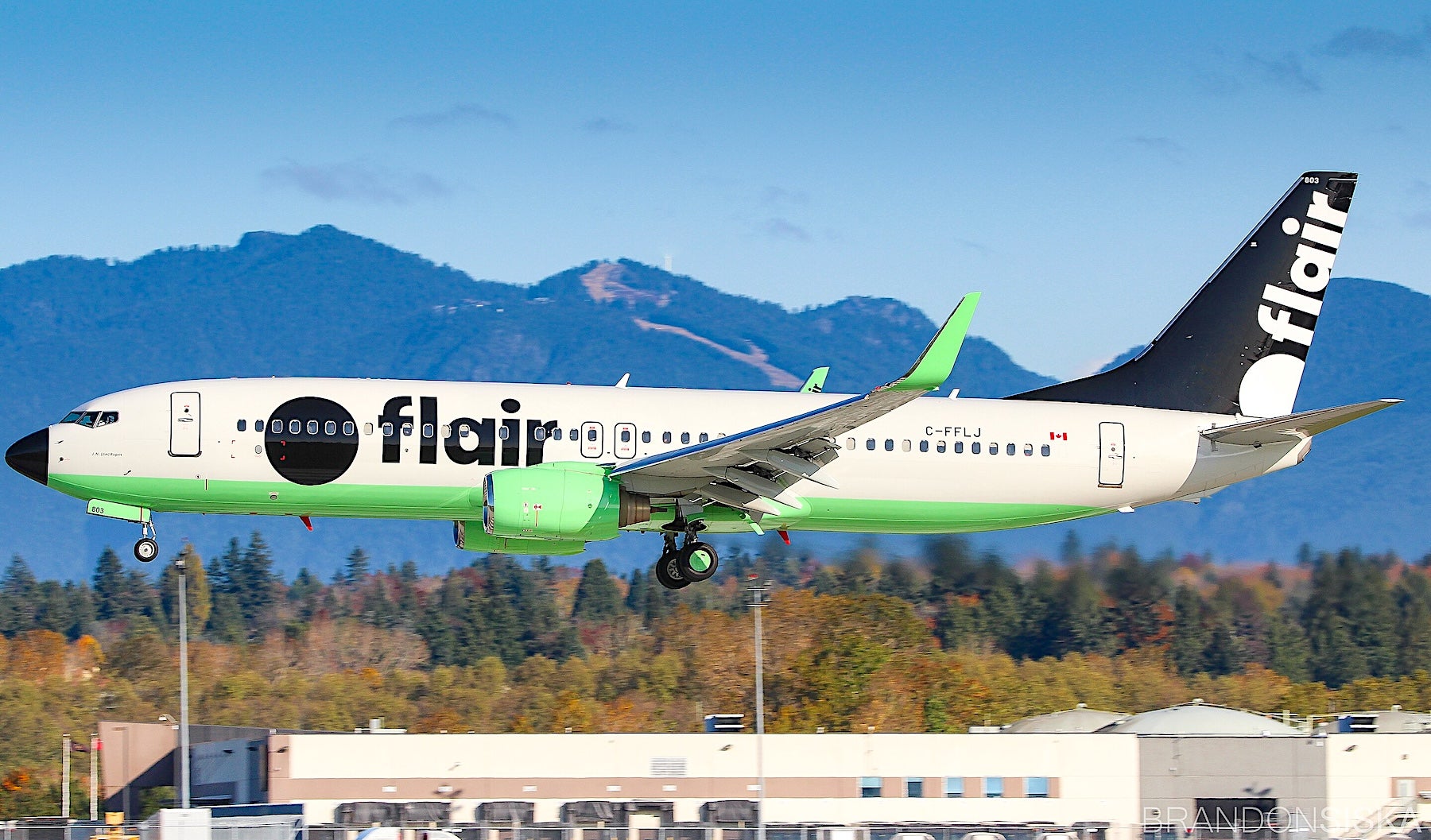

A confluence of errors and misfortune characterizes the accident report from Transport Canada on a Boeing 737-800 operated by low-cost Canadian operator Flair Airlines. There were no injuries among the 140 on board after the aircraft departed the runway on landing at Waterloo Airport (CYKF) on Nov. 25, 2022. It started with the captain (who was the pilot flying) having accrued significant sleep debt over the week before the flight, which began late on Nov. 24 as an overnight “red-eye” trip.
The initial outbound flight from Waterloo departed at 8:13 p.m. Eastern Standard Time, landing at Vancouver International (CYVR) at 1:18 a.m. The return flight to CYKF departed at 2:38 a.m. with 134 passengers and six crew members on board. A medical issue with one of the passengers occupied the flight crew for a significant time, “preventing them from having an opportunity to obtain controlled rest on the flight deck during the flight,” according to Transport Canada.
On landing, the captain was operating after nearly 18 hours of wake period at the end of a circadian low. Ceilings were reported as 600 feet above ground level with minimum visibility. Complicating the following sequence of events, the left thrust reverser was inoperative and stowed in the locked position, in accordance with the minimum equipment list.
At about 70 feet above the runway surface, the captain intended to disconnect the autothrottle, but instead accidentally activated the takeoff/go-around (TOGA) control. According to the Transport Canada report, “The left reverse thrust lever had been locked in the stowed position per the minimum equipment list. When selecting the right reverse thrust lever following touchdown, the pilot removed his hand from the forward thrust levers, allowing the left one to advance, undetected, as commanded by the autothrottle.” So, the aircraft was configured with reverse thrust on one engine and takeoff power applied on the other. The report concluded: “When the captain applied maximum braking, there was 2,500 feet of runway remaining, and the aircraft was traveling at a ground speed of 115 knots with no speed brakes, one engine at near maximum thrust, and the other engine nearing maximum reverse thrust. At this speed and in this configuration, there was insufficient runway remaining to stop the aircraft and it overran the end of the runway.”