















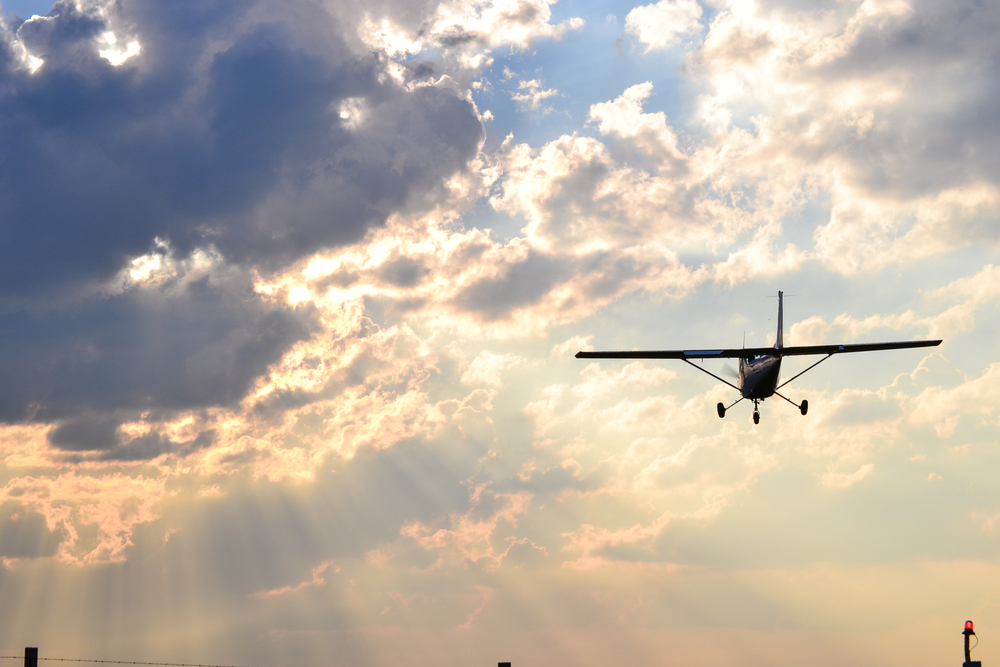

A Cessna 150 pilot was killed Wednesday evening after the airplane struck a Pennsylvania State Police Bell 407 during a training exercise at Carlisle Airport in central Pennsylvania. Two state police crew members aboard the helicopter survived the accident and were hospitalized.
According to a preliminary account from Pennsylvania State Police, the helicopter was hovering several feet above a grassy area next to the runway at about 6:52 p.m. when the Cessna 150 approached for landing. Acting Commissioner Col. George Bivens said the airplane veered to the right near the runway and struck the rear of the helicopter.
Helicopter Crew Escapes
“The pilots would not have been able to even see that airplane approaching them,” Bivens told reporters.
The helicopter lost its rotor blades and tail boom during the collision before coming down on its side. Cpl. Bryce Corman and Trooper Jason Mills were initially trapped inside, according to state police. Corman pushed out a window and helped Mills exit the aircraft.
“Tonight could have been much worse,” Pennsylvania Gov. Josh Shapiro said during a news conference at Penn State Health Milton S. Hershey Medical Center.
Hospital officials said both men suffered minor injuries and were in stable condition. The Cessna 150 came down a short distance from the helicopter and broke into multiple pieces. Authorities said they believe the pilot was the airplane’s only occupant.
Investigation Underway
The FAA responded to the airport Wednesday night, and the NTSB arrived overnight to investigate the collision. State police said investigators have obtained video and photographs from the area, and communications on the airport’s CTAF are also expected to be reviewed.
Officials have not determined the cause of the accident.


According to the ADS-B data, the helicopter was landing, not hovering. Maybe hovering off to the side to exit the runway, but just landed at any rate.
This might be a situation where the 150 pilot lost control due to the helicopter’s rotor wash. When a helicopter is hovering within a blade length of the ground, the rotor wash is very strong and spreads out at ground level in a donut shape. It’s strong enough to lift the wing of a nearby 150, which is a light two-seat airplane, and flip it. That could cause the landing pilot to veer into the helicopter. I’ve personally experienced this effect on a Cessna 185F parked on the ramp with a Eurocopter med-evac helicopter coming in for a landing over the ramp. Airplane pilots are not always alert to the rotor wash produced by a hovering helicopter and that may have been the case here.
Rotor downwash close to the ground is strong and unpredictable. From the video you can see the Cessna 150 yaw right on rotation and this indicates it was hit by the rotating downwash. Take away is don’t land or takeoff in a light plane with a hovering helicopter close to the runway, also heli pilots should avoid hover next to runways if at all possible.
Honestly I feel like the helicopter had no business hovering or doing any training exercises that close to the runway. This kind of stuff always really bothers me. I was in a mid-air collision with fatalities that shouldn’t have happened and that’s how this one sounds, preliminarily, like it never should have happened.
I feel the mishap assessment/causal factors cited by Tom and Andrew are very plausible given what we see in the video.
Regardless of the helo’s position on the infield close to the runway, the C150 pilot should have been aware of the conditions created by the helo and not attempted to land. In flying, we always have to understand and work with in our environment and in this case I believe the C150 pilot was not familiar with or knowledgeable of the conditions created by a helicopter’s rotor wash. Sadly, this lack of awareness was a key casual factor in the mishap.
As we know, tower controllers ensure proper interval/spacing for landing because wake turbulence can affect an aircraft, especially once crossing the numbers and transitioning to a flare. In the same way, there should be caution exhibited when a situation like the one at Carlisle emerges.
As a retired Naval Aviator, ATP, instructor and mishap investigator, I have done a number of mishaps where pilot error was the primary causal factor in the mishap. Honestly, a lack of situational awareness and keen understanding of the conditions created by the helo are the two (2) factors in this mishap, sadly.