















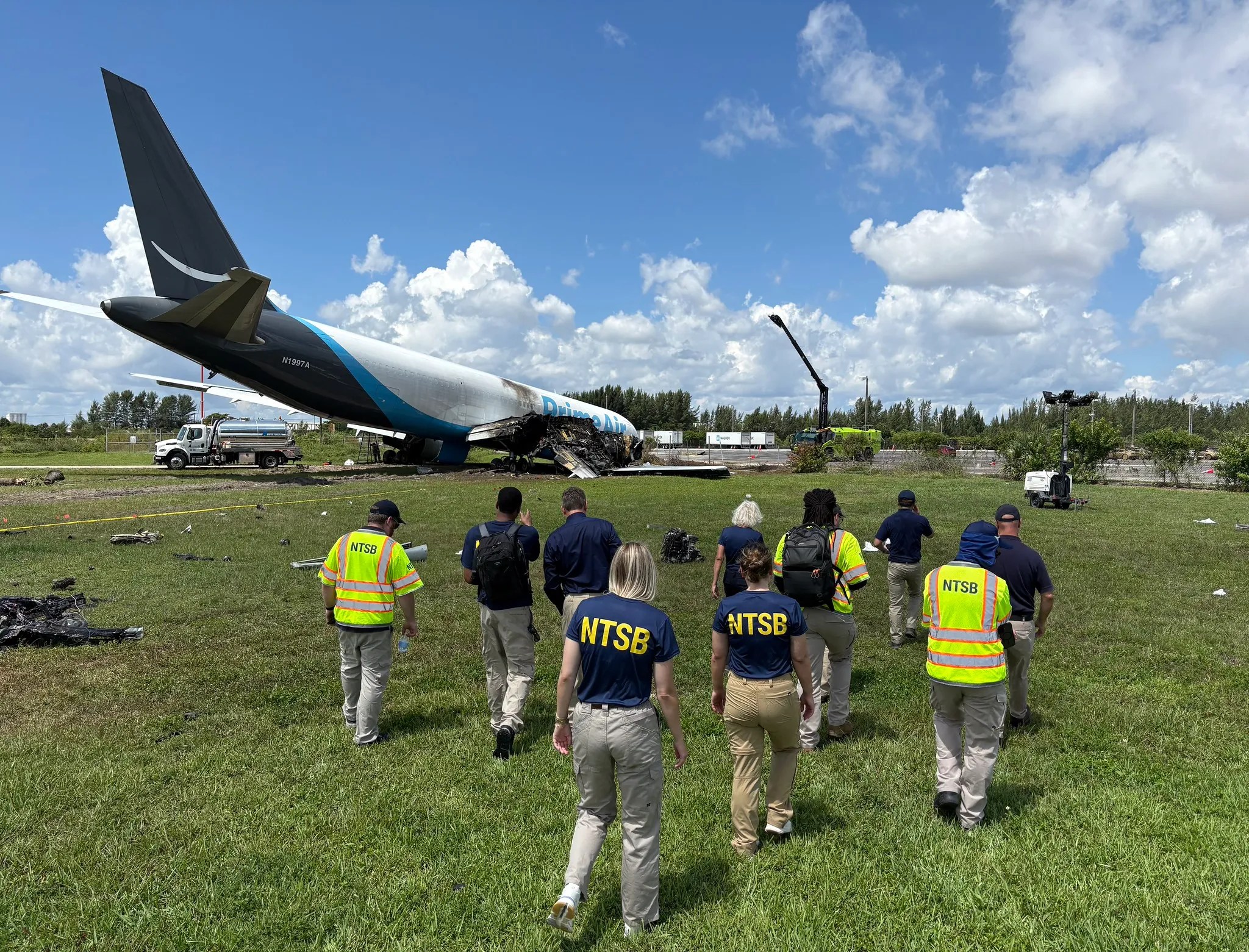

The National Transportation Safety Board released its preliminary report Thursday on the Sept. 6 accident involving an Amazon cargo aircraft at Miami International Airport. Among its findings, the report indicated that the Boeing 767 crew was not provided updated wind information before landing. The aircraft, operated by 21 Air for Amazon, touched down approximately 3,750 feet beyond the threshold of Runway 30 at a groundspeed of about 160 knots. It subsequently overran the runway and struck two vehicles, killing five people on the ground and seriously injuring three others.
Wind Information Not Provided
According to the report, thunderstorms were moving through the area around the time of the accident. Airport weather observations recorded winds from 190 degrees at 17 knots, gusting to 26 knots, near the time of landing. Approximately four minutes before clearing the cargo flight to land, the tower controller had provided another aircraft wind information indicating gusts of up to 22 knots. However, the Amazon cargo flight was operating on a different frequency at the time and did not receive that transmission.
“The LCS issued a landing clearance to flight 7598 but did not issue information about the wind,” the NTSB stated. “Per FAA Order JO 7110.65BB, titled ‘Air Traffic Control,’ both wind direction and velocity were required to be stated when authorizing use of a runway when a tailwind component exists.”
Crew Warned of Excessive Speed
Cockpit voice recordings revealed that the first officer repeatedly cautioned about excessive airspeed during the approach. The aircraft crossed the runway threshold at approximately 177 knots groundspeed before touching down. After touchdown, the crew initially applied wheel brakes but subsequently released them and advanced the throttles to settings consistent with go-around thrust.
At that point, approximately 930 feet of runway remained. The throttles were returned to idle and braking resumed seconds later, when only about 415 feet remained. Investigators found no recorded indication that the aircraft’s speed brakes or thrust reversers deployed, consistent with the NTSB’s earlier investigative update.
The aircraft departed the paved surface at approximately 113 knots and eventually came to rest about 1,200 feet beyond the runway. In a statement provided to NBC Miami, 21 Air said it was reviewing the report and would take appropriate safety measures as additional facts become available. Amazon previously suspended its relationship with the operator following the accident. The NTSB investigation remains ongoing, and investigators have not determined a probable cause.


Sure, that might somewhat contribute to the problem, but I’m sure that the crew was required to acknowledge receiving the ATIS, as well as monitoring their own ground speed over the numbers.