














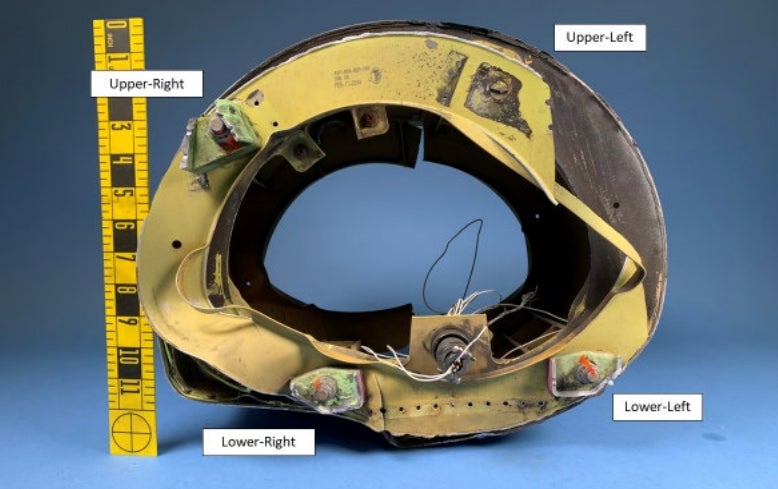

The National Transportation Safety Board (NTSB) is urgently recommending that the FAA and Transport Canada require both immediate and more frequent inspections for Bell 407 helicopters. The recommendations are the result of the NTSB’s ongoing investigation into the crash of a Bell 407 that experienced an inflight separation of the tail boom during an on-demand air tour flight near Kalea, Hawaii, last June. Of the six people onboard, the pilot and two passengers were seriously injured and three passengers sustained minor injuries.
“With hundreds currently in service, the Bell 407 helicopter is a popular model among tour operators, police departments, air ambulance providers, and many others, which is why our finding is so urgent,” said NTSB Chair Jennifer Homendy. “We’re calling on regulators to act immediately—before there’s another accident.”
The NTSB’s report (PDF) stated that the upper left tail boom attachment hardware on the accident aircraft was missing although the attachment fitting was still connected to the fuselage. Investigators found the remaining three fittings and hardware still attached to the tail boom, noting that one of the fittings had multiple fatigue fractures and two had overload fractures. Alongside immediate inspections targeting tail boom attachment hardware, the NTSB is recommending that the interval for torque checks of the tail boom attachment hardware and visual inspections of the tail boom attachment fittings be reduced from the currently required 300 hours to “a more conservative number.” The tail boom on the accident aircraft was found to have separated just 114 hours after its last inspection.
