
















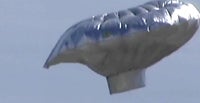
Was it ever even possible that a 20′ x 5′ helium balloon could lift the weight of a six-year-old to 8,000 feet MSL? Let’s take a look at some numbers. Taking Falcon Heene’s father at his reported word, the balloon that news helicopters followed for two hours Thursday (because they thought Falcon was aboard) was 20 feet by five feet. We don’t know if that included the compartment at the bottom – so let’s be conservative and assume it did not. The volume of such a shape is 1,047.2 cubic feet. The lifting capacity of helium, at standard atmosphere, is 28.2 grams per cubic foot. So, at best, the balloon had a lifting capacity of about 65 pounds with which to lift itself (we’ll assume mylar), the gondola-esque structure beneath it (cardboard and wires?), some tethers (not serving as such) and a six-year-old boy (not inside). Speaking of the six-year-old, an average one of those should weigh in at about 45 to 50 pounds (PDF). (The higher end assumes he didn’t turn six yesterday.) Ideally, that leaves 15 to 20 pounds of lifting force. But this situation in Colorado was hardly “ideal.”
Standard lapse rates in pressure suggest by our math that at 5,000 feet MSL (roughly the altitude of the Heene balloon’s launch site), the balloon would already be suffering from a loss of about 10 pounds of lifting force. That would bring its ideal, fully inflated, 65-pound-lifting force down closer to 55 pounds – to carry a child (plus its own structure), all of which might together ideally weigh in at about 50 pounds. That, of course, assumes that less than five pounds of structure could hold the boy without itself noticeably deforming. At 8,000 feet (widely reported as an altitude the balloon achieved) the loss is about 17 pounds, which suggests that at that altitude the helium balloon would be capable of lifting about 48 pounds.
So – was it possible? We’ll let you check our math. Those who prefer observational science can watch the balloon launch on Youtube and judge for themselves if it looks like it was filled to capacity with helium – and a small boy.

