
















image: Boeing
Boeing’s experimental Phantom Swift X-Plane program won $9.4 million from DARPA (the Defense Advanced Research Projects Agency), Jane’s Defence Weekly has reported. The funding will enable Boeing to “continue to refine their design of the experimental aircraft, bringing it to a preliminary design review level,” the Defense Department said. The Phantom Swift was selected for DARPA’s VTOL X-Plane program in March, as part of the agency’s effort to develop a new aircraft configuration that can both hover efficiently and cruise at high speed. “Proving these capabilities in a single aircraft has been the holy grail for tactical military aviation,” said Dan Newman, Boeing Phantom Works Advanced Vertical Lift capture team lead, in March. “We’re confident that Phantom Swift could be the solution.”
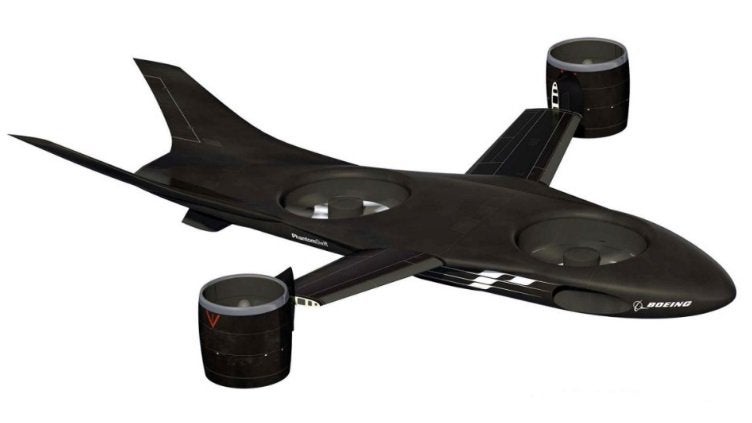
Phantom Swift features two large fans inside the fuselage that provide vertical lift. Once the aircraft transitions to cruise mode, the fans are covered. It also features smaller ducted fans on the wingtips that provide forward thrust, and additional lift and control in hover. Brian Ritter, Boeing’s program manager for Phantom Swift, said the aircraft’s combination of body-fans and tilt-wing fans for improved controllability is unique. “In the challenge of efficient hover and high-speed flight the answer is in ducted-fan technology, and this is something that Boeing is now investing heavily in,” Ritter said. The full-size design will be unmanned and measure about 50 feet across, wingtip to wingtip. The demonstrator will be powered by a General Electric CT7-8 engine, but Jane’s said an all-electric drive will be incorporated “as soon as the technology makes it feasible.” The company already has built and flown a scale model.

