
















The instrument rating checkride was the next morning. I wasready. N8236N was washed and polished and oiled and fueled and I had the logbooksthoroughly analyzed. There were bookmarks (these were the olden days, kids, we didn’t havesticky notes) to note the location of all required inspections and ADs. The static systemand altimeter had been freshly inspected and proclaimed healthy and I had my nifty VORaccuracy test log with entries almost every three hours for the past several weeks. I hadVOT tests, airborne tests, ground tests and tests of one VOR against the other. I couldexplain it all.
I had a stack of charts and flight logs. I had analyzed every possible destinationwithin range of my Cherokee and could discuss all the possible approaches at all theairports. There wasn’t a line or tick mark on the charts I couldn’t expound upon. I hadbeen watching the weather and knew all possible permutations — as well as anyone canthink they know the weather — and was prepared to discuss deviations to alternates andvectors around weather systems.
I had my test reports tucked into my logbook, which was bookmarked to enable quicklocation of records of all required signposts along my road to my instrument ticket. Mysecond-class medical and my newly minted temporary commercial pilot certificate wereclipped to my carefully typed and properly endorsed application form — along with thecheck for the examiner’s fee. (It cost $60 for an instrument rating checkride in thosedays.)
I was ready for whatever the morrow would bring. Except for AOS.
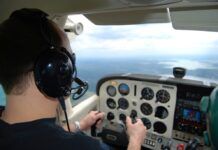
My instrument training had gone quite well. I had started with my instructor, JohnGoodpaster, a few days after I got my private certificate in July of 1974. (We took abrief hiatus from the instrument training in September and October to work on mycommercial ticket. There was an FAR change effective November 1, 1974, upping therequirements for commercial, and I chose to complete the ticket prior to that date. I gotmy commercial certificate October 28, 1974. Just in time.) My Cherokee — N8236N — haddual nav/comms, a glide slope and an ADF-what more could you want in an instrumentplatform-and since she was a 1969 model, she had the now-standard arrangement of theflight instruments.
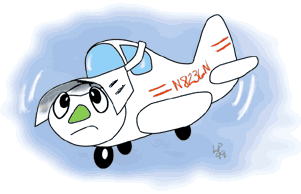 We started out with the typical chore of getting me able to keep the shiny sideup and pointy end forward "solely by reference to instruments." Doesn’t soundlike much when you read it on the page, but for one so fond of looking out airplanewindows as I am, it was quite an undertaking. The hood we used was one of those bigplastic bucket affairs which, I am convinced, was invented to see how long it could beworn before it snapped your neck. About an hour under the hood was all I could take, butwe kept plugging away.
Unusual attitude recovery fit right into the curriculum. I would attempt to flystraight and level. John would declare it an unusual attitude and direct me to recover. Noproblem. (It was during this phase of my training that I discovered that I have absolutelyno propensity towards motion sickness!) Finally I got to the point that I could maintainaltitude, airspeed and heading — and sometimes more than one at a time.
We flew almost every day, and each day when we returned, John would sign my logbook."Flight by reference to instruments — heading, altitude and airspeed. Straight andlevel flight. Recovery from unusual attitudes. AOS." (Actually, it read more like"flt/inst — hdg/alt/as, S&L, recov UA, AOS"). After a few lessons, I gotused to John’s abbreviations — and handwriting — and could decipher the entries.
Except for AOS.
John was a stern taskmaster and insisted that I approach each lesson fully prepared, soI read and studied and attempted to know — immediately — everything there was to beknown about instrument flying. I bought every book I could find on the subject. (I’m agreat believer in book lurnin’ and an avid reader, so Sporty’s has made a tidy little sumduring my aviation career.) I hadn’t come across AOS yet in my studying, but I was sure Iwould soon — or John would explain it to me during one of our lessons.
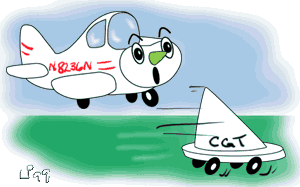 I began the daunting task of VOR orientation andtracking. John commented that I had mastered S-turns during my private and commercialtraining and there was no need to continue to practice them during my instrument training.Hmph! I called it bracketing and he called it S-turns. (I’ll never forget my surprise thefirst time I saw a VOR from the ground. It seemed firmly rooted in place and I had alwaysthought they kept them on the back of flatbed trucks. "Oh, oh! Here she comes Harry.Shift that damn thing about two miles south, and get a move on it. She’s getting close.Oh, oh, Harry. She’s turning. Hustle it back north, now.") I got to know the ChicagoHeights VOR better than I ever wanted. I would have dreams in which I would hear, over andover again "dah dit dah dit-dah dah dit-dah. Chicago Heights … Vortac. dah dit dahdit-dah dah dit-dah. Chicago Heights … Vortac. dah dit dah dit …"
Finally, I mastered it. I could tune any station, center the needle, and, with completecertainty, determine whether we were airborne or not. John recorded the progress in mylogbook. "VOR orn/trk, intrcpt/trk, CGT, JOT. AOS." There it was again. AOS. Ihad come to the point now where I was reluctant to ask John to explain AOS. I just knewthat the answer was going include something about my lack of preparation and seriousnessabout the whole deal. John was gonna say "If you had read everything I suggested, youwould know what AOS is. Study harder." I wasn’t ready to admit defeat yet, so Iredoubled my efforts.
Now, there’s one thing the government is good for, and that’s developing acronyms, andaviation certainly has received its share. Why, we even have an acronym for our collectionof acronyms! (You don’t think so? What about the AIM?) I looked through them all. AOA forangle of attack. ASOS — close but not invented yet. I kept looking. And the training wenton.
John and I moved on to ADF orientation and tracking and what a challenge that became. Ilove ADF work now, and I’ll be sorry to see it go in a few more years, but that was NOTthe case in 1974! 36N had a fixed-card ADF, and it was on the far right side of the panel.Digital tuning had not become a reality yet and so station identification was even moreimportant than today — and more frustrating. But those were not my chief difficultieswith ADF. I had no problem finding where in space a station was, and I could even home toone with a high degree of reliability, but the skill of intercepting or tracking apredetermined bearing eluded me for quite some time. John began muttering about S-turnsand descending spirals and some stuff I chose not to understand. But I finally got it.
And all was dutifully logged. "ADF tune/ID/orn/trk/intrcpt/trk. AOS." Thisthing was taking on a life of its own. I became more frantic to solve the mystery and moreand more reluctant to ask John for an explanation. I could just hear his response:"What do you mean ‘what’s AOS?’ You mean you don’t know? If you’d done the readingand studying I told you was necessary, you’d know what AOS is! You’ve got to get seriousabout this." And so I continued to search.
Finally, in the first week of October things began to click. I could maintain airspeed,heading and altitude — all at the same time. John found it necessary to induce unusualattitudes for me to practice recoveries. It was time to begin practicing approaches. We’dconquered all the pieces, now it was just time to put them all together. I was also ableto stand almost two hours under the plastic bucket before the pain became too severe totolerate longer.
What a joy it was to slide down an ILS and find the runway right there in front of mewhere it had been advertised to be. I had a bit more trouble with non-precisionapproaches. For a few hours, the technique of maintaining the airspeed and descending atmaximum rate seemed uncomfortable. I was much happier with a nice tidy ILS, but even NDBapproaches soon became routine. Circling approaches were also — and still are —uncomfortable. There’s just something about so much maneuvering close to the ground and inlow viz that doesn’t seem healthy to me. (I still accept a hefty crosswind before I’llconsent to circle.)
We were coming down to the wire. Only the instrument cross-country remained. And anexplanation for AOS.
The instrument cross-country was one of the most satisfying flights I’ve ever had. Iwas on top of it from the preflight to tie-down. It may take me longer than some to learnthings, but once I’ve got it, by golly, I’ve got it. And I’ve got it good! We departed 3HOand picked up the clearance for the Purdue University Airport. That wonderful littleCherokee of mine hooked onto the airways and just tracked the centerline like she was bornto fly VOR radials. The NDB approach was a non-event and we landed for a welcome cup ofcoffee. Back airborne, we headed for Indianapolis and an ILS to a missed approach at IND.On the way to the South Bend Airport (now called Michiana Regional) I felt like I was ontop of the world. The flight was a thing of perfection. I had never before — or probablysince — flown as precisely as I did on that magical flight. After a pit stop at SBN wewere on our way home. John played ATC and gave me an ASR approach to Hobart and we toucheddown on runway 18 at Hobart Sky Ranch.
And there it was in my logbook. The final entry for my instrument training:3HO-LAF-IND-SBN-3HO. NDB 10 LAF, ILS 22R IND, VOR 18 SBN.
And no AOS!!!
What made this flight different? Didn’t AOS apply to cross-country flights? Did Johnjust forget to log it? I had less than two days to find out. I was scheduled for mycheckride on November 16. It was now late afternoon November 14. I rushed home to begin afinal search through my references. When I got to my apartment, the day caught up with meand I collapsed in the couch in one exhausted heap. I rarely get tired while I’m flying —the adrenaline rush is too much — but I cave in in a hurry once the flight is over.
I spent all day on the 15th studying. By that evening I was frantic and I still hadn’tfound the definition for AOS. I was tempted to let it go, but I then I would hear thewords of the examiner. "You don’t know what AOS is? You come down here and waste mytime asking for an instrument checkride and you don’t know what AOS is? What kind of pilotare you? Take this pink slip home and come back when you’ve studied more." Which wasworse — admitting my failure to John or taking my chances with the examiner? I decided tobite the bullet and call John. I just couldn’t stand the thought of a pink slip after allmy hard work.
I made the call. It seemed to ring forever before John answered. Then I lost my voice.My throat was so dry I couldn’t talk. Just before John was ready to hang up, I croaked"It’s me. I have a question. What’s this AOS you logged on almost every flight?"And I braced myself.
"AOS?" He seemed confused, too. "Oh, yeah. AOS. Well that’s for ‘andother stuff’ in case I forget to log something we did."
And other stuff. AND OTHER STUFF. I almost got an ulcer over AND OTHERSTUFF?
But I guess I should have asked.
