




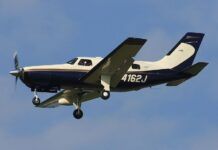





 I have a 100-knot airplane. Oh, sure; the airspeed indicator usually reads much higher than that. But when it comes down to what really counts – rate of movement over the ground – my shiny, expensive, 160-knot airplane is frequently relegated to speeds closer to an 18-wheeler on the Interstate highway below me than those approximating its “book” top speed. The reason? Headwinds. Eastbound, westbound – any direction – it’s not a matter of whether I’ll have a headwind, but how strong it will be. It’s almost enough to make me crazy enough to want to work as an aviation Web site editor for a living.
Uh-oh …
The Rodney Dangerfield Of Aviation?
Like comedian Rodney Dangerfield, I get no respect from the winds. If I plan a trip for Tuesday, on Monday the route I chose will afford me a nice little nudge. On the day of the flight, the fickle fates will deal me a howling 40 knots on the nose. After an unplanned fuel stop, I’ll drag myself into my destination about two hours late, landing only after being forced to shoot an ILS to near-minimums and well after the FBO has closed. The only food available will be a warm Pepsi and a package of cheese crackers. On Wednesday, of course, that route will once again have a nice little tailwind.
 Even the briefers at the local flight service station have noticed. It used to be that the briefer invariably collapsed (at least I think they collapsed – it’s hard to see them through the phone…) in a fit of hysterical laughter when they read the winds to me. Now, they recognize my N-number and are more prepared for the “headwind punchline,” as I call it. I can hear them gritting their teeth and taking deep breaths just to keep from breaking down and get through the briefing. When I call up an unfamiliar AFSS, my pre-flight briefings are usually pretty normal until we get to the winds-aloft portion. Then I hear the annoying laughter again and I lose the connection. That could probably explain why I seem to get a lot of full-route clearances, too.
I’ve compared notes with a few fellow pilots and they seem to get their share of headwinds. Not nearly to the same extent as me, of course. Somewhere along the line, a black cat must have crossed my path. Or, maybe I walked under a ladder.
Of course, there are good, logical reasons that pilots – other than me, of course – get headwinds. Here’s a few of them.
Playing The Odds
Prevalence …
In all seriousness, the likelihood of seeing a head- or tailwind on any given day is pure chance, right? Wrong. There is such a thing as a prevailing wind direction. It is even a defined term:
| prevailing wind In a particular locality, the wind direction that is most frequent over time. For most areas the prevailing wind varies, sometimes quite markedly, according to season. It may also change, or have changed, when the climate changes (as in ice ages). |
In North America (between 30 and 60 degrees north latitude), this means the nominal wind direction is from the southwest. In fact, these winds are called “prevailing westerlies,” so sayeth NOAA.In other areas of the globe, the prevailing wind will blow from other directions, of course. In other areas of the globe, of course, they will still be headwinds for me.
Living on the east coast of the U.S. as I do, there’s not much future in heading due east in a single. So, most of my trips start out heading either south or west. Right into a headwind.
… Not So Fast
 Based on the foregoing, you might conclude that the easiest way to ensure a tailwind would be to always fly a northeasterly heading, right? Not so fast, partner. There are such things as local weather patterns, for instance. Two trips I’ve flown between the east and west coasts in the past year bear this out. Put bluntly, I had a lot of time to contemplate the reasons.
One trip, in March 2000, involved flying with AVweb Marketing Manager Ann Devers in her highly-modified Cessna 172 from Manassas, Va. (HEF) to the North Las Vegas (Nev.) Airport (VGT), her plane’s new home. We made a few stops along the way during the trip, but one morning after departing Little Rock, Ark. (LIT), we were able to stay at a relatively low altitude and pick up a 25-knot tailwind on a leg taking us almost due west from LIT to Amarillo, Texas (AMA). Even though it didn’t last all day, we thoroughly enjoyed a 150-knot groundspeed for a few hours and, if other complications had not arisen, would have been able to make it all the way to VGT that day without undue wear and tear on the crew. Not bad for a 172. Instead, we called it quits in Albuquerque, N.M. Conversely, had we climbed up to a “normal,” more-efficient altitude for this leg, we would have had a handful of knots of wind on the nose and been forced to deal with “only” 100-110 knots over the ground. But, since the name of the game is groundspeed, the low-level run with this tailwind made much more sense. Obviously, there was a high-pressure system somewhere to our north and its clockwise circulation was giving us the push we so richly deserved.
 The other trip occurred last month as I made my way back east from a week at AVweb Editor-in-Chief Mike Busch’s house in California (since us AVwebbers work in a virtual office, we have to get together every now and then.) After dealing with 40- and 50-knot headwinds most of the way from Virginia to California, I was positively salivating at the idea of those same winds helping me along on the way home. Alas, I haven’t gotten over that black cat or the infamous ladder incident because it was not to be, at least at first. After I hung up from my pre-flight briefing and the weather guesser’s hysterical laughter faded away, it dawned on me that the forecast winds (from 150 degrees at 20-30 knots) at the 11,000-foot altitude I needed to be above most of the MEAs (minimum en route altitudes) along my route would continue my losing streak. This was because of yet another high-pressure system hovering out to the east, this time over central Colorado. So, I slogged my way out to Winslow, Ariz. (INW) for fuel before launching for an overnight at Dave Higdon’s house in Wichita.
The next day was the exception that proves the rule: I made the 940 nautical miles from Wichita’s Mid-Continent International Airport (ICT) to my home plate of Manassas, Va. (HEF), in an easy-to-handle 4:45, thanks to a blistering tailwind that boosted my 100-knot airplane into one boasting some 220 knots over the ground for most of the trip. After I slowly made my way past that Colorado high the day before, a low-pressure system over the Great Lakes took charge and provided the push home. Like winning the lottery or having dinner with Julia Roberts, stuff like that just doesn’t happen to me every day. The next day, the surface winds howled and locations to the north saw some snow.
Of course, there’s a lot more to local weather patterns than just the position of highs and lows. Topography – both natural mountains and man-made obstructions – play a role, as do other weather phenomena like fronts, troughs and the like.
The A-B-Cs Of Headwinds
Even putting aside the local phenomena and the position of highs, lows and fronts, we will have relative headwinds more then we will have relative tailwinds. It’s a simple fact of life in aviation, so get used to it. (Don’t shoot the messenger, though.) To explain why this is so, one needs to understand the wind triangle. From there, we can get a better understanding of the headwind’s nasty little secrets.
Wind Triangles …
Every ground-school graduate knows how to compute a magnetic heading using true airspeed, magnetic variation, true wind velocity and the leg’s true course. Plotting these values on the back of the trusty E6-B computer results in a diagram called a “wind triangle,” because the result is a three-sided shape the dimensions of which are dictated by the numbers used to create it. The wind triangle, as its name implies, has three basic components in its simplest form:

A typical wind triangle depicting a headwind situation.A line (really, a vector) representing heading and airspeed. In a headwind situation (i.e., when I’m doing the wind triangle), this is the hypotenuse of the triangle.
- Another line representing the wind direction and velocity. This line (okay, vector) can be as long as the one representing heading and airspeed. If it’s longer, you’re going backwards.
- A final vector which is the course and groundspeed. In my situations, this is usually the shortest of the three.
The image at the right illustrates the general shape and proportion of a typical wind triangle.
It’s pretty obvious that this arrangement of the vectors will result in a headwind, since the vector representing course and groundspeed is shorter than the one representing heading and airspeed. Conversely, if the vector representing the wind were angled down and to the right instead of down and to the left, the vector for course and groundspeed would be longer and, since the vectors have to connect to each other, it would connect with the wind vector further to the right.
… Crabbing …
The idea of a headwind when our desired course and the wind direction directly oppose each other is a relatively easy one to grasp: We don’t need a wind triangle to understand that if the air in which we are flying is moving at 20 knots in a direction exactly opposite our heading, our groundspeed will be reduced by 20 knots. But what happens most often is that the wind is not directly on the nose (unless I’m flying, of course). The result is that we must turn slightly into the wind to correct the tendency to drift downwind if we are to arrive at our destination. This is called a “crab,” and is just like a popular crosswind technique, except that we’re not close enough to a runway to land.
Look at the image again. See how the little airplane symbol on the course/groundspeed vector is angled into the wind? While the angle may not be correct, the fact that the symbol is angled into the wind is accurate. If we didn’t crab, we would drift downwind and could very quickly be hopelessly off-course. This difference between the magnetic course and the magnetic heading is called the wind correction angle. More important, though, is the question of what happens when we crab our little (or large) airplane away from our desired heading. Regardless of the wind, the answer is that our groundspeed between the point of departure and the planned destination decreases. The fact that a crab reduces our groundspeed is one of the headwind’s nasty little secrets.
Another nasty little secret headwinds present is also related to crabbing. Again, refer to the wind triangle image and, again, move the wind vector down and to the right to represent a tailwind instead of down and to the left. Even in this situation, we would be forced to crab to maintain a direct course to our destination. In other words, even with a tailwind, because we are forced to turn into the wind and away from our desired course, our potential groundspeed is reduced. Put another way, even a tailwind can have a headwind component.
… And the Double Whammy
The final nasty little secret is something I call the double whammy of a headwind. As we’ve learned, the headwind slows our groundspeed because the airmass in which we are flying is moving in a direction opposite our intended route of flight and because of the crab we often have to employ. As a result, our groundspeed is reduced. Because our groundspeed is reduced, it takes longer to get where we’re going. The double whammy? Because it takes us longer to get where we’re going, the headwind has more time to do its deed. Eventually, we get where we’re going, but it’s not as much fun and often involves a extra stop for fuel along the way.
Please note that this discussion doesn’t include the concept of pressure-pattern navigation, a method of long-range flying that attempts to predict local weather patterns to avoid – or at least minimize – headwinds and take advantage of any tailwind that exists. That’s a subject for another column.
Understanding Does Not Equal Acceptance
Even though I understand the trigonometry of headwinds, understanding it doesn’t make my lot in life easier. Despite it all, I’ll continue to make long flights. Along the way, I’ll pray for a tailwind, expect a headwind and hope that the FBO at my impromptu fuel stop is still open when I land.
I’ll see you there – I’ll be the one holding the phone away from my ear as the AFSS briefer breaks down into fits of hysterical laughter.
