


















Warbirds Collide — Aftermath
NTSB Probe Of Warbird Crash To Focus On Communications…
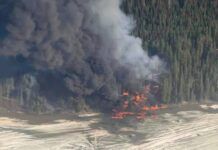
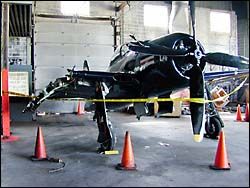 The NTSB said it will look closely at aircraft communication procedures inuse at the time of the formation takeoff that ended with the spectacular crashof an F-4U Corsair during the Thursday airshow at AirVenture ’99. Laird"Lad" Doctor, of Dallas, Texas, the Corsair’s pilot, was seriouslyinjured after his plane struck the right wing of a stationary F-8F Bearcatfarther down runway 18 and careened out of control. According to investigatorDave Bowling, of the NTSB’s Chicago office, Doctor’s Corsair had just becomeairborne when it struck the right wing of the Bearcat being flown by flightleader Howard Pardue, of Breckinridge, Texas, severing the outboard 11 feet ofthe Corsair’s left wing. The Corsair then cartwheeled off the left side of therunway before bursting into flames and breaking apart. Doctor was thrown fromthe burning portion of the wreckage, which probably helped him survive. Afterbeing rushed to a Milwaukee hospital in critical condition, Doctor’s conditionwas upgraded to critical but stable by late Friday night.
…As Details Of Crash Emerge…
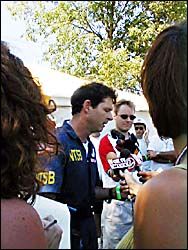 The aircraft involved in the collision were part of a four-plane flight thatwas to begin with tandem takeoffs of the two Bearcats and then the two Corsairs.Bowling explained that the warbird flights at AirVenture come under the controlof an airboss from the Warbird Association. In effect, the Oshkosh tower turnscontrol of Wittman airfield over to the airboss, who coordinates communicationsand sequences the warbirds participating in the airshow. Although the airboss isnot a certified air traffic controller, this system of handling warbird flightshas been used successfully for years at Oshkosh and other airshows, according toBowling. The two Bearcats were 1,400 feet farther down runway 18 doing theirrunups, when for an unknown reason the two Corsairs began their takeoff roll.Bowling said the poor forward visibility of the Corsairs might have made itdifficult for them to see the stationary Bearcats.
…And No Mechanical Failures Found
The other Corsair, flown by Jim Reed, managed to just avoid the two Bearcats— one piloted by Pardue and the other by Tom Wood — but still suffered someleft wingtip damage while banking away at the last second. The FAA wasmonitoring the airboss communication at the time of the mishap, and has an audiotape that the NTSB will review. A crucial part of the investigation will beBowling’s interviews with the pilots and airboss about their taxi, takeoff andformation flight procedures, which are thoroughly discussed before each airshow.Bowling added that preliminary data indicates that none of the four planes inthe flight suffered any mechanical failures prior to the accident. Aiding theNTSB in its investigation are numerous amateur and professional photographs andvideos of the collision. Bowling said it will be about six months before theNTSB concludes its investigation and releases its findings.
NOTE: AVweb’s extended coverage includes exclusive images of the wreckage of Laird Doctor’s Corsair.
Aviat Aircraft Debuts 110 Special Monocoupe
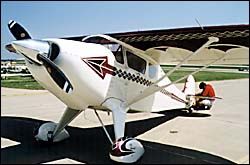 Visitors to EAA AirVenture got to see something few other people have seen.On Friday, Aviat’s new 110 Special Monocoupe went from a sketch in magazines towood and fabric in-the-flesh at the Aviat exhibit. The 1999 110 Special is basedon the 1932-59 110 Special, of which only seven were built. The new Special willlook like the original, but it won’t act like the original. The ’99reincarnation will be faster, more comfortable and fully aerobatic. AviatPresident Stu Horn sees the Monocoupe falling between his Husky and Pitts interms of product line, pricing and performance. It came to life after years ofrequests from customers looking for an aerobatic Husky. "But that planformdoesn’t lend itself to being outstanding in its class," Horn told AVweb,"and I didn’t want to develop a plane that was one of a pack."
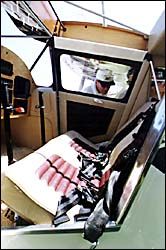 The numbers on the ‘coupe are good. It will be fully aerobatic with aninverted fuel system, but will still cruise at a solid 166 knots. That’s whatthe Aviat crew got out of the bird at 10,000 feet and 2,500 rpm on the way toOSH. Will the aerobatic Monocoupe compete with the aerobatic Pitts? "Ithink the Monocoupe will complement the Pitts," Horn said. He sees theprimary-to-intermediate trainer Monocoupe as competition to Decathlon andclipped-wing Cubs.
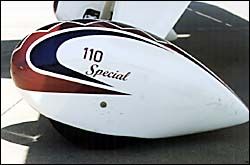 Horn and company began taking orders for the $159,000 110 Special atAirVenture on Friday. Horn told us that as far as the production schedule goes,all certification issues from the firewall aft are resolved. All that remains tobe done are tests on the AEIO-360 200-hp engine and the Hartzell 78-inchconstant-speed composite propeller, airframe and flight tests, and vibrationanalysis. "We hope to get that completed by September. We’ve already begunramping up production. Our retooling is complete and we’re ready to beginproduction now." Horn hopes to sell two Monocoupes per month and is alreadylooking ahead to additional options, including a cruise configuration prop forthose pilots who want a cool-looking but fast grocery-getter. Test pilot EdSaurenman put it well: "This aircraft will bring new meaning to the conceptof fun flying." Remember, he (or she) who has the most fun, wins.
Computer Flying The Jeppesen Way
In 1998, more than 62,000 certificates were issued to student pilots, butonly 26,000 stayed with their training and got their private pilot’s license.Jeppesen wants to increase that success rate by making flight training faster,easier and cheaper. Later this month, aspiring pilots will be able to purchasethe last of a series of interactive training CD-ROMs that will guide students onthe ground before they ever move to the cockpit. The new Guided Flight Discovery(GFD) Private Pilot Maneuvers Multimedia Training takes advantage of all thegreat things that computers can do: art, video, animation. The five CDs includeinformation on ground operations, basic maneuvers, airport operations, emergencylanding procedures, flight maneuvers and ground reference maneuvers. In additionto being educational, the CDs also promise to be entertaining. Small"Discovery Boxes" will include fun facts, such as what it’s like tofly the space shuttle or land the SR-71. Flight Discovery sells for $49.95 perCD, or $199.95 for a set of five.
 If private pilot training is behind you, you’re not out of luck. Friday atAirVenture, Jeppesen showed off their slick Next-Generation FliteschoolInstrument Multimedia Software. Fliteschool, too, uses state-of-the-art videoand colorful graphics to make studying for the FAA exam easier, faster and morefun. The instrument software sells for $199.95, the software and GFD InstrumentManual goes for $249.95. Fliteschool instrument is available now and Jepp says acommercial/ATP version will follow early next year.
But wait, that’s not all. The first week of September, Jeppesen willintroduce the new Aviation History Textbook that Jeppesen Associate MarketingRepresentative Paul Schiff says will "revolutionize what’s on the marketnow." Jeppesen promises the book will include almost everything there is toknow about the history of aviation for about $60.
Wayne Handley Smashes Time-To-Climb Record
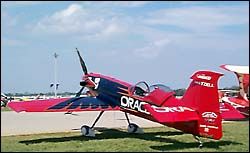 Airshow pilot and good guy Wayne Handley nosed his flame-red Turbo Raven to6,000 meters (19,700 feet) Friday in record time. The unofficial word is thatHandley broke by 25 seconds the record Chuck Yeager had held for 14 years.Handley’s 3:18 is unofficial until it is corrected for temperature and altitude.If one thing was working against the record attempt, it was the temperature.Temps on the tarmac were nearly 100, creating a density altitude of about 2,000feet. The Turbo Raven Oracle was even hotter, though, and fairly leapt off therunway, looking for altitude.
"I was comfortable. I wasn’t playing catch-up," Handley told AVwebjust after the record-breaking climb. "I had a schedule in the cockpit andI was ahead of schedule the whole way up." The funny thing about Handley’s6,000-meter record — and before that, his 3,000-meter record — is that theyare simply a by-product of Handley’s push to develop a new, more powerful andexciting airplane for his airshow routines. After he broke the record, Handleyjumped out, shook a few hands, and grabbed a cold shower before strapping backinto his Turbo Raven for the type of flying he really likes — down on the deck,upside down.
Pray Tell, It’s Proteus!
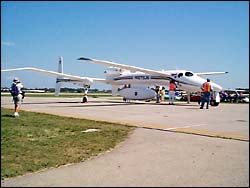 EAA AirVenture Oshkosh tries to have a real crowd-pleaser every year — lastyear, it was the Concorde; this year, it’s Proteus, Burt Rutan’s oddball bird.The Proteus was first exhibited at the Paris Air Show, but EAA AirVenture is theplane’s first U.S. appearance. Proteus arrived at OSH — actually, arrived inthe airspace some 50,000 feet above OSH — at about noon Friday and spent thenext several hours orbiting. Orbiting is what the Proteus was built to do andwhat it does well. The plane can "loiter" at high altitudes for up to22 hours, but because of crew considerations, flights are generally limited to10 to 15 hours.
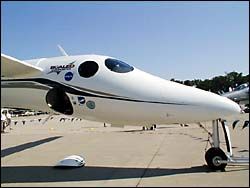 The high-tech machine was built, according to Rutan, "to stay out of itsown way" as it carries out its mapping, video and television broadcastmissions. The plane was designed with those missions in mind. It has less thrustat sea level than at 60,000 feet. Its average speed at the beginning of themission when fully loaded is 100 knots; as it lightens, the speed drops to 77knots. All three gear are mains and as the plane touches down, it dumps lift andthe nose main gear drops. This is Rutan’s 29th manned aircraft design and givenProteus’ mythology — as a shape-shifter — who knows what might be next!
1,000 Turn Out For EAA’s First Teacher’s Day
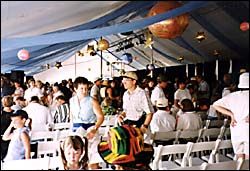 Teachers like to say that the reward of their job is knowing that they touchthe future, and if that’s true, they can be a valuable ally in EAA’s effort tokeep the pilot ranks growing in the next millennium. Children love things thatfly, and Lee Siudzinski, of the EAA education staff, is convinced that airplanescan help them to learn about science, math and technology — and on Friday atthe EAA Air Adventure Museum, he set out to convince 1,000 Wisconsin teachersthat airplanes belong in the classroom.
The turnout, from school districts between Green Bay and Fond du Lac,"was larger than we anticipated, but we’re very excited to share with theseteachers the excitement of aviation," Siudzinski said. His aim was toentice the teachers to visit the museum and check out the facilities andprograms available, attend some workshops and gather lots of ideas. Elementaryteachers could learn how to build an airport in their classroom, and teachers ofolder kids got an introduction to Microsoft Flight Simulator 98, a tool in the"Wild Blue Wonders" program. Many brought their children along, andthe kids got to try out a small airplane mock-up that let them move the planethrough its three axes, climb into the cockpit of an experimental aircraft, andbuild balsa-wood models. Exhibitors in a tent outside the museum offered kitsfor model rockets and airplanes.
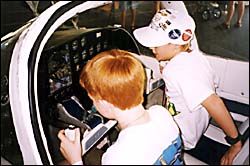 Bob Gonwa, who teaches special-needs children in a Kewaskum, Wis., highschool, said he would love to bring his students to visit the museum and PioneerAirport. "What a wonderful opportunity," he said, of the firstTeacher’s Day. As soon as he heard of the program, through brochures distributedat his school, he knew he would be here to check it out. Dave Hoem lives here inOshkosh, and is a high school guidance coordinator and an EAA member. He said hetakes a group of youngsters to the museum every year, and knows of formerstudents who have gone on to aviation careers. He enthusiastically supportsEAA’s efforts: "This is a real good start."
Briefs…
Clinton Taps GAMA Chairman Ed Stimpson For ICAO Post
 President Clinton Friday namedlong time general aviation advocate EdStimpson as the United States’ ambassador to the International Civil AviationOrganization in Montreal. The International Civil Aviation Organization, or ICAO,is the civil aviation wing of the United Nations, and oversees aviation policyfor international operations between signatory countries. Industry insiders saythat Stimpson’s appointment can only be good for general aviation around theworld. Stimpson has been one of general aviation’s staunchest advocates beforeCongress, the White House and sundry government agencies and departments formore than 25 years. He is the former president and chairman emeritus of theGeneral Aviation Manufacturers Association, a group he helped form nearly 30years ago. In 1996, Stimpson jump-started the Be-A-Pilot program — that’s been sosuccessful in recruiting new people to flying — by cofounding G.A. Team 2000. Healso is a former official of the Federal Aviation Administration and a formerexecutive of Morrison-Knudson, where he was recruited by former Mooney Aircraftpresident Tom Smith, a job he left GAMA to take before returning to the trade groupa few years later. Many industry executives credit Stimpson’s perseverance forCongress’ passage of the General Aviation Revitalization Act of 1994, the lawthat set an 18-year limit for manufacturers’ liability for the products theyproduce.
AlliedSignal Debuts Bendix/King Pilots Club
Like many other leading-edge aviation companies, avionics manufacturer Bendix/Kinghas concluded that the future of communications with its customers lies with theInternet. The company wants to be able to reach those customers via email, andis giving them a significant package of incentives to add their names to theBendix/King mailing list. The company has established a new "Bendix/KingPilots Club" web site. Membership is free, and pilots who sign uponline are entitled to:
Sneak previews of new Bendix/King products;
An option to become part of the Bendix/King Advisory Panel on Product Development;
The chance to participate in a VIP tour of the Bendix/King headquarters facility in Olathe, Kan., to see how Bendix/King products are designed, built and tested;
Discounts on merchandise in the Bendix/King Pilot’s Shop online catalog;
A discount on GPS database subscription upgrades; and,
A quarterly electronic newsletter with product updates, industry news and information about aviation people and events.
Tell ’em AVweb sent you.
Bigger, Stronger, Faster: Cirrus’ Need For Speed
 With 333 hard orders already on the books, one might think the folks atCirrus Design would sit back and take some well-deserved time off. Not so! AVwebconfirmed that Cirrus is launching into a research and development project withthe ultimate goal of hanging a TCM IO-550 off the front of an SR20. Therehave been no engineering studies as yet, but the belief among Cirrus staff isthat the bigger engine will increase the plane’s speed by 15 to 20 knots, to acruise of 175 to 180 knots. Cirrus Marketing Director Chris Maddy told AVweb theefforts are so preliminary that the new plane doesn’t even have a name. Plansare to keep the same fuselage and "look" of the SR20. "This isthe next natural step," he said, "and it’s largely due to input we’vegotten from our customers and potential customers." R&D is justbeginning, so don’t write out a deposit check just yet. AVweb will keep youupdated as production nears.
70th Anniversary Of Pietenpol Air Camper
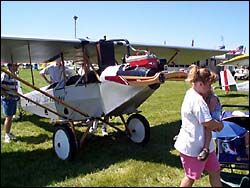 It has a funny name, and its design is older than most people at EAAAirVenture ’99, but Bernard Pietenpol’s Air Camper continues to attractbuilders. Pietenpol’s 1929 design called for a Ford Model A engine, andhomebuilders still opt for the four-cylinder water-cooled powerplant for theclassic Pietenpol. In the 1960s, Pietenpol modified his plans to allow theoption of the air-cooled Chevy Corvair six-banger. Since then, more than 30different engines have been used in the Air Campers. Pietenpol’s aim was todesign an airplane that could be built by anyone reasonably handy with tools.The structure is wood with fabric covering, and the hardware and fittings areeasily available. Pietenpol died in 1984, and the last Air Camper he built is ondisplay at EAA’s Pioneer Airport. EAA honored the design’s 70th anniversary byparking a group of the little two-seaters at show center in the Homebuilt area.
BFGoodrich’s Skywatch System Expands Compatibility
BFGoodrich Avionics Systems announced Friday at EAA AirVenture ’99 that itsSkywatch traffic advisory system will be able to interface with the AvidyneFlightMax situational display, the Garmin GNS 430 GPS/map system and Eventide’sArgus moving-map displays. STC approval is expected within the next few months.Previously, Skywatch data could be displayed on a Stormscope WX-1000 screen oron a weather radar display. The Skywatch system is an active surveillancetraffic advisory system that uses Mode C transponder interrogations to determinethe range, bearing, relative altitude and closure rate of potential conflictingtraffic. Today’s announcement means that information generated by Skywatch canbe depicted on displays that may also show moving maps, nav information andlightning-strike returns. Skywatch tracks up to 30 aircraft simultaneously anddisplays the eight most threatening targets. It generates aural and visualwarnings of potential collision threats.
Rolls-Royce Introduces The Aviation Heritage Trophy
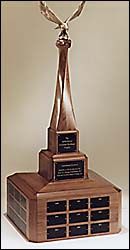 Rolls-Royce is teaming with the National Aviation Hall of Fame and the RenoAir Racing Association to present the National Aviation Heritage Trophy foraircraft restoration. Entries for this year must have been flying in 1954 andwill be judged on technical merit criteria developed by the Smithsonian Air& Space Museum, and by popular vote. The base of the trophy will show thename of the owner of the winning aircraft, as well as the aircraft type andrestoration facility, when appropriate, for each year. The trophy will bedisplayed at the National Aviation Hall of Fame in Dayton, Ohio, until the Air& Space Museum’s Dulles annex opens in 2003, when it will alternatebetween Dayton and Dulles.
NOTE: AVweb’s coverage allows you to print out a copy of the National Aviation Heritage Trophy entry form.
Century Aerospace Updates Plans For Light Jet
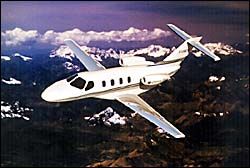 CenturyAerospace of Albuquerque, N.M., announced at AirVenture ’99 that it haspartnered with SGL Carbon Composites of Gardena, Calif., to build thecarbon-composite fuselage of the Century Jet CA-100. The CA-100 six-passengertwinjet was introduced at the NBAA convention last fall, and since then CenturyAerospace has been refining the design and seeking risk-sharing partnerships tobuild major portions of the aircraft. The $60-million deal with SGL is the firstof several subcontractor partnerships Century is pursuing to help reduce thecosts and time associated with certifying the light jet. Preliminary performancespecifications for the CA-100 call for a 370-knot cruise at altitudes up to45,000 feet, and a range of 1,500 nm. Century Aerospace is shooting for firstflight in 2001, with deliveries of the $2.6-million jet beginning in early 2003.More info can be found at the Century Web site.
Two Guys From Venezuela
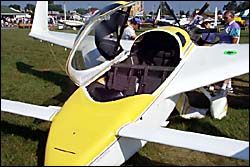 Ruben and Carlos Leon flew this Cozy II from their home in Valencia,Venezuela, to AirVenture Oshkosh ’99. Each leg of the trip was about four hours.Rather than taking the longer Windward Islands route, the first leg of their2,500-mile trip took them direct to Port Au Prince, Haiti. Ruben said, "Mybrother flew the first leg over water. No islands, no anything." As theyapproached Miami they knew they had it made. They landed at OSH 17 hours afterlaunching from home. According to Ruben, general aviation is healthy inVenezuela. "It’s not as easy as we’d like it to be, but it’s there andwe’re doing it." Carlos and Ruben built the airplane two and a half yearsago. The cowl is off because they do a mini-annual after a long trip like this.They’re operating under an FAA waiver that allows them to fly to OSH and home,but their plans for a cross-USA trip will have to wait.
Missing Men
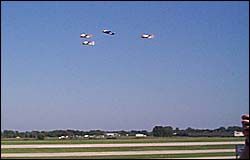 Whilemore than 100,000 people kicked tires and sweated Friday, a more somber eventtook place overhead — a missing man formation remembering three frequent EAAattendees and lovers of aviation who died recently in accidents both inthe air and on the ground. The special flyby honored the memory andachievements of former astronaut Pete Conrad, who died earlier in July after amotorcycle crash; former FAA administrator and National Air and Space Museumdirector Don Engen, who was killed in a glider crash in late July; and John F.Kennedy Jr., son of the late president who frequently made the trek to OSH.
