









|
 The 34th Annual Championship Air Races in Reno, Nevada opened on September 8, 1997 witha record number of entries in the unlimited racing class. All in all, there were 44aircraft, ranging from the pre-race favorite of Bill "Tiger" Destefani’s highlymodified P-51 known as Strega, to Miss Ashley II a sleek new hybrid racerbuilt by Gary Levitz and Bill Rogers. This year’s event also marked the return of LyleShelton, replacing John Penny as the pilot of his Bearcat, Rare Bear. The Sandersbrothers’ mighty Pratt & Whitney R4360-powered Hawker Sea Fury, known as Dreadnought,also returned after missing the 1996 racing event. Noticeably absent, however, was DavidPrice’s Dego Red which finished first in last year’s Gold competition, only to losethe race due to a pylon cut; and the beloved Lefty Gardner and his beautiful Lockheed P-38White Lightning.
The qualification runs, which took place Monday through Wednesday, were marred byseveral emergencies. On Monday Tiger Destefani declared a "mayday" after Stregasuddenly lost power when a leaking exhaust header burned through his magneto’s powercables. The problem was later fixed, and the following day Tiger went on to post the topqualifying speed of 464.245 MPH.
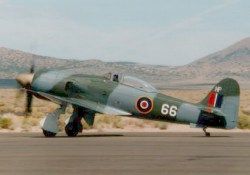
Matt Jackson also declared an emergency when one of the gear doors on his Sea Furymalfunctioned. The problem was sorted out in the air, and Jackson returned safely to thefield. Later, Alan Preston, flying the freshly restored P-51, formerly known as Stiletto,suddenly lost power. Preston managed a very difficult but successful 30 MPH crosswindlanding .
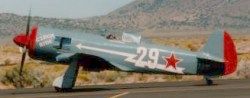
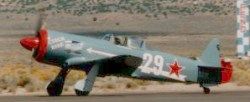
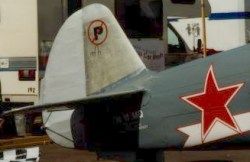
The most frightful emergency of the qualifying round occurred on Tuesday when HowardPardue’s Sea Fury collided with Sam Richardson’s R2000-powered YAK. Neither Richardson norPardue could recall exactly what happen but apparently Pardue’s Sea Fury came close enoughto the YAK to chew up half of the its rudder. Fortunately, superior piloting skills and agreat deal of luck brought both planes safely back to the field. Damage to the Sea Furywas limited to a large gash in one of its propeller blades; however, the complete tailassembly of Richardson’s YAK had to be replaced, and he later failed to qualify for thecompetition. The following morning, a mysterious red star appeared just below the canopyof Pardue’s Sea Fury. In an apparent retaliation to the red starred victory claim, theinternational symbol for no parking (the letter "P," overlaid by a circle with aslash through it) appeared on the tail surface of Richardson’s YAK. No word yet as to whatwas behind this symbolism, but the middle finger that also appeared below the no parkingsymbol could be a significant a clue. Qualifications concluded on Wednesday afternoon withRare Bear coming in second at 461.508 MPH, followed by Brian Sanders in Dreadnought at438.426 MPH. Although these speeds are fast, they are about six percent slower that the490 MPH that David Price and John Penny registered the previous year.
Thursday’s Heat Races
The top three qualifiers, Strega, Rare Bear, and Dreadnought, wereexempt from competing on the first day of the races, while the other teams used Thursdayto tune up for the more serious events later in the week.
|
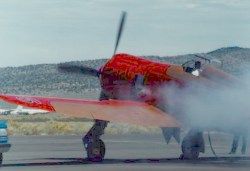
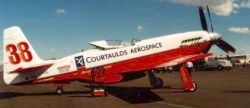
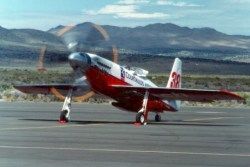
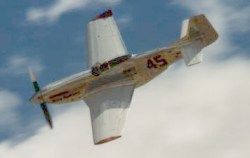
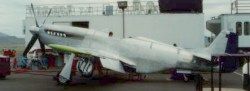
The first heat of the day, Heat 1C Medallion, included five P-51s, a Sea Fury, aBearcat and a YAK 11. Stu Eberhardt’s P-51 Merlins Magic took the checkered flag at361.330 MPH but was closely followed by Curtis Brown’s beautiful gray camouflaged SeaFury. Vlado Lenoch’s D-model mustang, Moonbeam McSwine, trailed a distant thirdwith 337.432 MPH. Thomas Camp’s white and red YAK 11, Maniyak, left the raceduring the second lap with a "mayday" but landed safely.
The Heat 1B Bronze race was won by Lloyd Hamilton (387.601 MPH) in his faded, but stillcompetitive, Sea Fury, called Furias. He was followed by Matt Jackson’s Sea Fury at383.431 MPH and by Dan Martin’s P-51, which clocked in at 371.924 MPH.
The last heat of the day, Heat 1A Silver, is the race that many of the race fans hadbeen waiting for because this event marked the debut of Gary Levitz and Bill Rogers newhybrid racing plane. Miss Ashley II, as she is called, garnished a great deal ofattention from the race enthusiasts as they marveled at the airplane’s clean design. Adesign that mates a scratch-built Mustang fuselage with a Lear Jet 23 wing and horizontaltail surfaces, coupled with powerful Rolls Royce Griffon engine. Unfortunately,Levitz experienced some difficulty in retracting the landing gear shortly after takeoff,but he managed to join his fellow competitors in time to start the race. However, theuncertainty about his gear situation kept him from running the plane at high power.
Bill Rheinschild, whose crew had just finished installing the race engine in hisairplane, flew his P-51, Risky Business, to a first place finish with a speed of394.929 MPH which bumped him up to Friday’s Gold Heat. Sherman Smoot’s Voodoo Chilecame in a close second at 394.402 MPH. Voodoo Chile, with its iridescent paint job,has always been a radical-looking airplane, and this year was no exception — that is,minus the paint job. This year, Number 55 arrived in a bare metal scheme looking like aStrega clone, minus the paint. Voodoo Chile sported the same canopy and tail filletas Strega and is powered by a Dwight Thorn engine. Talk around the pit indicatedthat this might be the sleeper of the entire racing event.
Third place in the Silver Heat was taken by Nelson Ezell in his Sea Fury.
Friday’s Heat Races
|

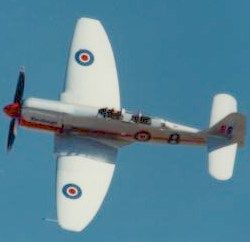
The results of Thursday’s competition vaulted Bill Rheinschild and Stu Eberhardt intothe respective Gold and Silver heats, while moving Gary Levitz’ Miss Ashley II tothe Bronze.
The Bronze Heat 2C proved to be an exciting race for the crew of the Levitz/Rogersracer, after putting in some long hours to resolve the previous day’s gear retractiondifficulties. Gary Levitz maneuvered into the last starting position as the eight-planeelement lined up for the race. Then Steve Hinton in the pace plane gave the go ahead tostart the race. Levitz pushed the power up and managed to take the first pylon and easilyout-distanced the competition to capture a first place finish with a speed of 402.597 MPH.Stewart Dawson’s Sea Fury, Spirit of Texas, and Brent Hisey’s P-51, MissAmerica, crossed the home pylon second (350.048 MPH) and third (342.468 MPH),respectively.
Veteran race pilot Skip Holm, flying Critical Mass for owner/pilot Tom Dwellewho had earlier been banned from air racing for life, surprised almost everyone by winningthe Silver Heat 2B with an average speed of 397.905 MPH. Holm had earlier qualified themodified orange Sea Fury at 403.006 MPH, which was a record for Critical Mass, buthardly anyone expected it to be this competitive. Matt Jackson followed closely with391.085 MPH, while Dan Martin finished third at 378.637 MPH.
Over the last seven or eight years, the Gold Heat races have been dominated by either Stregaor Rare Bear and this year was no exception. However, there were a couple ofwild cards, in the form of Dreadnought and Voodoo Chile, that could makethings a bit more interesting. There was also Bill Rheinschild who had a new racing motorin is plane. But in the end, it was the same old story. Tiger took the Bear for thefinish, followed by Brian Sanders in Dreadnought. Voodoo Chile suffered adamaged piston and was forced to leave the race in the second lap.
Saturday’s Heat Races
One day away from racing for the money… Saturday’s races again are, basically,tune-ups for the grand finale on Sunday, but it also offers the pilots the opportunity tobump up to a higher category. Gary Levitz’ win on Friday bumped him up from the Bronze tothe Gold. Not bad for Miss Ashley’s first time out. Skip Holm’s surprising finishin Friday’s Sliver Heat also bumped Critical Mass up to the Gold Heat.
Brent Hisey put Miss America in a good position to win the Sunday’s Silver raceby taking first place in Saturday’s Bronze Heat 3C. William Anders’ beautiful P-51D, Val-Halla,came in second, followed By James Michaels’ Queen B.
The Sliver Heat 3B was won by Dan Martin in his Mustang Ridge Runner. Thesurprising thing about this race was the speed. Martin’s basically stock P-51 clocked thefifth fastest time, 407.094 MPH, of the entire week. Matt Jackson also ran well at 397.323MPH, while Lloyd Hamilton managed to push Furias past the 395 MPH mark.
Tiger Destefani led the pack down the chute and won the Gold Heat 3A by a margin ofseven seconds over Lyle Shelton’s Rare Bear. Close behind the two leaders wereBrian Sanders and Gary Levitz.
Sunday — Go For The Money
|
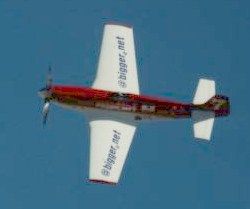
The story on Sunday was dominated more by the weather than the races. For the secondtime in as many years the weather for the final day of the competition was less thandesirable, with a chilly crosswind and gusts up to 40 MPH. Many of the pilots in the earlyevents reported that the course was very rough.
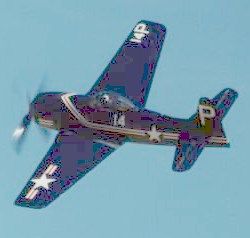
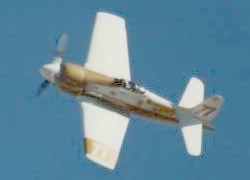
Stewart Dawson Hawker Sea Fury, Spirit of Texas, captured the Bronze race at369.826 MPH. He was followed by his good friend Howard Pardue (367.412 MPH) in his rareF8F-1 Bearcat. Voodoo Chile’s crew pulled an all nighter and replaced their damagedracing motor with a stock Merlin. This engine ran well enough (364.412 MPH) to capturethird place. No doubt that Voodoo Chile racing team will be the group in watch incoming years.
The weather may have played a role in the outcome of the Silver race as three pilotswere penalized for race course infractions, while a forth had to leave the course due to adamaged cowling.
Bill Rheinschild crossed the checkered flag first; however, the officials added 28seconds to his finishing time for cutting pylons 2 and 3 at the start of the race. Thatdecision vaulted Dennis Sanders in his Sea Fury Argonaut into the winner’s circle.Brent Hisey and James Michaels got tagged for low flying but still managed to finish thirdand fifth, respectively. During the fifth lap of the race Skip Holm, piloting CriticalMass, experienced what appeared to be an explosion when a piece of metal passed by thecanopy and embedded itself in the tail. Holm pulled out of the race and landed safely. Onthe ground an inspection revealed a large hole in Critical Mass’ cowling which wasattributed to metal fatigue. Stu Eberhardt also called a "mayday" when he lostpower in his P-51 Merlins Magic.
Traditionally, the winner of the Silver race is given the option of moving up to theGold competition. Dennis Sanders decided to pass on this opportunity, which left the dooropen for Bill Rheinschild to add his P-51 to the eight airplanes that had alreadyqualified for the Gold Race.
The Gold race began much as they have in the past with Strega taking the earlylead in front of Rare Bear. Slowly but surely, Strega increased the lead asthe Bear fell back. Lyle Shelton reported a rough engine over the radio after beingovertaken by Dreadnought. Gary Levitz again flew a very consistent race andfinished fourth, behind the trio of Strega, Dreadnought, and Rare Bear. Thenthe real drama began. Rear Bear’s engine was getting worse and then suddenly lossall power. A "mayday" was called and Lyle Shelton opted to land on runway 18 dueto the heavy crosswinds. In the meantime, Strega was also in trouble. Strega’scanopy was covered with oil that came from a leaking prop seal. Tiger, too, opted to landon runway 18 but came down a bit hard and the prop struck the ground several times beforethe damaged Mustang finally rolled to a stop near Rare Bear. The rest of Goldcompetitors a landed safely.
There’s no question that 1997 Unlimited class of racing events was a positive successfor the sport in spite of the lower speeds and hopefully next year will be even better.
