





























(Most photos are thumbnails. Click them to view larger,higher-resolution images.)
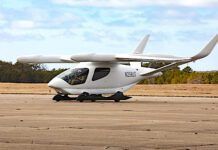
WhenDiamond Aircraft’s snazzy little Katana emerged into the flight training scene three yearsago, it seemed an easy setup for a bloody nose or two.
"Way too small," some said.
"A plastic airplane? Are you kiddin’? That thing won’t last a month on thetraining line."
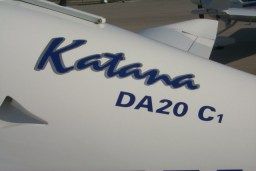 "No way I’m instructing in any airplane with a chainsaw engine."
While that carping may have some merit, the Katana has nonetheless established itselfas the leading-edge trainer for the 1990s, with some 300 airframes toiling away at flightschools across the country. That Diamond has the new trainer market virtually to itselfdoesn’t hurt. But the fact remains, the Katana seems to be delivering on its promise ofbeing a new-age trainer that’s both fun and cheap to fly.
Still, those wisecracks about the engine have scored some hits. It’s easy to get pastthe Rotax 912’s braaapy exhaust note but not so easy to ignore its 81 HP, which deliversrespectable cruise speed but anemic climbs at high density altitudes and high weights.
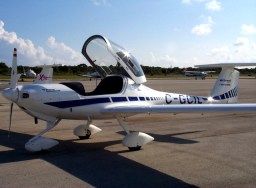 Diamond’s responseto this shortcoming rolled off the company’s London, Ontario assembly line last fall inthe form of the Katana C1, an improved airframe sporting a 125 HP Continental IO-240.Frankly, warts and all, we liked the Rotax-powered version well enough to recommend itwithout noteworthy reservations. The C1 represents significant enough improvements overthe original to nearly qualify as a different airplane.
Diamond plans to sell both Continental- and Rotax-powered Katanas but both engines willbe installed in an improved, lighter airframe. The TCM version is the Katana C1, the Rotaxversion will be called the Katana A2. (The original Rotax model is now the Katana A1.)
Editor’s Note: Since this article was published in early 1998,Diamond has dropped the Rotax engine for new Katanas and is offering only theContinental-powered version. However, it continues to support the Rotax-powered models andmany are available on the used market.
Hard to say how the market will respond but we predict that if Diamond sticks with therealistic marketing plans it has thus far pursued, the C1 will eventually displace theRotax version and likely earn a reputation in the training arena similar to the venerableCessna 150/152 series. Assuming, of course, that the IO-240 develops no nasty maintenancetraits and that its higher fuel burn isn’t a significant issue.
Rotax vs. Continental
 When Diamond morphed the Katana from the Austrian-designed Super Dimona motorgliderdesign, it took a sizeable gamble on the Rotax powerplant. Rotax is well-known in Europeand in the U.S. for two-cycle ultralight engines, which have also found their way intohomebuilts.
But the four-cylinder 912F3 represented its first foray into FAR 33-certified aircraftengines and Diamond openly admits to an uphill battle convincing buyers that this was nosnowmobile engine. Indeed, with electronic ignition, autoleaning carburetors andwater-cooled cylinder heads, the Rotax has more in common with a Honda Accord than aCessna 152. Moreover, it has a controllable pitch prop, which some flight schools werebound to shy away from due to worries about training and maintenance complexities.
Although relatively cheap to replace — $6000 initially for both an exchange engine andprop — the Rotax’s out-of-the-box TBO was only 1000 hours. TBO has since been raised to1200 hours but the exchange cost has ballooned to $10,100, meaning the hourly engine costis about $8, versus about $6 for the Cessna 152’s O-235 Lycoming. However, since theKatana burns half the fuel, its direct hourly operating costs — on paper, at least —edge out the 152 by a couple of bucks or more.
In nearly 200,000 hours of total fleet time worldwide, says Diamond, the Rotax hasturned in a respectable if not stellar service history. Some operators have easilyexceeded the recommended 1200-hour TBO and, of course, a few have come up short. The Rotaxhas had its share of cylinder problems and inevitable operator-induced glitches, plus ahandful of premature failures, none of which involved the engine’s bottom end.Maintenance-wise, mechanics haven’t exactly taken to the Rotax like ducks to water.
"We find that sophisticated operators — the UNDs [University of North Dakota] andthe larger schools — love it. Some of the smaller operators don’t," says Diamond CEOMichael Slingluff. "If it’s in Pete’s Aircraft Maintenance, Pete is trying to findthe mags so he can tap on them to get it going, just like he does with a Lycoming. That’snot going to work on this engine."
More to the point, the Rotax is an adequate performer in moderate weather and lightweights but a bit of a dog when the weather turns hot and humid or at high densityaltitudes. Operators have complained about 300 FPM climb rates in the pattern than canmake a few touch and goes an all-day affair. Even a ratted-out 152 can do as well orbetter.
Further, Diamond is learning what other airframe makers have: Putting all your eggsinto one vendor’s basket is risky. Although Slingluff and Diamond’s sales manager, JeffOwen, say they’re still sold on the Rotax, they also note that the company has not raisedits profile in the U.S. with the kind of national advertising and behind-the-scenestechnical support that Lycoming and Continental have routinely provided.
Although Rotax has technical developments in the works — including a 100 HP 912variant — Diamond has had to shift for itself on many technical problems that enginevendors traditionally tended to in the past. Further, Diamond needed to address theKatana’s anemic climb performance forthwith, preferably with an off-the-shelf engine.
Clean Sheet
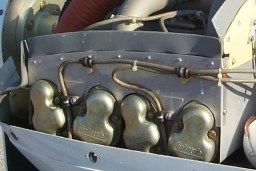 Continental’sIO-240 is a clean-sheet powerplant introduced four years ago, primarily for the homebuiltmarket. The initial version, the IO-240 A1, had fuel injection but with TCM’s traditionallog-and-runner induction system. But Diamond wanted a more state-of-the-art powerplant.
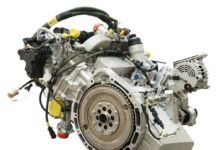
The IO-240B is just such. It has a balanced topside induction system similar to thatused on the larger displacement IO-550G found in the Mooney Ovation. Otherwise, itssystems and components are identical to those found on any other trainer and will thus befamiliar to any maintenance shop.
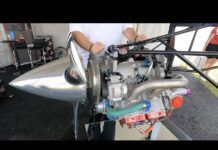
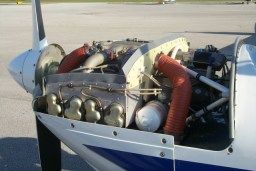
In comparing the two installations, we noted a striking contrast: The Rotax, with itswatercooling and electronic ignition, is festooned with hoses, wires and sensors, whilethe Continental has but a few umbilicals. The IO-240’s accessory case-including the oilfilter and mags-are readily accessible for maintenance, although it’s a tight squeeze forthe mags. The alternator — a belt-driven 40-amp Nippondenso — is mounted frontside,automotive style. Production C1s will have a TCM lightweight starter. Outwardly, the C1’ssnout is less pug nosed and the overall length is 1.6 inches greater. Natch, since theContinental is air cooled, the Rotax version’s sealed cowl has given way to a couple ofsmall cooling inlets. There are more changes beneath the skin; the emergence of the C1model is coincident with a number of minor but significant airframe improvements whichwill be incorporated into both the TCM C1 and Rotax A2 airframe.
To account for the Continental’s higher weight — 246 pounds versus 160 pounds for theRotax — Diamond squeezed 60 pounds of excess weight from the airplane, chiefly byretooling to produce composite parts more precisely and with better repeatability and byswitching from steel to aluminum gear struts.
To account for the more forward CG, the wing sweep was increased 1.5 degrees, thenosegear tire size was decreased and the battery was moved from the firewall to a bulkheadbehind the baggage compartment shelf. Further, the C1’s gross weight was increased to 1653pounds, from 1609 on the Rotax-powered version.
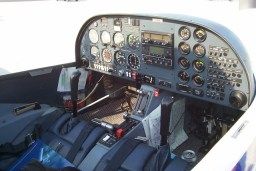 Other changes include:
- A redesigned horizontal stab and elevator that’s larger and reduces parts count by eliminating an anti-servo tab
- Replacement of simple hinged flaps with modified slotted flaps
- Improved two-stage canopy latch
- Improved brake master cylinders
- Instrument panel moved higher and more forward, creating more knee room
- Higher recline angle on seatbacks
- Improved heating and defrosting system
- Additional instrumentation, including EGT, fuel flow and large tachometer
Price, Payload
IO-240: |
The C1 sells for $114,260 versus $112,125 for the new A2. The numbers cover a basicairplane, certified for night and day VFR but not IFR. Diamond has no plans to certifyeither model for IFR, which has been a source of some irritation to buyers. The DA 40four-place version, under development in Austria, will be IFR-certified. It will also beContinental-powered, using a 170 HP version of the same IO-360-ES Cirrus picked for the SR20.
A line-by-line performance comparison between the C1 and the existing Katana revealsthat the higher horsepower doesn’t yield improvements across all categories. The C1cruises and climbs faster, but its payload with full fuel is 364 pounds versus 394 poundsfor the Rotax-powered variant. However, the C1 carries 4 more gallons of fuel than the A1,so with equivalent fuel, they’re about equal in payload.
In the real world of flight training, this means that in the C1, a student andinstructor each weighing 200 pounds can launch on a cross-country with 18 gallons of gas.They’ll have to watch fuel consumption carefully; learning leaning will be a must.
According to Diamond’s preliminary specs, at 65 percent power and 123 knots, that 18gallons will last a bare two hours or, with careful leaning, about 2:35. Reducing to themax range cruise of 50 percent power drops the fuel flow to 4.8 gallons leaned at a speedof 109 knots, stretching the endurance to 3:45.
In the Rotax version, student and CFI taking off with the same 18 gallons could cruiseat 110 knots, burning 4.5 gallons for an endurance of 4 hours.
The A1 Katana has a service ceiling of 14,000 feet, versus 13,000 feet for the C1.Landing and takeoff distances are comparable, although the C1 enjoys a slight edge inlanding performance.
Flight Impressions
Right from start-up, the C1 clearly has a noticeably different personality than theRotax-powered Katana. Rather than the car-like start procedure used to fire up the Rotax,the IO-240 starts like a real airplane motor: mixture rich, pump on and crank. You canfeel the loppy idle through the airframe, rather than sensing it as a distant vibrationsomewhere beyond the instrument panel, as with the Rotax.
The downside of fuel injection is usually cantankerous hot starting. After our flights,we did try a couple of hot starts. With throttle open and mixture at idle cutoff, theengine seemed to catch and fire within a half dozen blades.
However, with that light prop up front, the engine screams to max RPM right now.On hot starts, a student will have to be both dexterous and quick with throttle andmixture or risk having everyone on the ramp dash for cover. One shortcoming of the Katanais a certain nervousness during taxiing. Since it lacks a steerable nosewheel,differential braking keeps it on the yellow line. However, the brake pedals are closetogether and in the original model, all but the daintiest feet collide with a structuralshelf on the back of the firewall.
In the C1 and A2 airframes, the shelf is gone and improved brake cylinders give theairplane more manageable ground handling. The ground turn radius is also smaller, thanksto a limit adjustment in the nosewheel.
When we flew a prototype C1 in late fall, Diamond hadn’t yet settled on a prop for thenew design but will probably offer a choice of three: two Senseniches — one a cruisepitch, the other a mid-range — and one Hoffman pitched for cruise speed. We flew firstwith the Hoffman prop, then Diamond flight test pilot Bob Salton did a quick prop changeso we could try the Sensenich.
Before flying the C1, we took a few turns around the patch in a Rotax-powered Katana tore-familiarize ourselves with its performance. By comparison, on the takeoff roll, the C1with the Hoffman cruise prop accelerated more briskly, although not dramatically so.
Rotation is at 50 knots, same as the Rotax version. Climb rate is dramatic. Diamondclaims an initial rate of 920 FPM for the Hoffman-equipped C1 and we noted a bit more,nearly 1100 FPM at 80 knots, this despite the fact that the rather coarse prop limitedstatic RPM to 2350.
We noted that the airplane could easily maintain 800 FPM in a cruise climb to thepractice area without heroic deck angles. Noise and vibration of the Continental/Hoffmancombination are perceptibly different than the Rotax but not necessarily greater, in ourview.
Diamond claims a cruise airspeed for the C1 of 132 knots TAS at 75 percent power at6000 feet, which, according to the draft POH, will burn 7.3 to 8.3 GPH leaned. We notedabout 126 knots TAS, at about 70 percent power at 2500 feet. By comparison, the RotaxKatana typically cruises at 110 to 115 knots on 4 to 4.5 GPH. With the flatter Sensinichprop, the IO-240 cranked to 2500 RPM on the takeoff roll and literally careened down therunway with noticeably quicker acceleration and an initial climb rate of 1300 FPM at 80knots.
However, Diamond notes that this prop will need repitching for use in a trainer; it’ssimply too flat. Even in a 90-knot climb, it’s possible to reach the engine’s 2800 RPMredline and full throttle in cruise will easily exceed 3000 RPM. Our guess is that theideal prop is the Sensinich pitched closer to the Hoffman’s cruise setting.
How about a constant speed prop, as in the Rotax-powered version? While we feel thatprejudices against a CS prop in a trainer are unjustified, it may not be an option for theC1 because of excess weight and the fact the IO-240 lacks a hollow crankshaft to flow oilinto a prop hub. Diamond is considering an electric three-blade CS prop, but it won’t bean option in the first C1s, if at all.
No Surprises
With the additional weight out front and larger tail section, we wondered if theKatana’s handling characteristics had changed. It appears to retain the same handling ofthe original, with light to medium maneuvering stability and no tendency to drop a wing orbite in a stall, no matter how aggravated. (The C1 airframe has stall strips, the earlierairframe doesn’t. They were installed to correct a slight wing drop tendency.)
In our view, the addition of Fowler flaps which deploy to 45 degrees versus 40 degreesfor the A1 made little noticeable difference in approach and landing characteristics,although preliminary data for the C1 says it will land over a 50-foot obstacle in 1280feet versus 1490 feet for the Rotax Katana. With the climb-pitch prop, reducing powerinduces a high sink rate, so it was hard to judge the effectiveness of the flaps.
In both airplanes, using the recommended 60-knot approach speed into a 10-knotquartering headwind, we were easily able to make the first turnoff on London’s runway 27,a distance of about 1100 feet. In our opinion, the Katana remains an exceptionally easyairplane to land well, a desirable characteristic in a trainer. With practice, we’re sure600-foot landings would be a snap.
Although it’s not obvious at first glance, Diamond has improved the Katana’s cockpitlayout by more logically grouping switches and adding additional conventionalinstrumentation for the IO-240 version. The extra knee room under the panel is a welcomeaddition as are minor touches, such as redesigned controls for the heater and defrosterand the ability to mix heat and defrost, plus convenience improvements such as a pocket inthe baggage compartment for a couple of quarts of oil.
Students and instructors have complained about the Katana’s torturous andnon-adjustable seatback angle so the improved version reclines more gracefully. At first,this seems to place the pilot too far from the stick and panel but it’s not troublesome inflight, once the adjustable rudder pedals are set. We didn’t fly the C1 long enough tojudge the seat comfort; we’ll wait until the model is in the field and contact operatorsfor their views.
Conclusion
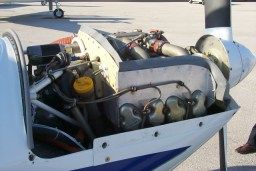 There’s no doubt in ourview that the C1 engine/airframe addresses the Katana’s few faults, especially the anemicclimb performance. Over the long haul, its slight additional purchase cost is notsignificant.
The Katana has found virtually no market as a weekend fun flier; it’s a workingairplane and a few grand leveraged over the life of the airframe is trivial, in our view.Whether the IO-240’s higher fuel burn will raise operating costs enough to be abottom-line factor remains to be seen.
There’s also little doubt that the IO-240 performs as advertised and seems to us like aterrific choice for the Katana. The great unknown is how this relatively untested enginewill fare in the day-to-day grind of flight training. Diamond reports the 240 has survivedthe rigors of certification flying without a hint of complaint but students have a way ofdriving wedges into the tiniest flaws in trainer engines.
The IO-240 won’t be proven until a few C1s bounce through a couple of thousand hours oftraining. Nonetheless, worries about the motor wouldn’t stop us from buying a TCM-equippedC1.
Ironically, the C1’s introduction represents nothing less than a real-market flyoffbetween the high-tech Rotax and the old lump-of-iron approach of TCM. (Okay, so it’s atuned-induction lump of iron.) When we visited Diamond last spring, one company officialjokingly referred to the C1 as a "Fred Flintstone engine in a George Jetsonairplane."
There’s sad truth in that observation. Buyers have whined for years about theindustry’s lack of innovation so Diamond is offering two clear options: Pay about the sameamount of money and take your choice between bleeding edge and improved but oldtechnology.
Continental has recently purchased Aerotronics Controls, Inc., an electronic enginecontrol company, with the stated purpose of developing electronic controls — presumablysingle power lever-for TCM engines. The time line is reportedly aggressive and we wouldn’tbe surprised to see such controls applied to the IO-240, nudging it toward thetechnological equivalent of the Rotax, less the water cooling.
For any buyers considering a Katana, we recommend flying both versions before deciding.The C1’s additional climb performance could be a must-have and worth the few extra dollarsfor a flight school suffering through the doldrums of high density-altitude summers.
