





NASAGives Students A Taste Of Space Flight — 30 Seconds At A Time
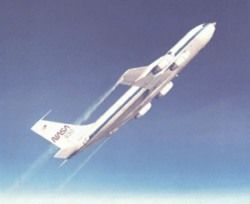
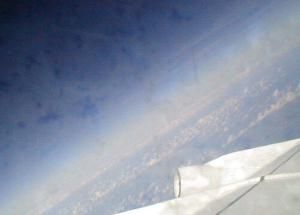
 The engines are screaming at full power as I pullmyself up off the floor against the 1.8 Gs and manage to look out the sidewindow. What I see is not the typical view from a four-engine transport categoryaircraft: the starboard wing with the two Pratt & Whitney engines is tiltedupwards at a steep 50 degree angle, the blue waters of the Gulf of Mexico over30,000 feet below. If I were in any other plane of this size at this angle, I’dstart asking the Almighty forgiveness for all the stupid things I did in mylife. But today it won’t be necessary. A few seconds later I hear the enginesthrottle back and NASA test director John Yaniec shout, "Hear we go, overthe top." You feel it first in your stomach, just like the top of theroller coaster, but then the rest of your body catches up and the next thing youknow you are weightless and floating free. The whoops and hollers of my fellowpassengers on the NASA KC-135A say it all: This is what it feels like to reallyfly, to float free just like in those youthful dreams where you spread your armsand soared through the sky.
|
This time I’m not dreaming, but instead flying on the NASA plane with thenauseous name, the Vomit Comet. I’m participating as the journalist invited by ateam of students from my alma mater, Purdue University, to cover their flight,and put my digestive tract in peril for AVweb readers. The Purdue team isone of 32 selected from colleges throughout the U.S. to participate in theReduced Gravity Student Flight Opportunities program for three weeks thisAugust. Funded by NASA and administered by the Texas Space Grant Consortium, theprogram allows college students to design and build an experiment for testing inzero gravity aboard a NASA KC-135A. The KC-135A simulates spaceflight by flyinga series of parabolas that produce about 30 seconds of zero-G at the top of eachparabola.
Not Just Another Junket
|
Started in 1995, the primary goals of the program are to involve students inresearch areas of interest to NASA while providing them with an invaluableeducational experience. To be selected to fly aboard the KC-135A, the teams mustcreate an idea for an experiment and then prepare a detailed proposal for reviewby NASA. The proposal is evaluated on scientific merit, design feasibility,fabrication, and compliance with NASA experimental protocols. NASA doesn’t wantthis experience to just to be a joy ride for the students, and only the best ofthe proposals are selected to fly. The objectives are for the teams to conductreal science, learn as much as they can, and then share their experience withfellow college students and also primary and secondary students from their localarea.
The team that invited me is one of four from Purdue University, WestLafayette, Ind., that had been chosen for test flights this August. Purdue has areputation for one of the best aerospace engineering programs in the country(Hmmm, I guess that’s why they accepted me), and has produced more graduates whohave gone on to be astronauts, including Neil Armstrong, than any other college.My Purdue team included Nick Sadaah, from Oklahoma City, Okla., the team leaderand a co-op student working at NASA’s Johnson Space Center (JSC) during the summer; Curt Peternell, Ft.Atkinson, Wis.; Rob Whiteman, Walled Lake, Mich.; and John (J.D.) Yamokoski,Tampa, Fla. Nick is an aerospace engineering major, with Rob, Curt, and J.D.majoring in mechanical engineering.
|
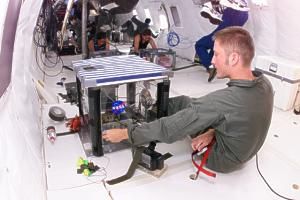
Their experiment was titled "Investigating The Use Of PiezoelectricActuators To Actively Dampen Vibrations In Microgravity." I won’t go intogreat detail about their experiment, but basically they were trying to usesmall, lightweight piezoelectric actuators to dampen the vibrations of a beamfloating in zero-G. The beam simulated a spacecraft fuel tank that is subjectedto vibrations when fuel sloshes around inside after an orbital thruster fires.If the vibrations are bad enough in the tank, it can disrupt experiments beingconducted onboard the spacecraft. In their experiment for the KC-135A, theactuators were used to induce accelerations at the same frequency as the initialbeam vibrations, but out of phase to dampen them. Think of the active noisereduction principle that makes your pricey pilot headset work, but apply it toaccelerations in a beam instead of sound waves, and you get the idea.
All four team members and this experiment flew in March, but the team hadn’treceived good results. They took at hard look at what went wrong with theirexperiment, made changes, and applied to fly again this summer. NASA encouragesthis type of repeat effort, as very few research experiments work perfectly thefirst time. From my own experience as an engineer, this is usually what happensin the "real world." I used to say that we never learned anythingunless we broke something during a test program.
|
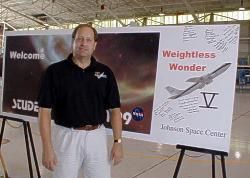
Professor Steven Collicott, from the school of Aeronautics and Astronauticsat Purdue University, was the faculty advisor present in Houston to watch thePurdue teams in action and offer last minute advice and encouragement. ProfessorCollicott has been the driving force behind the program at Purdue since 1996when two students approached him with their desire to participate. So far ninePurdue teams have had their proposals selected by NASA, with over 30 studentsgetting the chance to fly. The program has become so popular that aeroengineering students can now chose it as a three-credit elective.
Professor Collicott feels that participation can help jump-start a student’scareer, saying, "As the years go by I think they will appreciate more ofthe months that lead up to the flight, not just remembering the flight, but thewhole engineering education and experience. If you talk about what’s going tohelp someone’s resume jump out of a stack of 500, this type of experience iswhat employers look for when hiring engineers."
Some of the Purdue students who participated in the program have since goneon to work for NASA and are currently working on the International SpaceStation.
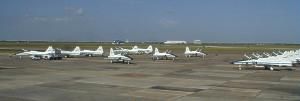
During the week I spent at Ellington Field (EFD), about 10 miles north of Johnson Space Center, I witnessed a wide variety of aircraft operations, spanning everything from a Cessna 150 to NASA’s giant cargo-carrying plane known as the Super Guppy. The airport was once known as Ellington Air Force Base, but has been operated by the City of Houston Department of Aviation since 1984. During the week I spent at EFD, I saw Coast Guard HH-65A and Army Guard AH-64 helicopters, Texas Air Guard F-16s, UPS Boeing 727s, and Continental Express regional jets, along with numerous GA types, operating out of the ex-military base. EFD is also home to a wing of the Confederate Air Force.
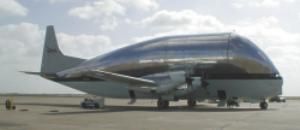
Probably the most visible presence at EFD is the various NASA aircraft, several of which are one-of-a-kind, that are used to support the flight operations of Johnson Space Center (JSC). While at EFD, I ran into former shuttle astronaut Steve Nagel, who is now the aircraft operations director for JSC. I worked with Steve back in the late ’80s after the Challenger accident when NASA was investigating escape systems for the shuttle. Steve was nice enough to take some time to show me the numerous Northrop T-38s and Grumman G-II aircraft operated by NASA. The T-38s are used primarily to keep shuttle pilots current and give non-pilot mission specialists some back-seat high performance jet experience. Several of the G-IIs have been modified as Shuttle Training Aircraft (STA) to simulate the atmospheric flight characteristics of the shuttle as it returns from orbit, and others are unmodified and used for personnel transport. Another of the unique planes that NASA operates from EFD are the last two flying Martin WB-57Fs. These former bombers have extended wingspans and are used primarily for high-altitude environmental research by NASA. But it was on my last day that I saw the most unusual aircraft when the NASA Super Guppy returned to EFD from a recent mission. The Super Guppy is a "Frankenstein" plane consisting of components from various aircraft (the biggest percentage coming from a KC-97), four Allison 501 turboprop engines, and a bulbous oversized cargo area. Originally operated by NASA in the 1960s in support of the Gemini and Apollo space programs, this particular Super Guppy had been used in France since the early ’80s transporting Airbus components. With a renewed requirement to transport large space hardware components, NASA struck a deal with Airbus for the Super Guppy to return to NASA service last year.
The Super Guppy has a cargo bay 111 feet long and over 25 feet tall at its highest point. It can carry a payload of 52,000 lbs., cruise at 290 mph, and range out to about 2,000 miles. The Super Guppy has a unique hinged nose that opens 110 degrees for loading the large cargo. One interesting consequence of this feature I noticed while touring the plane is that each time the nose is opened, dozens of aircraft control cables running under the cargo floor have to be disconnected, and then reconnected before flight. Looking up at the high ceiling in the cargo bay, I couldn’t help wondering what type of serious "flight time" passengers could get if this behemoth were used for zero-G parabolas. NASA plans to use the Super Guppy to transport various sub-assemblies of the International Space Station from facilities throughout the country to Kennedy Space Center. |
An Ordinary Tanker With An Extraordinary Mission
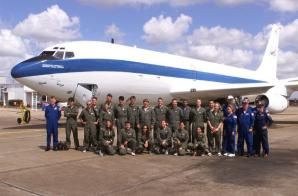
N931NA, the KC-135A that I flew on, is the eighth aircraft that NASA has usedfor reduced gravity research, beginning with a C-131 back in 1957. NASA alsoused a C-135 before switching to the KC-135A, and 931NA is the fourth KC-135A tobe used for this purpose. Over the years, the NASA planes have flown over 80,000parabolas, the equivalent of almost five weeks in space. The Boeing Company’smodel 367-80 was the basic design for the KC-135A Stratotanker as well as thelater 707 commercial airliner. The first production Stratotanker was deliveredto the Air Force in 1957, and 931NA was the second-to-last one ever made, withproduction ceasing in 1963 after more than 600 were produced. The majority ofStratotankers still flying in the Air Force or Reserves have been modified withturbofan engines that are more powerful, quieter, and fuel-efficient. Re-enginedStratotankers were designated either the KC-135E, R or T models.
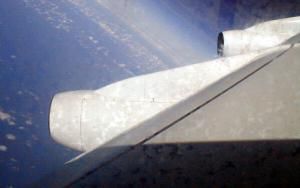
Surprisingly, 931NA has not seen any major modifications since NASA beganoperating it in 1995. Unlike the existing Air Force models, it is still equippedwith the original Pratt & Whitney J-57 turbojet engines. This was clearlyevident by the four black exhaust trails streaming behind the ex-tanker, plusthe high noise levels as it flew in and out of Ellington Field (EFD), where itis based. The refueling boom, minus the maneuvering "wings," is stillattached to the underside of the aft fuselage. Inside, the 60-foot-by-10-footmain cabin is padded all around to protect wayward floaters, with about 25 seatsremaining in the back for passenger use during takeoff and landing. There havebeen some minor modifications to the hydraulic system to keep the pressure fromdropping to zero during the periods of zero-G, but the structure itself has notbeen strengthened, as the NASA missions are still within its normal certifiedoperating envelope of +2.5/-1.0 Gs.
Although most people are familiar with pictures of astronauts being trainedin 931NA, this makes up only about 20% of the aircraft’s missions. Scientistsand engineers from NASA and other organizations use the majority of its flighttime for microgravity research. 931NA is also used as a "pathfinder"aircraft whenever the 747-carrier plane has to fly a shuttle back to the KennedySpace Center (KSC) from a landing at Edwards AFB. 931NA flies 15 minutes aheadof the 747/Shuttle combo to warn of any rain or turbulence that could threatenthe shuttle’s delicate heat tiles. It is also used to calibrate the microwavelanding system at the KSC runway in Florida, so you can see that this plane isnot just a one-trick pony. Even though NASA has not made any structural mods to931NA, they do have a very thorough maintenance and inspection program. Thisincludes a Phase I inspection every 180 days, at which time it can take four ormore days to perform a detailed non-destructive inspection analysis of criticalstructural components, searching for any evidence of fatigue. From what I couldsee after being in and around the plane for five days, it looks well cared forby the full-time four man crew from NASA maintenance contractor DynCorp.
Parabola Flying 101
I was curious to discover what it was like to handle such a large planeduring the parabolic maneuvers, so I sat down and talked with Stephanie Wells,the NASA pilot who commanded my flight. Stephanie, an Iowa State Universitygraduate with a degree in meteorology, was one of the first women accepted forflight training by the U.S. Air Force back in the ’70s. In her ten years ofactive duty in the Air Force, she was an instructor pilot on T-37s and T-38sbefore moving on to fly the C-130. She joined NASA thirteen years ago, butcontinued to fly in the reserves, commanding the largest aircraft in theirinventory, the C-5A Galaxy. According to Stephanie, a checkout in 931NArequires two weeks of Air Force ground school and simulator work, and then areturn to EFD for a local check ride in the copilot’s seat. There are eight NASApilots (four pilots, four copilots) qualified to fly 931NA, but just like in theairlines, you have to wait until a pilot retires or leaves before you can slideinto the left seat. Then, five more flights are required before you can startcarrying experiments in the back. Stephanie is one of the "newbie"Vomit Comet pilots, with about 300 parabolas to her credit in the six monthssince she has been checked out.
|
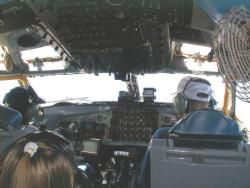
According to Stephanie, a typical flight begins with a morning takeoff fromEFD heading out over the Gulf of Mexico. The flights are always conducted underan IFR flight plan and handled by Houston Center, with the majority of theflight conducted in a warning area that extends from 60 miles south of EFD to120 miles south of EFD. As far as weather minima are concerned, NASA won’t flyparabolas in the clouds or if there is moderate turbulence forecast orencountered. Stephanie said that turbulence could affect the quality of theparabolas and thus the experiments in the back. Although the KC135A has a grossweight capability of 290,000 lbs., NASA flies the parabolas at 150,000 lbs. orless. At this weight you don’t have any fuel in the forward or aft fuselagetanks to slosh around and screw up your ability to fly a smooth parabola.
Stephanie described how she begins the parabolas after leveling off at FL250."The autopilot is engaged for roll and yaw. The pitch part of the autopilotis disengaged so we can hand fly just the pitch. The autopilot is actuallyhooked up into the navigation system so it keeps us on the track. All you haveto worry about is pitch. The right-seater runs the throttles to make sure theenergy level is right. We enter the parabola indicating 350 knots, which isright up near the redline speed. Start your pull-up at 1.8 Gs, bleeding off 100knots in the pull, start your pushover at about 240 knots, and at this pointyou’re about 50 degrees nose-high. Push over smoothly, and it takes about 10seconds to go from 1.8 Gs to zero-Gs. Stabilize at zero-G as you go over the topuntil you are about 40 degrees nose-low. You have to push the yoke pretty farforward, but it’s not a heavy push because you’re pretty slow by then. Then onceyou’re in the zero, it’s not heavy at all, you just make small adjustments tothe pitch. To finish the parabola, you try to hit 350 knots on the way downbefore pull-up," and then the whole process begins again. Each parabolatakes about 10,000 feet from pull to top of the parabola, and they fly 16parabolas on a straight track before making a 180-degree turn to fly theremaining 16.
Keeping The Vomit Out Of The CometWith such an unusual mission, the reputation of 931NA strongly precedes itself with anyone who is going to fly in it. From the moment I arrived at Ellington Field, the question that seemed to be on the mind of all of the rookies was "How long will I last before I blow chunks?" Watching live video feeds from the flights that preceded mine was not exactly encouraging. Video of the first few parabolas showed students conducting their experiments or floating around, generally smiling and waving at the camera. But as the number of parabolas increased, you could tell which passengers were losing it as the smiles left their face and they became more lethargic. The onboard NASA videographers were pretty good about not showing people puking, though occasionally you couldn’t miss someone reaching for that white plastic bag strategically place in their flight suit breast pockets. Soon afterwards you could see the sick passenger crawling out of the picture to the back of the plane, where they were strapped into their seat to ride out the rest of the flight in relative misery. After hearing NASA say that typically 40-50% of first-time fliers on the KC-135A will experience nausea and vomiting, I wasn’t too optimistic about my chances. But as I learned in the days leading up to my flight, there are ways to minimize your chances of getting sick. I talked with NASA KC-135A test coordinators John Yaniec, Judy Rickard, and Jim Withrow, who have flown thousands of parabolas, for any advice on avoiding motion sickness. Their first suggestion was to not psyche yourself out about getting sick. If you tell yourself it’s inevitable, you’re probably going to get sick. They mentioned that you should definitely eat before you fly. Of course not the Denny’s Grand Slam breakfast, but something with a lot less grease and fat, such as a bagel or a bowl of cereal. They also suggested taking it easy during the first several parabolas and not trying any fancy gyrations. Finally, they emphasized not making abrupt head movements during the 1.8 G pullout. The best thing to do during the pullouts is to lay on the floor with your head motionless. Along with these tips, NASA was also offering passengers the medication SCOPDEX before the flight to help combat motion sickness. The main ingredient Scopolamine has been shown to help combat motion sickness for some people. However, I talked to several people who had flown after taking SCOPDEX and they still got sick. Some even felt it actually contributed to their nausea. They also felt that the Dexedrine portion of the medicine kept them wired up all day, and then they felt washed out later that night. Talking further with Jim Withrow of NASA, I discovered that he was an AVweb subscriber, and had just bought several ReliefBands that he wanted to try on the KC-135A for the first time. I told Jim how I had just returned from Oshkosh where AVweb‘s Dr. Brent Blue took pity on me after learning I would be flying on the Vomit Comet. Brent gave me a Woodside Biomedical ReliefBand to wear on my flight, probably figuring this would be the ultimate test of a device that has proven surprisingly successful in combating motion sickness.
Since Withrow is basically immune to the motions of the KC-135A, we decided to try his ReliefBand on someone who had flown before and gotten sick. As it turns out, two of the students on my Purdue team had flown in March and both became sick early in the flight. One of the students was scheduled to fly on my flight, and the other the day before. We put the bands on them right before the flights, and told them how to use them. They turned the bands on before takeoff and kept them at a setting of 1.5-2 for the entire flight. Both students also chose to take SCOPDEX again, even though it hadn’t helped during their first flight. Not only did both students make it through the entire flight without nausea or vomiting, they were finally able to enjoy the flight, doing some flips and spins during the last five or six parabolas. Although the results were encouraging, Withrow and I agreed that a much more scientific study would be required to determine the capabilities of the ReliefBand to combat the extreme types of motion sickness sometimes seen on the Vomit Comet. As for my me, I never got real sick on an airplane, but sometimes when I’m riding as a passenger in turbulent conditions, I can get a little sweaty and then tingling in the fingers. After hearing about some passenger’s experiences with SCOPDEX, I decided to rely entirely on the ReliefBand and the test director’s tips to avoid motion sickness. For breakfast I had a bagel, a banana, and some Gatorade. I made sure I took it easy during the first few parabolas, and I laid down on the floor during the pullouts. I had the ReliefBand set on 1.5 when we took off. After about ten parabolas, I started getting a little sweaty, so I cranked the band up to 2, and after about 5 minutes, I stopped sweating. I kept the setting at 2 the rest of the flight, and didn’t have any more symptoms. I was able to fly around the cabin, take pictures, and have fun without feeling nauseous or seeing my breakfast for the second time. Once again, the ReliefBand factor was encouraging. Since this was my first flight on the KC-135A, I can’t say for sure if my gastronomical success was due to any resistance to motion sickness I may have acquired through my flying experience, to following the NASA tips, or to the ReliefBand. In all likelihood it was probably a combination of all three. [Editor’s note: To learn more about Woodside Biomedical’s ReliefBand, check Brent Blue’s article.] |
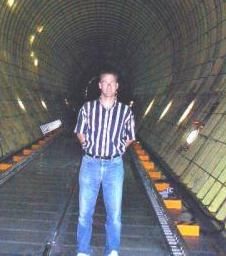
When asked how she would compare flying the KC-135A to the C-5, Stephaniesaid, "The C-5 has much better handling qualities. The KC-135A can be ahandful. It has negative Dutch roll qualities, and when it hits turbulence orcrosswinds or gusty winds you have to learn how to overcome those. But it’s anhonest flying airplane and you really feel the airplane when you’re flying it.It’s a pretty heavy feeling compared to a hydraulically controlledairplane." In addition to flying 931NA, Stephanie also flies T-38s andGulfstream G-IIs for NASA. I’m sure Stephanie Wells could have made more moneyflying for the airlines, but I got the feeling she’s having much more fun flyingfor NASA. As Stephanie put it, "It’s a cool job, a very good job."
No Zero-G Recess Until You Complete All Your Homework
Preparation to take on the challenges of the Vomit Comet started severalmonths before when I was required to submit medical papers to NASA proving I wasfit enough to fly on their plane without croaking. NASA requires all those whofly on 931NA to meet the medical requirements of an FAA Second Class flightphysical. Easy enough, since I already had a current Second Class medical. But,since I was an "old-timer" (over 35), NASA also wanted to see anacceptable chest X-ray and EKG. Once the NASA medical types approved mypaperwork, I then had to go through a day of physiology training at JohnsonSpace Center (JSC) with the students and other journalists before I could fly.The training included classroom instruction on hypoxia, decompression sickness,and of course spatial disorientation and motion sickness.
|
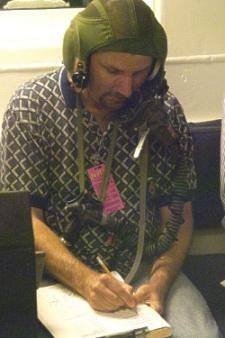
Our physiology training culminated with a "ride" to 25,000 feet inNASA’s altitude chamber. During our "flight" we reviewed emergencyprocedures in case we encountered a rapid decompression on the KC-135A, and wealso got to see first-hand the effects of hypoxia. At 25,000 feet we wereinstructed to take off our oxygen masks for five minutes to experience theinsidious nature of hypoxia. Some of my fellow chamber mates started acting alittle goofy after only two minutes, but when questioned by the Chamber operatorthey swore they felt perfectly normal. I noticed a tingling in my cheeks andears about a minute before we put our masks back on, which turned out to be mysigns of hypoxia. (If you are a GA pilot, I would highly recommend an altitudechamber ride so you can learn to recognize your own symptoms of hypoxia. Checkwith your local FSDO, as some can arrange chamber rides at a nearby militaryaltitude chamber for civilian pilots.) After successfully completing the chamberride and passing a written test, NASA finally gave me the green light to fly onthe KC-135A.
Mr. Pete’s Wild Ride
|
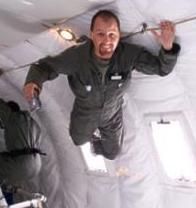
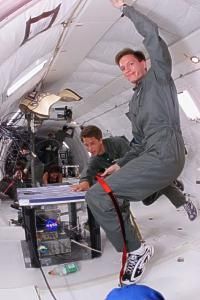
After all the briefs, training, hype, and nervous anticipation, I’m finallyonboard and experiencing weightlessness for the first time. With Stephanie Wellsat the control yoke, smoothly pushing us over the top on the first parabola, I’mwatching my fellow free-floaters trying to adapt to zero-G. Your first reactionis to start flailing your arms and legs, as if you are swimming. Of course airis a lot less viscous than water, so unfortunately all that flailing doesn’treally help. You quickly learn to plan your moves so you have a way to stop,such as grabbing support straps or even your fellow floaters. As each parabolawas finishing up, test director John Yaniec would shout "Feet down, comingout!" Like a tumbling cat that always tries to land feet-first, those whowere upside down had to do some quick aerial contortions to insure they didn’tland on their heads. Usually you only had three-to-five seconds of warning before thepull-out, and one time I almost landed on top of an experiment before I pushedoff the wall and twisted my body to just miss it before tumbling onto the paddedfloor.
After about 12 parabolas I was getting a little better at controlling mybody, so I became a little bolder and started flying across the cabin. When theastronauts are training on the KC-135A, there are usually no more than tenpeople onboard and no hardware strapped on the floor, so they can fly all overthe cabin. On our flight there were about 24 passengers, plus eight experimentsof various sizes, so you couldn’t float very far without banging into someone orsomething. However several times I had a clear path to float across the cabin,which I found was very easy to do with just a light push. I soon got to where Icould push off one wall, fly across the cabin Superman-style, do a quick flip atthe other wall, and fly back to where I started.
In spite of the aircraft’s reputation for trying even the strongest ofstomachs, I felt pretty good the whole flight, thanks to several precautions,including my secret weapon, the Woodside Biomedical ReliefBand (see sidebar).Making the experience much more pleasant for us all was the fact that only twopeople on our flight actually barfed, so you didn’t have to worry about dodgingfloating chunks or getting a whiff of that unpleasant smell. Throughout theflight I kept an eye on J.D. as he conducted the Purdue experiment, and I washappy to see that he had a smile on his face, which meant he wasn’t gettingsick. After about 25 parabolas I noticed J.D. had finished his data collectionand was having some fun with his own aerial gymnastics.
|
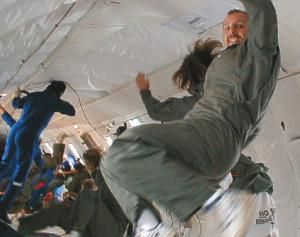
After parabola number 30, Yaniec shouted, "Next stop, the moon!"Wells flew this parabola at a higher entry speed, which produced only 1/6Earth’s gravity, but lasts longer — about 45 seconds. On this parabola I feltlike the Apollo astronauts on the moon, making giant leaps with each stride. Thefinal parabola was flown to simulate Mars’ gravity (1/3 Earth’s), prompting someof the students to show off their "strength" by performing easy pushupswith two students on their back. Finally, Yaniec called "That’s awrap!" after parabola 32, signaling an end to our high-flying adventure. Wereturned to our seats for the flight back as Yaniec announced that with only twopersons sick, our flight was one of the best he had ever seen. After landing atEFD, we exited 931NA to the applause of other students and NASA personnel whohad watched our flight on the live downlink. Walking down the stairs from theplane, some of my fellow floaters triumphantly waved their empty barf bags to showthat at least on this flight, our stomachs had beaten the infamous Vomit Comet.
|
Coming Back Down To Earth
Sitting in the hanger after the flight getting my "land legs" backagain, all I could think of was what a great experience this program providesfor students. Based on my own engineering experience, the Reduced GravityStudent Flight Opportunities program gives students an excellent feel for thestruggles and triumphs associated with solving "real world"engineering problems. Talking to the Purdue team after their flights, they toldme how the experiment worked much better than their first flight in March.According to Curt, "We got some fantastic data on this flight compared tothe flight in March." Nick, J.D., Curt and Rob told me that all the hardwork was definitely worth it. Rob, a senior planning to apply for the Rhodesscholarship, added, "Without a doubt I’d fly again. It’s well worth all thework that goes into it, about a semester’s worth of constant work, a lot ofall-nighters." The team summed it up by saying that they gained invaluableexperience, have a nice addition to their resumes, and most of all, had a blastwhen they finally got to fly.
|
Along with the student’s efforts, NASA and the Texas Space Grant Consortiumshould also be commended for not only offering such a unique program but foralso providing an enjoyable experience during the students’ two week stay inHouston. When teams weren’t working on their experiments or flying, they couldtake tours of JSC facilities, attend lectures by astronauts and engineers, orjust unwind at informal picnics. As for me, it was a chance to share theenthusiasm of young people with their entire careers ahead of them, and alsoexperience flight totally unencumbered, just as I had always dreamed. Who knows,when the International Space Station is fully operational, NASA may givestudents the chance to test their experiments in real weightlessness sometime inthe next century. If that happens, you can bet I’ll be badgering Purdue to onceagain be invited to report first-hand on the exploits of our next generation ofengineers and scientists.
Special thanks to Nick, Rob, J.D., Curt and Professor Steven Collicottfrom Purdue. NASA KC-135A test directors Jim Withrow, Judy Rickard, and JohnYaniec. KC-135A pilot Stephanie Wells, and former astronaut Steve Nagel. FinallyDebbie Mullins from the Texas Space Grant Consortium. To learn more about theReduced Gravity Student Flight Opportunities program, check theprogram’s web site.
The Purdue zero-g teams are always looking for corporate sponsorship tohelp defray the costs of hardware, with sponsors getting their logo on anyexperiments that fly. For more information on sponsorships, contactProfessor Steven Collicott.
