




























The manifold pressure (MP) gauge is a very simple instrument, but what it does is a mystery to many pilots. Simply put, if you do not fully understand what that instrument is telling you, you cannot possibly understand the engine, engine management, power settings, or troubleshooting.
Quiz Time
First, allow me to pose a few rhetorical questions to help you understand why there’s more to this subject than meets the eye. You might be uncomfortable with the thought of actually doing some of these things to your engine – and that’s fine – but I ask that you visualize them as a mind exercise and think about them, please.
This entire column will deal only with normally-aspirated engines – those without superchargers or turbochargers. I’ll be dealing with the fire-breathers in another column.
Question: Assume that someone – perhaps a CFI quoting a poorly-done old POH, or perhaps just regurgitating what his CFI taught him – has told you that the first power reduction after takeoff should be to 25 inches and 2,500 RPM. Leaving aside the issue of whether this is really a good procedure, let’s assume you take off and dutifully pull the throttle back from about 29 inches, to exactly 25 inches. Then you pull the prop control back from 2,700 to 2,500. Are you surprised to see the MP rise to 26 inches or so as the RPM comes down? Do you understand clearly why that slight rise occurs?
Question: Suppose you leave the throttle wide open after takeoff, and just reduce the RPM from 2,700 to 2,500 (usually a better choice in the big-bore flat sixes). What would you expect to see the MP do, and why?
Question: Suppose you do a full-power runup in position before releasing the brakes (another bad procedure, but never mind). You note the MP and release the brakes. What will the MP do during that takeoff roll and the early climb, and why?
Question: Do you know (in general) where the “sensor” is for the MP instrument, and how it works? Which would you think is more stressful to the engine’s intake manifold plumbing: a power setting of 12″ MP (in a power off descent, for example), or 30″ at takeoff power? Why? How is that pressure transmitted to the instrument you’re reading?
Question: Your airplane is sitting at rest, engine not running, at a sea-level airport. What should the MP show? Suppose you’re parked at an airport at 5,000 feet above sea level; what MP indication would you expect? What else can affect that reading? Suppose you know what it is supposed to show, but it’s two inches low in a airplane you’ve never flown before? What effect would that have on your flight? Would you depart with it showing that error? Could you correct for it? How?
Question: Suppose you start the engine and idle at 1,000 RPM to warm the engine. What will the MP show at sea level, or at that 5,000-foot elevation? Suppose you just happen to know the answers to these two questions in your own airplane, and one fine day you notice the MP is three inches higher than normal at 1,000 RPM while warming up? What would you think? Suppose the MP was lower than normal; can you think of a possible cause for that?
Question: Suppose you’re cruising at 10,000 feet, full throttle, 2,500 RPM, and you cycle the prop between 2,700 (redline), and the lowest it will go, perhaps 1,200 RPM. What would you expect to see the MP do during this huge variation in RPM?
Question: Finally, suppose you’re sitting in the runup area, ready to go, and you notice an audible whistle coming from the engine. What would you suspect, and what would you do about it?
Suction, Not Pressure
First, let’s get rid of this idea of “pressure,” because what the MP instrument of any normally-aspirated engine really shows is lack of pressure. In short, with the engine running, the MP gauge is always reading suction – it’s just marked with numbers that don’t make that obvious.
Let’s look at a normally-aspirated engine at rest, using the graphic below.
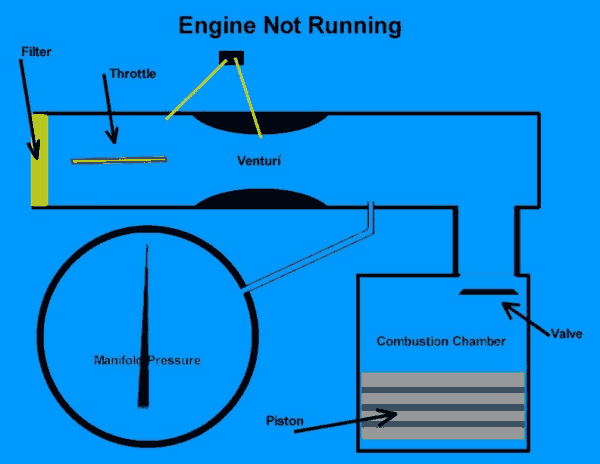
I have deliberately made this a very primitive schematic, something I call a “concept schematic” in my ground school classes. I’ve left out everything that is not essential to this discussion, and have drawn a very simple one-cylinder generic induction system. In real engines, of course, there are multiple cylinders, curving ducts, many more parts, carburetor heat or alternate air, etc.
Not Started, Yet
The ambient air has equalized in all parts of the engine portrayed here, represented by dark blue. I’ve shown the throttle (yellow) fully open here, but with the engine at rest it doesn’t matter – even with the throttle fully closed, there’s enough of an opening for air to get by and equalize. (The throttle never really closes all the way – a “fully-closed” throttle must still pass enough air for the engine to idle.) In this picture, the air pressure is at ambient pressure in the intake, in the induction plumbing, and in the combustion chamber. This will show on the MP gauge as 29.92 inches at sea level on a standard day. I know, it’s hard to read it that accurately on the usual instruments, but you should see it very close to 29.9, and that’s “close enough.” If the sea-level airport has a big high-pressure area located over it with a local station pressure of 31.10, for example, then your gauge should show 31.1 inches of manifold pressure. If the airport is located at some higher elevation, the MP gauge will show an inch less for each thousand feet above sea level. (This rule-of-thumb is close enough at normal airport elevations, though it breaks down at altitudes above 10,000 feet.)
It is a good habit to note the MP gauge reading before engine start, and do a quick calculation to see how close it is. Set your altimeter to the field elevation, note the altimeter setting in the Kollsman window, subtract one inch per thousand feet above sea level, and your MP gauge should show very close to that value with the engine not running. At a 6,000-foot elevation airport, for example, set 6,000 on the altimeter, read (say) 29.5 in the Kollsman window, subtract six, and check that your MP gauge shows approximately 23.5 before start.
Anything else is an error in the instrument.
At that 6,000-foot airport, suppose it actually reads 22.5 (one inch too low), after you double-check your procedure. That would indicate that for any power setting you want, you should set the MP one inch low to correct for that error.
Take that “Static Manifold Pressure” reading, subtract about one inch (for most engines), and you get the reading you should expect to see at full throttle on takeoff. (We’ll get to the reason for the one inch soon.) If you don’t see that much MP on the takeoff roll, something is seriously wrong. You should probably abort and investigate.
Digressing briefly, how does the engine figure out how much fuel to pass into the induction system? Good question! There are several variations on this, the oldest being the venturi, and differential pressure.
See it there, in the graphic, the narrow part of the air path? When the parcel of air comes in and passes through that restriction, it has to speed up to get all the molecules through the narrow spot. When it speeds up, our old friend Bernoulli says the pressure drops, right? Then the air expands again, returning to the same pressure it had before entering the venturi; nothing lost, nothing gained. But if we measure the difference between the air pressure just before the venturi and the air pressure right in the venturi, we can tell how much air is flowing through the venturi. That’s the sole purpose of the venturi: It just creates a pressure differential within a given stream of air so we can measure the mass airflow! A very clever trick!
This venturi method is used for carbureted engines (including most of the big radials) and for injected Lycomings equipped with the Bendix/RSA fuel injection system. TCM does it a little differently on most of its fuel-injected engines: Fuel flow is dependent on simple throttle and mixture control position, engine RPM, and for some, altitude compensators.
These are subjects for later columns.
Gentlemen (and Ladies), Start Your Engines!
Okay, enough talking about an engine that isn’t even running yet, let’s crank it up.
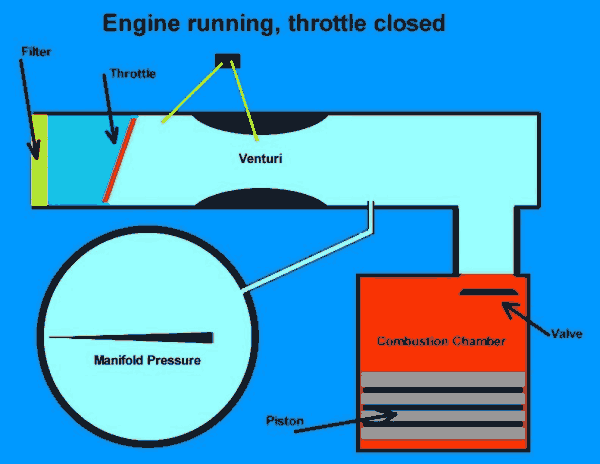
In this graphic, I’ve left the throttle fully closed, which should give us minimum idle RPM. There’s only a very small crack through which air can flow, so relatively little air can move into the system.
What Moves the Air?
This is the key point in this whole column.
In a normally-aspirated engine, the only thing that can move air through the induction system is the piston, travelling downwards, with the intake valve open! The piston sucks the air in, past the filter, past the throttle, past the venturi (on those engines so equipped), through the induction plumbing, and into the cylinder. The force to drive that piston down is supplied by either another piston on a power stroke, or the airflow past the prop in a dive with low power.
It should be clear from this that the intake system of any normally-aspirated engine is nothing more than a vacuum pump! With the throttle plate closed (throttle lever fully retarded), the piston pulls (sucks) really hard, but simply can’t move much air through or past the closed throttle. The engine is literally starving for air. What happens to the manifold pressure? Why it drops, of course, actually showing substantial suction (in other words, a lower pressure than the outside air). In most engines, idle MP will be around 12 inches or so, less than half the sea-level pressure. To look at it another way, the atmospheric pressure in the intake system (downstream of the throttle) of an idling engine at sea level is somewhere up around 20,000 feet. Thus the answer to one of the quiz questions: The most stress on an intake pipe is at idle, because it is trying to “implode.” Of course, we’re talking about only 8 PSI difference or so, and even a light aluminum pipe will take that with ease, so it’s not a problem. You wouldn’t want to use a soft rubber hose for an intake pipe, though!
If we could turn the engine fast enough, if the cylinders had perfect compression, and if the throttle plate could close off the induction system completely, we could create a perfect vacuum, which would show a manifold pressure of zero. Since all the numbers on the MP gauge are referenced to this theoretical perfect vacuum, we say that the MP gauge shows “Absolute Pressure.”
Note the color shades in my graphic, dark blue for ambient air pressure, a little lighter for slightly less pressure behind the filter, and much lighter for the very low pressure air behind the closed throttle plate.
I’m Hungry, Mom!
What we have at idle is an engine that wants to run, but is simply too starved for air to do so. Since there’s very little air moving, there’s also very little fuel. It is literally wheezing for breath, and on some internal combustion engines, you can hear the “suck.” Take the air filter off a car engine, and start it up, to see what I mean.
Suppose an anti-aircraft burst blew off the front end of that system in the picture, taking away the filter, the pipe, and the throttle assembly. What would happen? Well, if the venturi were still there and working, the engine would instantly go to full power. If that shot also took off the part of the system that contained the venturi assembly, the engine would quit (no differential pressure, no fuel). Unless it was an injected Continental, of course.
Balls to the Wall
Finally, we look at the same intake system, engine running at full throttle.
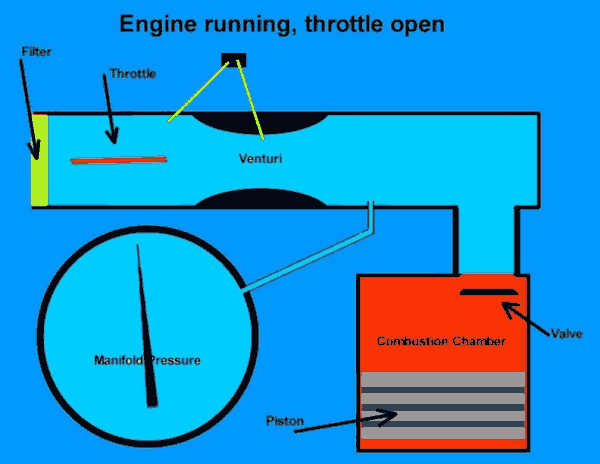
The engine can now get all the air it wants, with the only restrictions being the filter, the small area of the wide-open throttle plate (edge-on), and the turns in the ducting on the normal engine. Usually, those factors will cost you about an inch of MP, or a bit less. This is the answer to another quiz question as to why you’ll see about an inch loss in MP during a full-power runup, just before brake release. During the takeoff and early climb, as the speed increases, a little bit of this loss is regained due to “ram effect” as the speed of the airplane literally rams more air into the induction system’s air intake. At high airspeeds, some engines actually gain a little manifold pressure over ambient due to this ram effect.
Another key point. The intake system we’re looking at has no idea what is taking place on the other side of that intake valve in the combustion chamber. It doesn’t matter if there’s “fire in the hole,” or if the prop is windmilling in the breeze because an airline captain is talking nearby and pumping out the usual hot air, or the airplane is diving with the fuel shut off, engine not even running.
If that engine is turning for any reason, the pistons are hopping up and down, and every time one goes down with the intake valve open, it’s sucking more air in. If the throttle plate is closed, it’s sucking against resistance, creating suction that shows up as low MP; if the throttle is open, it’s not blocking the airflow so manifold pressure remains equal to outside ambient (or perhaps an inch less due to unavoidable restrictions in the induction system).
Rule #1525
(Why Rule #1525? I don’t know, aviation is full of rules, and this one is hardly the most important, so I picked #1525. Rule #1 is “Don’t hit anything,” Rule #2 is “Don’t do nuthin’ dumb.”)
The rule: Manifold pressure depends on ambient pressure, the position of the throttle plate, and the speed at which the pistons are moving up and down. Manifold pressure does not indicate “power,” unless other things are taken into account.
For a silly-but-true example, take an engine that is not running, and lift it from sea level to 18,000 feet. If the MP is 29 inches at sea level, it will be about 14.5 inches at 18,000. The change in MP is entirely due to the reduction in ambient pressure at altitude. Did the engine’s power output change when the MP went from 29 inches to 14.5 inches? No, of course not – it’s zero either way.
Now a real-world example: Assume you’re cruising at some low altitude (say 4,000 feet), throttled well back to about 20 inches MP and 2,000 RPM. (Remember, this means the throttle plate is somewhat cocked, restricting induction airflow.) Now reduce the RPM to 1,200 without changing anything else, and you’ll see the MP rise sharply. Why? Simple: The ambient pressure hasn’t changed; the throttle plate hasn’t changed; the only thing that has changed is the speed at which the pistons are pumping the air. Since they are moving much more slowly at the lower RPM, they are not sucking nearly as hard – not creating as much of a vacuum – so the MP goes up, towards ambient pressure. The natural extension of this experiment is to reduce the RPM to zero, when the MP will rise all the way to outside ambient pressure (about 25 inches at 4,000 feet).
In this example, the RPM has been lowered. The pistons are sucking far less air, the speed of the air going through the intake is less and fuel flow is less. This means there is less power being developed, in spite of a much higher MP! You will also see the airspeed drop off sharply, confirmation of “less power.”
Conversely, start once again with our example of cruising at 4,000 feet, 20 inches MP and 2,000 RPM. Now run the RPM up to 2,700, leaving everything else unchanged. Now the pistons are pumping much faster, drawing more air in past the (partially open) throttle plate. That creates more suction – a lower pressure in the induction system – which will show as a lower MP. There will be more fuel flow, and you’ll be producing more power at lower MP. (This is complicated by prop efficiency, so give me a little room here.)
Back to Full Throttle
The foregoing examples were all with the throttle plate cocked at the angle that gave us an initial cruise power setting of 20 inches MP, and 2,000 RPM.
What if we push the throttle in to the full-throttle position, changing nothing else? By opening that throttle plate, ambient air (plus a little ram effect, minus the resistance of the air filter) is allowed to flow rather freely into the induction system, so the MP indication jumps up to ambient pressure, about 25 inches. This causes more fuel to flow, and the engine produces a lot more power.
Now, at full throttle, let’s vary the RPM again. Run the RPM up to 2700. The pistons are pounding up and down much faster, so they are pulling a lot more air in. But what happens to the manifold pressure? Essentially, nothing. Since there is no restriction in the intake, ambient air pressure is free to enter, no matter how fast the engine wants it, or the pistons suck it.
(If you have trouble with this concept, think of your own breathing. If you open your mouth wide, and take a slow breath, there is no resistance, and if you take a big quick breath, there is no resistance. Very little difference, anyway. If you suck air through a soda straw very slowly, there is also no noticeable resistance. But just try and suck a big breath of air through that straw, and you’ll know how that poor intake system feels at partial throttle and high RPM.)
In this example, still at full throttle at 4,000 feet, you should see about 25 inches and 2,700 RPM. The mass airflow is way up, so is the fuel flow – and you’re movin’ out!
Don’t Try This at Home, Folks!
This next test is one you really don’t want to do with your engine, because at high power settings and low RPM, your engine may detonate, even at very rich mixtures. But it’s a useful thought experiment. (I’ll cover detonation in a later column.)
From full throttle at 4,000 feet, 25 inches MP and 2,700 RPM, we reduce the RPM back to 1,200, changing nothing else. (Again, please don’t do this!) The pressure in the intake is already at ambient pressure, so it can’t go any higher, nor can it go any lower. The pistons are still pumping, but at less than half-speed, so they’re not pulling nearly as much air through. The MP will not change appreciably. (A few pilots report a very slight rise in MP, which is probably because there is less resistance to the slower-moving air at the filter screen, but essentially there is no change.) Because of the dramatic drop in RPM and airflow, the fuel flow drops too, meaning much less power is being developed, with no change in MP.
The Induction Air Filter
What’s the filter for, anyway? These engines pump vast quantities of air. An IO-550 at full power pumps over 400 cubic feet of air per minute, a small roomful. Do that for a few hours, and you’ll also pump a fair amount of trash, grit, and dust through the engine, and that’s not good for the finely-machined surfaces. So an air filter catches the majority of that stuff, at a cost of perhaps an inch of MP at high power (assuming the filter is clean). Note that the filter has exactly the same effect on MP as the throttle plate when slightly closed.
A dirty filter, on the other hand, could cost you many inches of manifold pressure. So pop for a new one every once in awhile, please? They’re cheap, even by airline pilot standards.
It seems intuitive that a dirty air filter is “bad” because it restricts airflow to the engine. What doesn’t seem to occur to many people is that a throttle that is only partially open is exactly the same as a very dirty air filter! It doesn’t matter how you restrict the air, the end result is the same: less power available.
All else being equal, any engine will be more efficient if operated at full throttle. If you don’t want all that power (or fuel flow), use a lower RPM, a leaner mixture, or both. Of course, full throttle makes it tough to get slowed down in the traffic pattern, and it can be tough on the brakes while taxiing, so the throttle can come in handy now and then. But it’s best to avoid using it during climb and cruise, and I’ll be talking more about this in another column.
The Whistling Engine
What’s that whistle at idle power I asked about in the quiz? You should be getting an idea by now. It’s probably from an induction leak, and the low pressure in the pipe is sucking air in from outside through the leak. Good reason to take a break, open up the cowling, and have a look.
What will happen if you go flying with an induction leak? Well, think about it. There is air sneaking into the engine that has not been “measured” by the venturi, so the fuel flow is unchanged. More air, same fuel, makes a leaner mixture in the cylinders fed by the leaking intake pipes, so that cylinder (or cylinders) will be running leaner than you intend, unless the the throttle is fully open. On the ground, you’ll probably see an abnormal idle, perhaps roughness caused by one cylinder running too lean, or not at all.
I don’t mean to suggest that all induction leaks will produce an audible whistle. They won’t. But there’s another, better way to detect an induction leak. Have you figured it out? What will such a leak do to the MP indication at idle? Right! Less suction, higher MP. So if you’re used to seeing 12 inches of MP at idle at your home airport and one day you see 15 inches instead, suspect an induction system leak.
The Rest of the Story
Manifold pressure is only one part of the story: We still have props and mixture to go. Not to mention turbos. Stay tuned.
Be careful up there!

Thank you for that extremely well done article. Huge help, I haven’t seen any explanation nearly as good thanks!
These diagrams are wrong. The butterfly labeled ‘throttle’ should be on the engine side of the venturi and fuel passages, not on the filter side. That is where the choke is located, which floods the engine with extra fuel when closed to compensate for low starting temperatures.