

















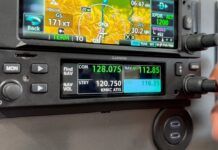
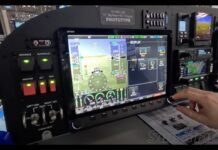








After seeing theSN3308, I naturally assumed that its inventor and Sandel founder GerryBlock was a seasoned veteran of the avionics industry. So when I flew down to SandelAvionics in a northern suburb of San Diego to interview him for this article, I was quitesurprised to learn that the SN3308 was Block’s very first aviation product. Turns out thatGerry’s previous career was as owner of a company that manufactured audio broadcastequipment used in motion picture and television production. Block sold his company in 1995and soon started thinking about starting a new career that combined his background inelectronics with his love of aviation.
|


Gerry had been a pilot for many years, and his audio equipment company owned a Cessna421 with a very sophisticated Collins FD-112 flight control system. For the longest time,Gerry wanted to put an EFIS system in that airplane. But the only thing available that waseven remotely practical was the Bendix/King EFIS 40 system. Gerry looked into thatpossibility quite seriously, but found that he couldn’t put an EFIS 40 in the airplanewithout literally ripping out the entire panel and starting over, at a cost of around$50,000 by the time labor and ancillary equipment were included. That was simply too much.
In early 1996, after his audio equipment company was sold, Gerry started seriouslylooking into the notion of creating an EFIS of a size and price within the reach of pistonaircraft owners. He quickly discovered there were a tremendous number of technical hurdlesinvolved. The most significant of these was that in order to make a three-inch indicatorpractical, it had to be virtually 100% screen area. Standard CRT or LCD displays wouldn’twork: The best they could do in a three-inch opening would be about 21/4 inchessquare of actual display area, which simply doesn’t provide adequate size or resolutionfor a primary flight instrument.
Grimes (now AlliedSignal) and BFGoodrich had both developed such flat-panel displaysfor use as backup instruments, and Honeywell makes one they use for TCAS. But all areextremely expensive, and none provide adequate area or resolution for a primary flightinstrument. If you tried to use one as an electronic HSI, you’d wind up with a compassrose significantly smaller than the one on a three-inch mechanical HSI, which is already abit too small for comfort. Another problem was that standard mass-produced LCD displaysare typically rectangular rather than square, and having a square one custom-built for alow-volume application like avionics would increase the cost of the instrument toimpractical levels.
Gerry then came up with the concept of using a small LCD and rear-projection optics tocreate a display that could occupy virtually the entire height and width of theinstrument. This was a brand-new approach, never used before, and on which Sandel hasapplied for a patent.
|
This idea made the SN3308 feasible, but there were still many technical hurdles toovercome. Product development would require substantial talent in numerous disciplines:software engineering, hardware engineering, graphics, analog interfaces, optics,packaging, and FAA certification. From his previous company, Gerry had lots of experiencein both hardware and software engineering of embedded processor products and analoginterfaces. But, he did not have the requisite background in graphics, optics, packaging,and especially FAA certification. So, he hired several very smart consulting engineers towork with him. He also worked with some consulting DERs (FAA-Designated EngineeringRepresentatives) to develop the application for certification. But even at its peak, onlya half-dozen people were involved in the development and certification effort. Gerrymanaged the project personally, and wrote all the software for the instrument himself.
It took about a year to develop the first real working prototype of the SN3308, whichwas shown at both NBAA and AOPA Expo in October 1997. The prototype was “quitecrude” according to Gerry, but it generated a lot of interest and useful feedbackthat contributed to the final design of the product. The first production units wereshipped in July 1998.
I asked Gerry what he had to go through to get the SN3308 FAA-certified. He admittedthat the certification process took longer than he expected, both because the SN3308 wasso novel and because this was Sandel’s first certification effort so the FAA really heldits feet to the fire. Gerry says the FAA certification folks were both very demanding andvery fair. “They didn’t make us jump through any hoop that wasn’t reasonable,”he added. Gerry explained that the FAA certification people provided a great deal ofconstructive input to the design, and made Sandel redo some things they didn’t like in theprototype, but the result was a much-improved instrument. Sandel worked on SN3308certification primarily with the Los Angeles Aircraft Certification Office (ACO) andManufacturer Inspection District Office (MIDO). Gerry refers to the FAA folks he workedwith as “a great group of guys.”
Hearing Gerry talk about the certification of the SN3308 was refreshing. So manyaviation entrepreneurs complain endlessly about the time, cost and hassle of FAAcertification. But to Gerry Block, certification was just one more challenge, and the mangenuinely seems to love challenges.
| Editor’s Note: Don’t miss Mike Busch’s in-depth review of the SN3308! |
